AIA|LA ADVOCACY REPORT
May 20, 2025

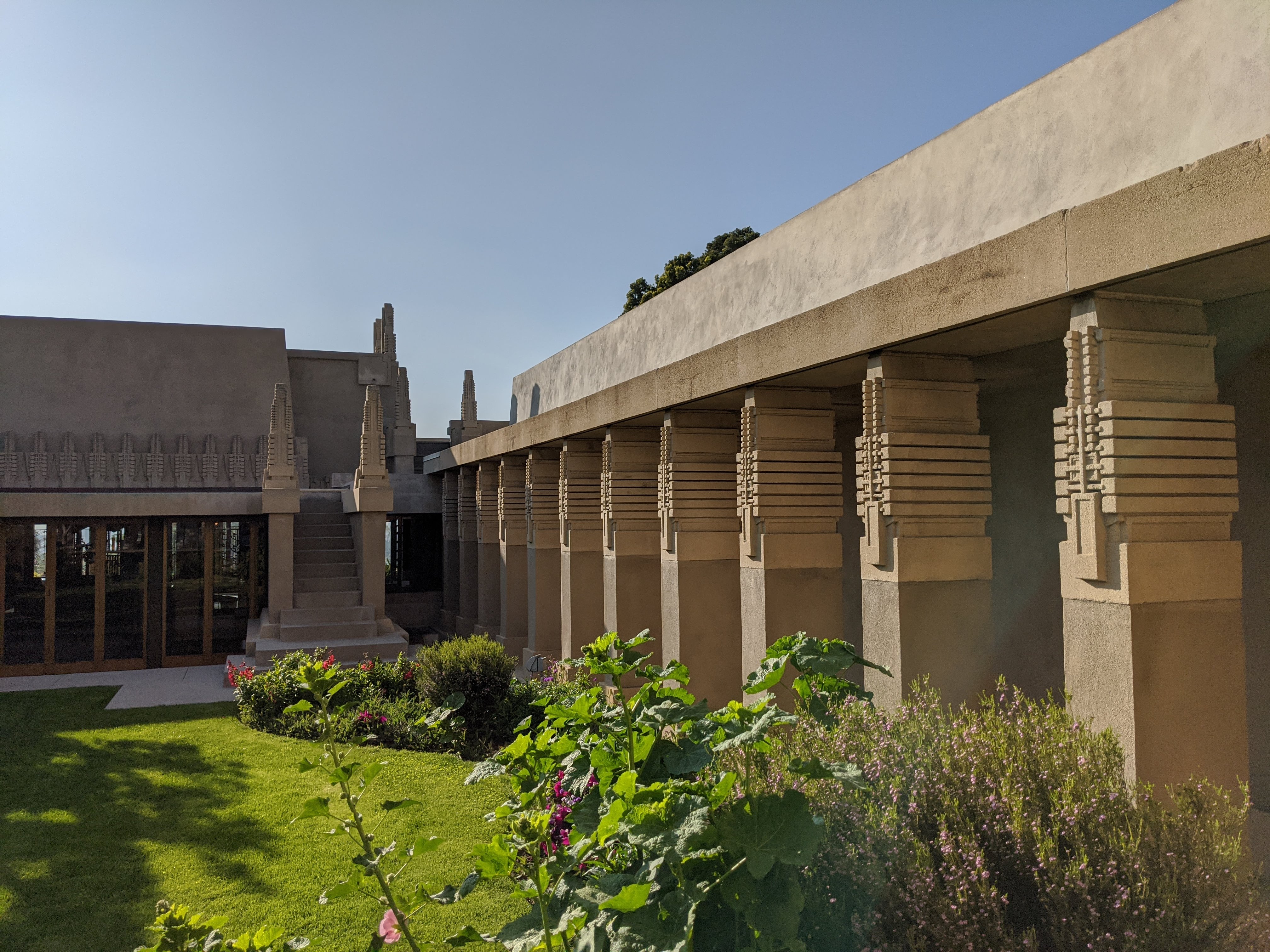


PENDING CITY OF LA BUDGET CUTS THREATEN UNESCO HERITAGE STATUS OF THE HOLLYHOCK HOUSE
As many of you may have already read in the recent press, due to proposed budget cuts to the Department of Cultural Affairs, the UNESCO Heritage Status of the Hollyhock House is under threat.
A petition is circulating that we encourage you all to sign. AIA|LA has also shared a letter of support to encourage the Los Angeles City Council to continue funding the personnel and resources required to operate, maintain, and provide community access to this important Los Angeles architectural treasure.
CLICK HERE to sign the petition.
CLICK HERE to read more about the City of LA 2025 – 2026 Budget Summary.
“Frank Lloyd Wright’s Hollyhock House could close due to city budget cuts” by Noah Goldberg.
AIA Los Angeles Strongly Supports Sustained Funding for Hollyhock House, Barnsdall Park, and Department of Cultural Affairs – COUNCIL FILE 25-0600
On behalf of the Los Angeles Chapter of the American Institute of Architects (AIA|LA), representing over 4,500 architects, designers, emerging professionals, and students, we are writing to express our strong support for the continued and adequate funding of Hollyhock House and Barnsdall Art Park in the City of Los Angeles’s 2025-2026 budget. We urge Los Angeles City Council to oppose the proposed budget cuts to the Department of Cultural Affairs, which would have a devastating impact on this invaluable cultural resource.
AIA Los Angeles, as a leading voice for architects and the built environment in the region, recognizes Hollyhock House as an architectural masterpiece of global significance. Designed by Frank Lloyd Wright, it represents a pivotal moment in the development of California Modernism and is a source of immense pride for our city. Its designation as a UNESCO World Heritage site underscores its importance not only to Los Angeles but to the world.
The proposed budget cuts, which would eliminate three of the four full-time staff positions at Hollyhock House, would force the closure of public tours. This would not only deny public access to this irreplaceable cultural and educational resource but also jeopardize the city’s commitment to preserving its architectural legacy. As advocates for responsible stewardship of the built environment, AIA Los Angeles is deeply concerned about the potential loss of this landmark.
Beyond Hollyhock House, Barnsdall Art Park is a vital community hub providing all Angelenos access to arts and culture. The proposed cuts would drastically reduce programming at the Los Angeles Municipal Art Gallery and Barnsdall Gallery Theatre. Furthermore, eliminating positions at Barnsdall Arts Center and Barnsdall Junior Arts Center would severely diminish the low-cost fine art education classes that have enriched the lives of thousands of local children and adults for over 50 years. AIA Los Angeles believes that access to arts education is crucial for a thriving and equitable city.
Los Angeles is preparing to host the world for the upcoming World Cup and the 2028 Olympics & Paralympics. This is a time to invest in and protect our cultural treasures, not dismantle them. We ask you to consider the long-term consequences of these cuts and their impact on our city’s cultural identity and the well-being of our communities.
AIA Los Angeles strongly urges you to vote against these proposed cuts and ensure that Barnsdall Art Park and Hollyhock House receive the funding they need to continue serving as invaluable assets to the City of Los Angeles.
CLICK HERE to read the letter of support from AIA Los Angeles
AIA Los Angeles Recommendations to Improve BRC’s “Supporting a Resilient and Sustainable Rebuild” Draft Report
On behalf of AIA Los Angeles and our 4,500+ members, we would like to thank the Blue Ribbon Commission on Climate Action and Fire-Safe Recovery for their leadership and the opportunity to provide feedback on the draft report, “Supporting a Resilient and Sustainable Rebuild.” We commend the Commission for its comprehensive work in addressing the critical challenges facing our region.
AIA Los Angeles has reviewed the draft report and offers the following recommendations to further enhance its impact and effectiveness:
I. Core Areas of Enhancement
Innovative and Resilient Building Systems:
We strongly recommend that the report more explicitly address the expanded implementation of fire-resistant earthen construction and other innovative, resilient, and passive (or traditional high-performing) building and foundation systems and materials. As detailed in the attached memo from Ben Loescher, AIA, these systems offer significant potential for sustainable and resilient rebuilding.
To facilitate wider adoption, the report should recommend strategies to overcome barriers such as the lack of City/County resources or policy frameworks to support adequate funding for third-party (or in-house) testing and certification.
Program Management for Large-Scale Capital Projects:
Given the importance of efficient and effective rebuilding efforts, we suggest incorporating best practices for procurement, project delivery, and overall project management. The discussion around establishing a joint powers authority (or alternative governance model) highlights the critical role of a dedicated Program Manager in large-scale capital improvement projects (e.g., Build LACCD, LAWA).
We recommend including a section or appendix dedicated to this topic, outlining key principles and strategies for successful implementation.
II. Additional Specific Recommendations:
Inclusion of Architects, Landscape Architects, and Urban Designers: We note the absence of architects, landscape architects, and urban designers on the Commission. Given the critical role of design in resilient and sustainable rebuilding, we strongly recommend including these professionals in future stages of this work. AIA Los Angeles would be pleased to offer our expertise and support.
We advocate for the creation of a “Resiliency Entity” within LA County’s Chief Sustainability Office that is charged with integrated thinking across both City and County Planning, DWP, and LADBS, incorporating representation from the professional community (architects, landscape architects, and planners) toward preparedness, response, and rebuilding.
Emphasis on Innovative Solutions: While the report rightly addresses the need for rebuilding with hardened and sustainable methods, we urge the Commission to more strongly advocate for innovative solutions. This includes exploring opportunities for:
+ Additional density
+ Property trades and/or cooperation with other governmental / land management bodies, to create additional buffers and open space
+ Different urban models that enhance resilience and sustainability.
Equity Considerations:
Regarding Page 8, Recommendation 3D, we express concern about the potential equity issues related to charging customers who “most benefit” from enhanced system resilience investments. We recommend exploring alternative funding mechanisms that avoid disproportionately burdening low- and moderate-income households.
+ We suggest considering surcharges based on higher utility usage or property size, while ensuring that low- and moderate-income households within burn areas are not unfairly penalized.
+ We recommend that equity considerations be gathered in a separate section or clearly identified and integrated throughout the report to ensure a comprehensive and equitable approach.
Under Section 5, page 27, include a policy to support the establishment and funding of localized Fire Safe Councils and Fire Adapted Community organizations to provide education, stewardship, and preparedness efforts.
Establish a state-wide program for guaranteed soil testing following a wildfire event.
Water Pressure Protection (Page 24):
+We support the recommendation for easy-to-shut-off water valves.
+ We suggest further exploration of automatic options, such as subsurface thermal sensors, to enhance safety and efficiency.
Insurability (Page 9, 6B):
+ To improve clarity, we recommend rewording the section on insurability to explicitly state that policymakers should work with insurers to ensure rebuilt homes will be insurable if they are built to specified standards.
+ We also emphasize the need to ensure that financing is available for low- and moderate-income households to meet these standards.
+ For properties with exterior sprinklers, we recommend ensuring that these systems can operate independently.
+ Advocate for the State Insurance Commissioner to investigate alternative insurance models, such as Parametric Insurance and Community-Based Catastrophe Insurance, which better address the complexities of climatic or other emergency events, and are based on cooperative resiliency and mitigation efforts.
Land Banking:
+ We strongly support the recommendation for land banking to create buffer zones, additional infrastructure, and open space.
+ We further suggest considering the purchase or trade of property in high-risk wildland and wildland-urban interface areas.
Landscape / Defensible Space:
In response to Section 2D, page 14, we strongly support the recommendations of ASLA and allied professional landscape architects against the recent Zone 0 policy. While we understand and agree that this is a key area to help mitigate ember intrusion and structure ignition, the most recently adopted policy creates adverse environmental conditions (increased heat, etc). A holistic policy based on science and research, that allows some levels of vegetation and takes into consideration proper soil hydration and ember-resistant ground cover, should be adopted. The incorporation of Section 6 recommendations toward Green Infrastructure and nature-based solutions is instrumental in this regard, and not to be relegated to only an urban scale.
Density and Urban Models:
+ We advise reconsidering the recommendation on Page 15 regarding maximizing structural spacing to 10 feet, as it may reduce density and usable open space.
+ We urge the Commission to explore innovative urban models that maximize both density and open space. This could include:
++ Reconfiguring blocks to reduce or eliminate fences
++ Combining open space between buildings
++ Establishing distance requirements between structures rather than from structure to property lines (e.g., Sea Ranch model)
++ Allowing additional density in these zones
++ Encouraging and funding ADUs and JADUs to aid homeowners and increase housing options.
AIA Los Angeles believes that these recommendations will contribute to a stronger, more resilient, and more equitable rebuilding plan for Los Angeles. We are committed to working with the Blue Ribbon Commission and the City to achieve these goals. We welcome the opportunity for further discussion and collaboration.
CLICK HERE to read the Letter of Recommendations from AIA Los Angeles.
AIA California Finalizes 2025 Legislative Bill Positions
The AIA California Board of Directors routinely reviews and takes positions on legislation that impacts the architecture profession—whether that impact is positive or negative. At its April 24, 2025 meeting, the Board finalized positions on 61 bills. A full list of bill positions is available here.
This year’s Legislative Session saw 2,397 bills introduced. Among these were numerous proposals addressing issues closely aligned with AIA California’s policy priorities, particularly in the areas of housing and climate action. Key topics included CEQA reform, permit streamlining, building code updates, density bonus laws, adaptive reuse, accessory dwelling units (ADUs), pro-housing designations, passive housing strategies, tax credits, zoning changes, and homeowners insurance reform.
AIA California staff conducted a thorough review of all introduced bills, identifying approximately 100 with direct relevance to the profession. These were assigned to three subcommittees—Climate Action, Housing Steering, and Advocacy Advisory, comprising about 40 AIA CA members collectively.
Each subcommittee evaluated the legislation and made recommendations to the Board. The Executive Committee then reviewed those recommendations before the Board voted to adopt formal positions.
As bills often undergo significant amendments during the legislative process, AIA California actively monitors updates and brings any substantially altered legislation back to the committees and Board for reassessment as needed.
Stay tuned in the coming weeks for a closer look at some of the most impactful bills this year and what they mean for the profession.
To view the complete list of AIA California’s 2025 bill positions, CLICK HERE.
The AIA LA & LACP Professional Volunteer Program (PVP)
Architects & designers passionate about improving the design quality of newly proposed projects throughout the City of Los Angeles are encouraged to participate in the Professional Volunteer Program (PVP), which is a collaborative design review program organized by AIA LA & Los Angeles City Planning (LACP)’s Urban Design Studio.
This year, we will be coordinating thirty-one virtual design review sessions, which will serve as opportunities for architects and designers to help the Los Angeles City Planning’s Urban Design Studio critically review upcoming projects throughout our City.
May 20 (10am)
June 3 (10am)
June 10 (10am)
June 17 (10am)
FOR MORE INFORMATION:
Will Wright, Hon. AIA|LA
Director, Government & Public Affairs
t: 213.639.0764
e: will@aialosangeles.org
www.aialosangeles.org


