AIA|LA ADVOCACY REPORT
May 13, 2025

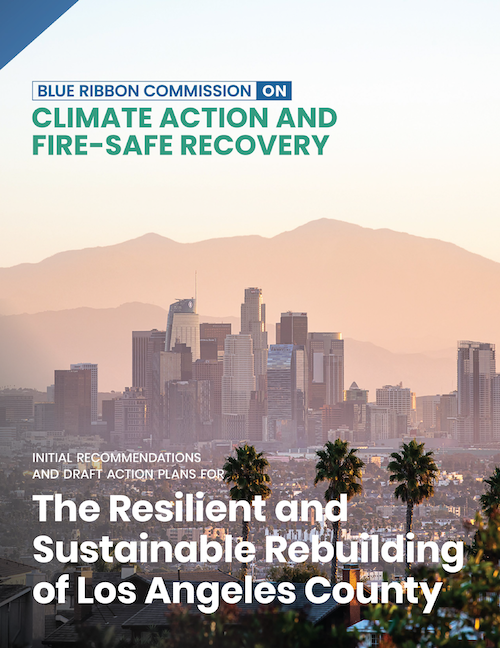
BLUE RIBBON COMMISSION ON CLIMATE ACTION AND FIRE-SAFE RECOVERY
INITIAL RECOMMENDATIONS AND DRAFT ACTION PLANS FOR The Resilient and Sustainable Rebuilding of Los Angeles County
On May 1st, the Blue Ribbon Commission on Climate Action And Fire-Safe Recovery, established by Supervisor Lindsay Horvath, released its Initial Recommendations and Draft Action Plans For The Resilient and Sustainable Rebuilding of Los Angeles County.
AIA Los Angeles has an opportunity to review those draft plans and to provide helpful, proactive feedback. We encourage you to review the DRAFT REPORT and share your feedback with AIA|LA via email to Will Wright, Director of Government & Public Affairs for AIA Lo Angeles.
Please provide feedback by Monday, May 19 (5pm).
To learn more about the Blue Ribbon Commission on Climate Action and Fire-Safe Recovery, please CLICK HERE.
The DRAFT REPORT outlines initial recommendations and action plans from the Blue Ribbon Commission for Climate Action Fire-Safe Recovery aimed at resilient and sustainable rebuilding in Los Angeles County following devastating fires.
Blue Ribbon Commission Formation and Purpose
The Blue Ribbon Commission was established to address the aftermath of the January 7 fires in Los Angeles, aiming to create actionable recommendations for climate-resilient recovery. Its goal is to engage policymakers and affected communities to ensure a sustainable rebuilding process.
Initial Recommendations and Action Plans
The Commission has outlined initial recommendations to guide policymakers in making informed decisions for sustainable recovery efforts. These recommendations focus on enhancing resilience and reducing vulnerability to future climate events.
Key Recommendations for Rebuilding and Recovery
The Commission proposes specific actions to streamline recovery efforts and enhance the resilience of rebuilt structures. These actions include legislative measures and community engagement strategies.
Energy and Water Resilience Strategies
To improve energy efficiency and water supply reliability, the Commission recommends various strategies aimed at reducing greenhouse gas emissions and enhancing infrastructure resilience.
Addressing Human Impacts and Community Needs
The Commission emphasizes the importance of addressing immediate human impacts from the fires, focusing on health, safety, and mental well-being of affected residents.
Financial Viability and Insurance Solutions
To ensure that rebuilding efforts are financially viable for low and moderate-income families, the Commission recommends clarifying insurance coverage and providing financial incentives.
Establishing Regional Entities for Resilient Rebuilding
The Commission recommends creating regional authorities to facilitate the rebuilding of fire-affected areas in Los Angeles, focusing on resilience and sustainability. These entities will streamline rebuilding processes, reduce costs, and enhance fire protection measures.
Enhancing Fire Control and Mitigation Strategies
The proposal includes establishing a dedicated LA County Fire Control District to improve fire risk mitigation through sustained funding and strategic planning. This district will implement fire risk mitigation strategies and enhance community safety.
Updating Building Codes for Fire Resilience
The Commission emphasizes the need for updated building codes and resilience standards to ensure structures in fire-prone areas are more resistant to wildfires. This includes extending existing codes and developing new standards.
Promoting Energy System Resilience and Modernization
The focus is on creating efficient, clean, and resilient energy systems for rebuilding efforts, integrating policies for electrification and renewable energy. This includes providing clarity on energy codes and streamlining permitting processes.
Improving Water System Resilience and Safety
The recommendations aim to enhance water infrastructure and management practices to withstand climate-driven wildfires. This includes assessing existing conditions and prioritizing improvements.
Addressing Community Resilience, Equity, and Health
The Commission highlights the importance of addressing the health, safety, and psychological needs of affected residents and workers. This includes ensuring equitable access to resources and mental health services.
Implementing Land Use and Community Restoration Strategies
The goal is to guide land use decisions and restoration efforts to enhance community resilience and incorporate nature-based solutions. This includes adopting strategies for ecological benefits.
DRAFT RECOMMENDATIONS FROM AIA LOS ANGELES
Although Supervisor Horvath did not appoint any architects to serve directly on the Blue Ribbon Commission, a substantial purview of the commission’s mission and objectives rests firmly within the subject matter expertise of the architect. For the commission and its recommendations to be effective, it will benefit substantially with more direct input from the architecture community.
Some initial ideas include:
Based on the report’s focus on resilient and sustainable rebuilding, AIA Los Angeles can offer the following recommendations to ensure best practices in resilient design:
FIRE RECOVERY RESOURCE: SIGNIFICANTLY DISCOUNTED AIA CONTRACTS TO AID REBUILDING EFFORTS
Architects are ready to help communities rebuild–and having the right tools in place is essential. Clear, reliable contract documents help everyone involved understand the scope of project delivery and ensure property owners are protected from the start.
Thank you, AIA Contract Documents for making these vital resources available at a 66% discount so that clients, communities, and neighbors who lost homes, partially or fully, can more easily access them and benefit from their protections.
This partnership between AIA Contract Documents and the AIA in California reduces relevant contracts:
Covered contracts are for all AIA California members and will be available through December 31, 2026. They are:
We’re grateful that AIA Contracts will include contractor agreements in this offering, to ensure that clients, facing amongst the largest emotional and financial challenge of their lives, are supported with documents that are easy to read and understand, and provide clarity and consistency to minimize ambiguity.
By clearly defining specifications, scope, and quality control requirements, AIA Contracts help to ensure that the work done meets the required standards. When a construction project starts, having a reliable contract that lays out the crucial details sets the right foundation.
Here’s how to access the documents and obtain a discount for covered projects:
The AIA LA & LACP Professional Volunteer Program (PVP)
Architects & designers passionate about improving the design quality of newly proposed projects throughout the City of Los Angeles are encouraged to participate in the Professional Volunteer Program (PVP), which is a collaborative design review program organized by AIA LA & Los Angeles City Planning (LACP)’s Urban Design Studio.
This year we will be coordinating thirty-one virtual design review sessions, which will serve as opportunities for architects and designers to help the Los Angeles City Planning’s Urban Design Studio critically review upcoming projects throughout our City.
May 13 (10am)
May 20 (10am)
June 3 (10am)
June 10 (10am)
June 17 (10am)
IDEAS AND OPPORTUNITIES TO ADDRESS OUR ONGOING HOUSING AFFORDABILITY CHALLENGE
1. SB 867 – Climate Bond and CA Prop 4: Integrating Design-Thinking into Project Criteria
How do you envision design thinking playing a role in the implementation of Prop 4 to ensure projects are both sustainable and aligned with community needs?
What mechanisms could be introduced to prioritize design quality and environmental resilience in projects funded by the Climate Bond?
2. Adaptive Reuse and AB 529 Working Group
The adaptive reuse of existing buildings can offer a sustainable path to increased housing. What specific regulatory changes do you see as necessary to accelerate adaptive reuse projects as we leverage the insight of the AB 529 working group?
How would you like to direct/ inspire the AB 529 Working Group plan to address current barriers to adaptive reuse, and what role can architects play in helping shape effective guidelines?
3. City of Los Angeles Alternative Building Standards (Chapter 85)
The City of Los Angeles has introduced alternative building standards under Chapter 85. How can these standards serve as a model for other cities, and what challenges do you foresee in expanding them statewide?
What types of input and innovation from the architecture community would be most valuable to ensure these standards meet affordability and sustainability goals?
4. Affordable Housing – Synthesizing Design Guidelines from Public Funding Sources
Architects face a challenge in balancing often disparate design guidelines from different public funding sources. What steps can the state take to streamline or harmonize these guidelines to ensure more efficient and cohesive affordable housing projects?
With SB 469 and Prop 5 in mind, how can policymakers and architects work together to simplify the compliance process for affordable housing projects while maintaining design integrity?
5. AB 2910 (Santiago) – Alternative Building Standards for Affordable Housing
AB 2910 seeks to implement alternative standards for affordable housing projects. What do you see as the most effective alternative standards, and how might these encourage more innovative, lower-cost design solutions?
In what ways can AB 2910 support high-quality design and livability without driving up project costs or creating additional barriers for developers?
6. Green and Resilient Building Standards
In light of California’s climate goals, how do you see green building standards evolving over the next decade? Are there specific sustainability benchmarks that will likely be prioritized in housing legislation?
What role do you think architects and urban planners can play in advocating for or shaping these green standards at the legislative level?
7. Challenges with State Funding and Design Quality in Housing
Funding for housing often comes with stringent guidelines that sometimes limit design flexibility. How might California adjust its funding criteria to better account for both affordability and architectural quality?
Are there any legislative efforts underway to ensure that public housing funds do not inadvertently discourage innovative or contextually appropriate design?
8. Impact of SB 469 on Affordable Housing and Architectural Innovation
SB 469 aims to support affordable housing, but how can we ensure it also promotes architectural innovation and sustainability? What types of oversight or incentives might help achieve these dual goals?
Could SB 469 set a precedent for other states in combining affordable housing mandates with design standards that support long-term urban resilience?
9. Architects’ Role in Policy Development and Community Engagement
Architects often have firsthand knowledge of both community needs and the feasibility of design projects. How can the state better leverage this expertise in developing housing policies?
Would you support a formal advisory role for architects in the legislative process for housing and infrastructure projects? If so, what might that look like?
10. Streamlining Housing Delivery through Regulatory Reform
Architects and developers frequently cite regulatory complexity as a significant barrier to efficient housing delivery. What steps is the legislature taking to address these challenges and reduce unnecessary red tape?
Are there opportunities for a more centralized approach to housing standards to create consistency and reduce project delays?
11. Promoting Adaptive Reuse in Housing Projects Statewide
Adaptive reuse can significantly expand housing stock in urban areas. How can the state support more cities in adopting adaptive reuse policies and ensuring they align with both local and statewide housing goals?
What can be done to incentivize adaptive reuse for affordable housing, especially in communities with limited resources?
12. Design Thinking as a Strategic Tool for Meeting California’s Housing Needs
How can California better incorporate design-thinking principles into housing policy to enhance livability, sustainability, and community identity?
Could design thinking be integrated into the early stages of policy development to ensure housing solutions are adaptable to different communities across California?
FOR MORE INFORMATION:
Will Wright, Hon. AIA|LA
Director, Government & Public Affairs
t: 213.639.0764
e: will@aialosangeles.org
www.aialosangeles.org


