AIA|LA ADVOCACY REPORT
November 11, 2025

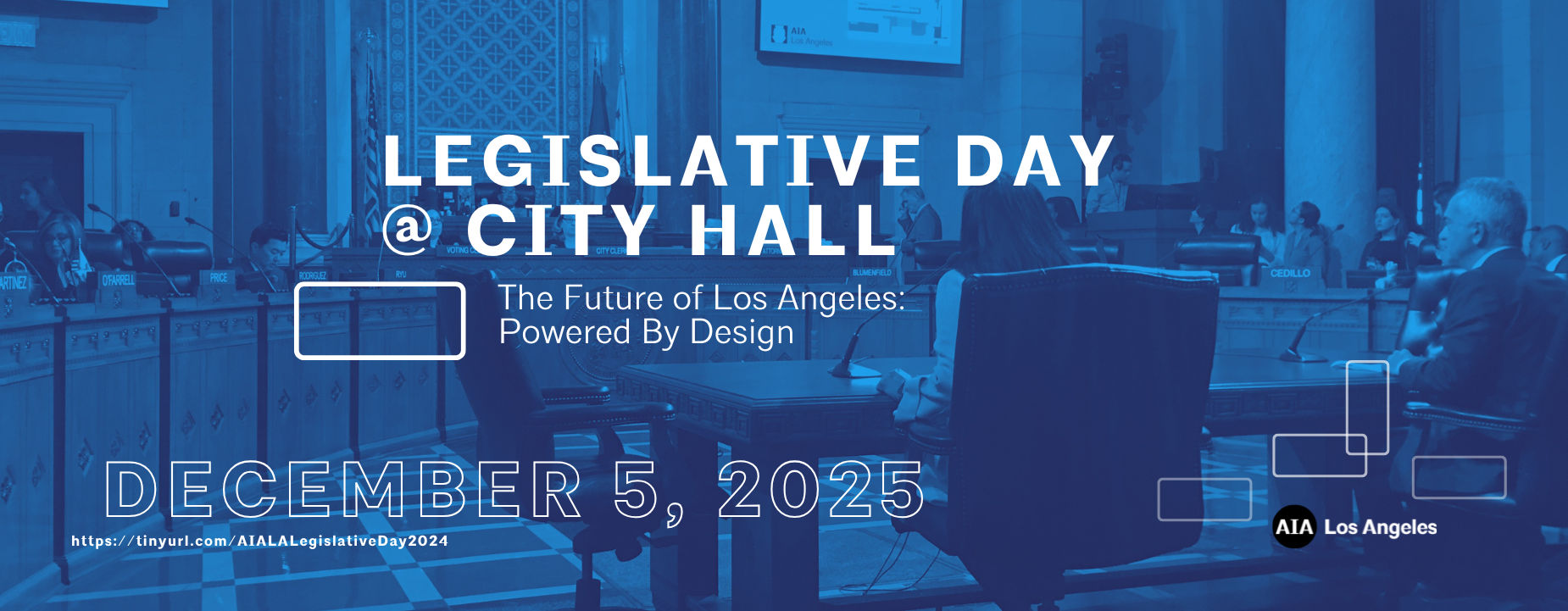
Your City. Your Expertise. Your Voice.
AIA|LA Legislative Day(s) at City Hall: December 4-10, 2025
Calling all Architects & Designers!
The future of Los Angeles is being shaped right now, in the halls of power, through policies that directly impact our built environment. AIA|LA Legislative Day(s) at City Hall is your unparalleled opportunity to step forward, connect directly with civic leaders, and ensure that the voice of design is not just heard, but leads the conversation.
This isn’t just a series of meetings; it’s a powerful, collective movement to advocate for smarter, more resilient, and more equitable development in our city.
Why Your Participation is Absolutely Critical:
Be the Expert Voice: Policymakers need your specialized knowledge on planning, land use, zoning, and building codes. Without you, crucial decisions are made in a vacuum.
Drive Real Change: Directly influence the policies that will define LA’s future – from urgently needed housing affordability and sustainable development to the revitalization of our civic core.
Elevate Our Profession: Demonstrate the indispensable value of architects and designers, solidifying our seat at the decision-making table and shaping the built environment with purpose.
Network & Empower: Connect with passionate peers, amplify your impact, and be part of a community actively building a better Los Angeles for everyone.
This year, we’re returning to City Hall in person, strengthening our direct connection with the policymakers who need your insights most! A few virtual meetings will also be available for flexibility.
Mandatory & Highly Recommended Orientation: Monday, December 1 | 4:00 PM – 5:00 PM (Virtual – Zoom) Join us to delve into the 2025 AIA|LA Advocacy Platform and prepare for impactful meetings. This is where you’ll gain the critical context and confidence to make your voice count. [RSVP FOR ORIENTATION HERE]
Legislative Day(s) at City Hall: December 5-10, 2025 (Primarily In-Person at LA City Hall)
RSVP HERE to JOIN US AT LA CITY HALL on December 5th.
Spaces are limited – secure your spot and make your impact! Contact Will Wright at Will{@}aialosangeles.org to learn more about how you can contribute to shaping the future of our city.
Don’t just witness the future of LA being built – help design it! Join us. Your city needs you.
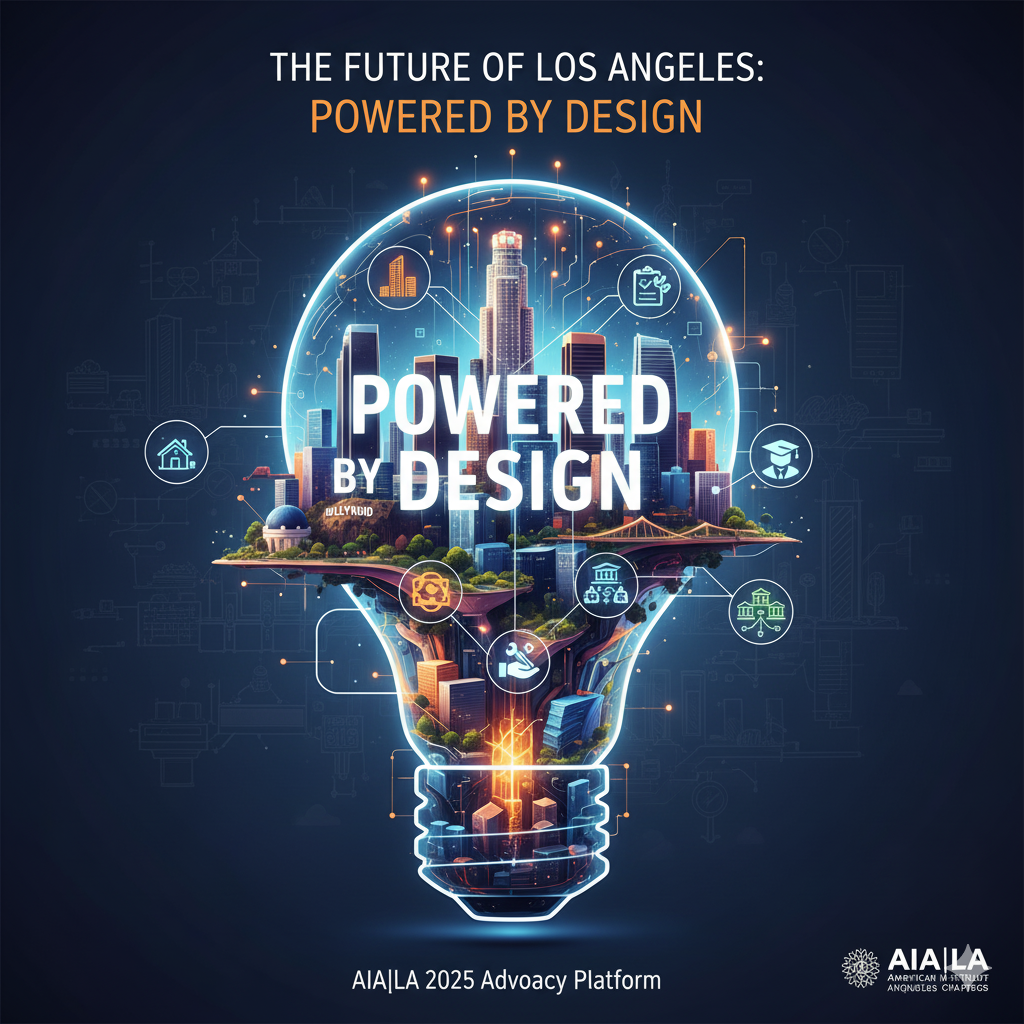
The Future of Los Angeles: Powered By Design
Want to help us shape the 2025 AIA|LA Advocacy Platform?
We welcome your comments. Kindly review the draft below and help us improve this platform with greater precision, expertise, and recommendations that will deliver achievable results to improve our city.
Please share your comments with me at Will{@}aialosangeles.org
All feedback is welcome! You can also add your EDITS HERE on this google doc.
The AIA|LA 2025 Advocacy Platform: Priority Issues & Recommendations (DRAFT)
The American Institute of Architects, Los Angeles Chapter (AIA|LA), through its 2025 Advocacy Platform, will champion critical reforms to enhance Los Angeles’s built environment. Our focus is on creating a city that is more efficient in its development services, more resilient and affordable in its housing, more functional in its governance, and more thoughtfully designed in its civic spaces.
Priority Issue 1: Streamlining & Modernizing Development Services Citywide
Challenge: The City of Los Angeles’s development services are plagued by inefficiencies, bureaucratic hurdles, and a lack of transparency, significantly delaying projects and increasing costs for all types of development, including much-needed housing. While the 2028 Olympic & Paralympic streamlining is a necessary measure, its lessons must be applied universally.
Recommendations:
Establish a Permanent, Cross-Departmental “Expedited Review Unit” (ERU): Formalize and expand the proposed LADBS dedicated Olympic unit into a standing, inter-departmental ERU. This unit would serve as a single point of contact and coordination for all projects meeting defined public benefit criteria (e.g., affordable housing, sustainable infrastructure, community facilities), not just projects directly related to the Olympics & Paralympics.
Implement a Citywide “Zoning Certainty” Program: Mandate a preliminary, expedited zoning confirmation process for all projects, providing architects and developers with written confirmation of development rights before significant design and engineering work begins. This reduces upfront risk, costs, and project delays.
Advance Architect Professional-Certification for Low-Risk Projects: Leverage the experience from Olympic temporary use exemptions to pilot and rapidly expand a robust architect professional-certification program for specified low-risk tenant improvements and minor alterations, thereby reducing City Plan Check workload and expediting project delivery.
Integrate and Modernize Digital Permitting Infrastructure: Capitalize on any IT infrastructure upgrades spurred by the 2028 Games to achieve true inter-departmental system integration. A unified, transparent e-permitting portal accessible to all stakeholders is essential to eliminate bottlenecks across the “10 other departments.”
Develop Objective, Transparent Metrics for Review Performance: Establish clear, publicly accessible service level agreements (SLAs) for review times across all City departments involved in development. Regularly publish performance data and hold departments accountable for meeting these targets to drive continuous improvement.
Priority Issue 2: Fostering Housing Affordability & Resilience Through Diverse Talent
Challenge: Los Angeles faces an acute housing crisis, exacerbated by a complex development process and a workforce that is not fully leveraged. Immigrants and international students are crucial to both the economic vitality of the AEC industry and the diversity of thought needed for innovative housing solutions.
Recommendations:
Champion “Design-Driven Affordability” via Streamlined Approvals: Advocate for expanding objective design standards and streamlining administrative approvals for affordable housing projects, including incentives for projects that integrate sustainable design and community-serving ground-floor uses.
Invest in AEC Workforce Development & Immigrant Integration Programs: Support initiatives that provide mentorship, upskilling, and pathways to licensure for immigrant architects and skilled tradespeople (e.g., expanding programs like the Immigrant Architect Coalition’s mentorship and scholarship initiatives). This is crucial given that the construction industry could face a nearly 16% GDP contraction without immigrant labor.
Leverage International Student Talent for LA’s Future: Advocate for policies and programs that better integrate international architecture and design students into the local workforce post-graduation, recognizing their role in driving innovation (over half pursue STEM fields) and enriching design perspectives.
Promote Resilient, Culturally Responsive Housing Design: Encourage the adoption of design guidelines and funding mechanisms that prioritize resilient building practices and culturally sensitive design for new housing, particularly for communities vulnerable to climate change, drawing on the inherent resilience and diverse perspectives of LA’s immigrant population.
Advocate for Immigration Policy Reform at the Federal Level: Partner with AIA National and other organizations to advocate for federal immigration policies that create more stable and predictable pathways for skilled architects, engineers, and construction workers (e.g., reforms to H1-B visas, expanded access to EB-2 NIW, O-1, and L-1 visas), ensuring a robust talent pipeline for housing delivery.
Priority Issue 3: Restoring Civic Center Functionality & Cohesion
Challenge: The Los Angeles Civic Center, a critical nexus of governance, suffers from deferred maintenance, underutilized assets, and a lack of cohesive planning, exemplified by the threat to the Kenneth Hahn Hall of Administration. This fragmentation hinders public service and undermines civic identity.
Recommendations:
Halt Demolition of Kenneth Hahn Hall of Administration (HOA) & Commission Independent Reassessment: Strongly advocate for an immediate pause on all demolition plans for the HOA. Demand an independent, objective, and transparent reassessment of its seismic safety and rehabilitation costs, exploring all viable, less expensive retrofit alternatives (e.g., shear walls, diagonal bracing) and prioritizing its retention as a public-facing government asset.
Activate the Los Angeles Civic Center Authority for Master Plan Update: Leverage the existing “Civic Center Authority” (LAAC Chapter 2) to convene a multi-jurisdictional task force. This task force, with strong representation from the architecture and design community, should be directed to conduct a comprehensive study and recommend a holistic update to the Civic Center Master Plan.
Conduct a Comprehensive Civic Center Asset Optimization Study: Commission a study to identify and strategize the adaptive reuse, revitalization, or optimal development of existing federal, state, county, city, and private-sector holdings within the Civic Center. This includes addressing “missing teeth” like the Parker Center replacement site, Civic Center Mall, First and Broadway lot, and underutilized surface parking lots.
Prioritize Public Access, Green Space & Multi-Modal Connectivity: The Civic Center Master Plan update must prioritize enhanced public access, expansion and integration of green spaces (like Grand Park), and improved multi-modal transportation connectivity, fostering a more vibrant, pedestrian-friendly, and accessible public realm.
Establish a Civic Center Design Review Panel: Create a standing, independent design review panel, comprised of leading architects, urban designers, and community representatives, to provide expert oversight and ensure high-quality, cohesive design for all future development and renovation projects within the Civic Center.
Priority Issue 4: Enhancing Equitable & Healthy Urban Design Across LA
Challenge: Los Angeles’s urban fabric often lacks equitable access to quality design, green space, and infrastructure, leading to disparities in health and economic opportunity. Development, while essential, must be guided by principles that ensure it serves all communities.
Recommendations:
Develop a “Signature Events” Framework for All Neighborhoods: Implement a citywide program, inspired by Santa Monica’s model, that streamlines permitting, waives fees, and provides priority support for qualifying community events (e.g., those benefiting non-profits, free to the public, supporting local businesses) across all LA neighborhoods to foster local identity and economic vitality.
Integrate “Healthy Community Design” into Planning Codes: Advocate for the revision of zoning and planning codes to explicitly incorporate principles of healthy community design, promoting walkable neighborhoods, access to fresh food, public art, and green infrastructure in all new developments and significant renovations.
Mandate Design Excellence for Public Infrastructure Projects: Champion policies that require higher standards of architectural and urban design for all public infrastructure projects (transit, parks, public buildings), ensuring they contribute positively to the aesthetic, functional, and social fabric of their surrounding communities.
Expand Community Design Workshops & Participatory Planning: Fund and promote community design workshops and participatory planning processes that actively engage diverse local residents, especially in underserved communities, in shaping the design outcomes of projects affecting their neighborhoods, ensuring equitable and culturally resonant urban development.
Utilize 2028 Legacy Infrastructure for Broader Community Benefit: Strategically plan for the post-2028 Games conversion and adaptive reuse of temporary Olympic infrastructure, ensuring these assets transition smoothly into permanent community facilities, public spaces, or affordable housing, rather than being dismantled without lasting benefit.
### DRAFT ###

The AIA LA & LACP Professional Volunteer Program (PVP)
Architects & designers passionate about improving the design quality of newly proposed projects throughout the City of Los Angeles are encouraged to participate in the Professional Volunteer Program (PVP), which is a collaborative design review program organized by AIA LA & Los Angeles City Planning (LACP)’s Urban Design Studio.
This year, we will be coordinating thirty-one virtual design review sessions, which will serve as opportunities for architects and designers to help the Los Angeles City Planning’s Urban Design Studio critically review upcoming projects throughout our City.
Nov 11 (10am)
Nov 18 (10am)
Dec 2 (10am)
Dec 9 (10am)
FOR MORE INFORMATION:
Will Wright, Hon. AIA|LA
Director, Government & Public Affairs
t: 213.639.0764
e: will@aialosangeles.org
www.aialosangeles.org
*Disclaimer: The advice and perspectives shared here belong to the author and should not be considered official recommendations from AIA Los Angeles.


