AIA|LA ADVOCACY REPORT
June 16, 2026

OPPOSABLE COMPLEMENTS
A reflection on Los Angeles, our collective purpose, and the tools we build to find it (written on the train on the way back from the AIA26 Conference in San Diego)
*By Will Wright*
It’s 5:38 pm on a Thursday evening. The sun is lowering down in long slants on the West Coast, and Southern California is rolling past me. We’ve just crossed Los Penasquitos Lagoon, heading towards Del Mar on our way home to Los Angeles. I learned a lot during the AIA26 Conference, set against the backdrop of the pleasant vibes and clean streets of San Diego, and it’s making me think sharply about the current conditions in Los Angeles. Nostalgia seems to percolate on trains, and right now, I’m remembering a moment of my life that was a blank canvas.
Back in 2003, as a graduate student at the Art Center College of Design, I was driving home in my old, rusted 1980 Jeep CJ-5 in the rain. No top, just a Dodgers cap. The radio was on. I was thinking about my future—where should I go, and what should I do to get there?—when, crossing the Los Angeles River along Fletcher, a song came on that I’d never heard before. It was one of those songs you keep sitting with long after you’ve reached your destination. Tim Buckley’s voice, crackling, letting the pain build to a crescendo and then break. “Buzzin’ Fly” from the Happy, Sad Album (I found out later). I didn’t mind the rain. Hearing it that first time, I think I finally understood something about the complexities and contradictions of this city.
I’ve called Los Angeles home for a long time now (since 1995), and my heart still palpitates over my love affair with it. Sometimes I love it here. Sometimes I don’t. Both are true. They coexist like two halves of a sphere.
I’ve come to believe that most of what matters about this city—and about this strange, accelerating moment we’re all living through—works exactly that way. Two competing ideas, both true at once. I call them opposable complements. Not contradictions to be resolved, but tensions to be held. A thumb is only useful because it opposes the fingers. The grip comes from the opposition.
Los Angeles is shedding its skin again. It’s unclear whether it will emerge as a rattlesnake—just fatter and more vulnerable and protective—or like a caterpillar transitioning into its chrysalis before it changes into something with wings. I don’t always know which. But I’m dead certain the molt is underway. You can feel it in the streets, on the sidewalks between Union Station and Chinatown, along the river, in the open green of Los Angeles State Historic Park. The city is buzzing with emergent opportunity even as it withstands real strain. Make-it-or-break-it. A transition that will either carry us ahead of the curve or leave us choking in the dust of the rest of the region’s maverick ambition.
However, LA is what exactly? A city. A county. A place. 88 suburbs in search of Jimmy Gleason? How do you love/hate or even just connect with a place that is not easily defined, and therefore rarely understood? LA is BLANK, and its buildings, streets, parkways, and plazas become a language to unite us. But even that language is effusive. Because it’s not what LA is that matters. It’s how LA makes one connect with others that’s most important.
Here’s the thing I keep coming back to: it was never really about the buildings. Buildings take forever. The action of the architect, though, can be immediate and fast. As the design profession evolves, I see its impact becoming more integral to the health and beauty of the places people actually enjoy—not the walls, but the volumes. Not the structures, but the spaces in between. The sidewalk, the street tree, the bus bench, the bench’s view, the small dignities that make a block feel like it belongs to the people standing on it. I look forward to when we get fully past the walls and into the volumes, because that’s where a city becomes a place worth loving.
We won’t get there by ourselves, and we won’t get there by fighting each other. For too many decades, we’ve nursed an us-versus-them posture, when the truth is we’re all in this together. The most useful thing I’ve learned in this work is that genuine change comes from building bridges—between architects and engineers, planners and policymakers, developers and the resident who has lived on the same corner for forty years and knows things about it no entitlement application will ever capture. My job, as I’ve come to understand it, is to be a fulcrum: to leverage and amplify the ability of design-thinkers to make the public realm more beautiful, more walkable, more humane. And to be a constant reminder to public officials that smiles, beauty, and delight are legitimate metrics of success.
What “working together” actually looks like
I want to resist the temptation to leave that idea at the level of sentiment, because “let’s all work together” is the kind of phrase that means everything and therefore nothing. So let me put a concrete object on the table.
For years, our profession’s instinct in Los Angeles has been to fight the housing crisis one heroic project at a time—each parcel a custom battle, each approval a bespoke ordeal of variances, appeals, and delay. It is noble work, and it does not scale. The math of our shortage is brutal, and artisanal entitlement is not going to close the gap.
There is another way, and it is one of the most exciting opportunities in front of us right now: a pre-approved courtyard-block pattern book. Picture a small library of vetted, beautiful, by-right building types—courtyard housing forms grounded in the typology that has defined the best of Los Angeles living for a century, from the bungalow courts of the 1920s onward. Designs that have already cleared the code, already resolved the hard problems of light, air, egress, and neighborliness, sit on a shelf ready to be adapted to a thousand lots. With the AB 835 single-stair reform window opening, and with the courtyard-block typology that thinkers like Alicia Pederson have been articulating as a genuine alternative to the podium slab, we have a chance to make good design the path of least resistance rather than the exception that requires a hero.
This is what working together can produce that no solo act can. A pattern book is, by its nature, a collaboration across time: architects, planners, code officials, builders, and communities agreeing in advance on what “good” looks like, so that the next person doesn’t have to relitigate it. It turns the architect’s gift from a one-off into a public utility. It is, frankly, the most leveraged thing our chapter could put its name to—and it is exactly the kind of work that becomes more possible, not less, in the moment we’re about to talk about.
The tool, and the fear it deserves
A million new tools rain down on us every day, like a swarm of locusts. We grovel. We gasp. We moan under the weight of so much opportunity. And then, slowly, one by one, one tool at a time, we get the hang of it. Artificial intelligence is the loudest of these tools (right now), and the fear it provokes is not naïve. It is correct, and it deserves more than a reassuring pat.
So let me steelman the fear rather than wave it off. There is a BIM designer in a mid-sized firm in this city—maybe forty-eight years old, 25+ years (or more) of mortgage left, a skill set built patiently over twenty years—who has watched every previous wave of “tools that free us” arrive with the same friendly press release and leave with a thinner payroll. CAD did not just augment the drafting board; it emptied the room of drafting boards. When that person hears an association director say that AI will “take the drudgery off our desks,” they are right to hear, underneath it, the possibility that the desk itself is what’s being taken. To tell that person that “purpose proliferates even as jobs go extinct” is to offer philosophy to someone who needs a paycheck. It can sound, at best, like a comfortable abstraction from someone whose own livelihood isn’t the one on the line. I don’t want to pretend otherwise, because pretending is how our profession loses the trust of its own members.
Here is the honest version of what I believe, with the discomfort left in.
AI may displace many of the current jobs. Yes. That is one true thing, and it is not a small one. And humans will always be here—to exist, to connect, to seek meaning, to make and remake the places we live in. That is the other true thing. Opposable complements again. The error is in thinking we have to pick one. The harder, truer task is to hold both and then *act on the second one deliberately*, so that the first one doesn’t get to write the whole story by default.
Because a tool only ever has the aim we give it. AI is an oar to a canoe. It is an airplane to a destination. It will not row the boat for you, and it will not decide where you’re going. Left to its own commercial momentum, it will optimize for whatever is easiest to measure—clicks, throughput, billable units eliminated. But pointed on purpose, the same tool can compress the tedious labor of a project so that an architect spends more of her week on what no machine can do: thinking about how a plaza feels at dusk, how a stranger might fall into easy conversation on a well-designed corner, how a courtyard block lets a grandmother watch children play without leaving her own front porch.
This is where the pattern book and the tool meet, and it’s why I’m not just hand-waving about purpose. The drudgery of getting good housing approved—the redrawing, the code-checking, the endless reconciliation of overlapping regulations—is precisely the kind of labor these tools are good at compressing. If we aim them there, the architect is not replaced; the architect is redeployed to design the volumes, to renegotiate the public realm, to recalibrate the human questions that were always the point. The work that survives is the work that was most worth doing. That is not a consolation prize. That is the job finally becoming what it should have been.
Purpose, honestly
I still owe you the hardest part, because “purpose over jobs” is easy to say from a podium and cruel to hear from a layoff notice.
So let me be precise about what I am and am not claiming. I am not claiming the transition will be painless, or that purpose pays rent, or that anyone owes you serenity while your field reorganizes underneath you. I am claiming something narrower and, I think, sturdier: that society is a cultural vehicle for redesigning how humans enjoy their time on Earth, and that we get a say in the design. Jobs are one arrangement we invented for distributing both income and meaning. When that arrangement frays, the honest response is not to romanticize its loss but to insist—loudly, politically, collectively—that we build the next arrangement on purpose rather than letting it congeal by accident.
That means the conversation about AI in our profession cannot only be about productivity. It has to be about who captures the gains, what we owe the people displaced along the way, and how we make sure the time the tools give back is spent on the public good rather than simply pocketed. Those are questions of governance, of smart regulatory frameworks, of financial design. They are, in other words, exactly the kind of complex, multi-stakeholder problems our profession is unusually well-suited to convene. The curious generalists—the people who can step back and hold two true things at once—will not just survive this; they are the ones we need to lead it.
I’m confident in humanity’s resilience, but it is not a passive confidence. I’ve watched us, over and over, take the swarm of overwhelming change and, one person at a time, turn it into a craft we practice daily and gladly. That outcome is not guaranteed. It is earned by people who decide to aim the tools at the things worth building.
So here is what I’d ask of you, not as a feeling but as an action. Get involved in the pattern-book work; lend it your name and your judgment. Show up to the hearing where the courtyard typology lives or dies. Demand, on your very next project, that beauty and human connection are written down as metrics of success and not left as someone’s afterthought. Treat the new tools as oars, and then row toward the public realm.
I’ll close where I started—in that Jeep, in the rain, over the river, with my whole future ahead of me and a question I still haven’t outgrown. Where should we go, and what should we do to get there? I don’t have every answer. But I know we decide it collectively, I know the deciding has already begun, and I know the molt can still end in wings.
Who else is there with me in that optimism?
PRESENTED BY GRAPHISOFT
Your seat at the table with Los Angeles’s civic decision-makers.
Each month, a small circle of architects, designers, and civic stakeholders gathers for a candid roundtable breakfast with a leader at the center of Los Angeles’s built future — a developer reshaping a skyline, a utility chief navigating electrification, a legislator crafting land-use policy. No panels. No lectures. Just a real conversation about what Los Angeles is building, who it’s building for, and how design professionals can shape what comes next.
WHY ATTEND
| Rare Access
The roundtable format means you’re not in the audience. You’re in the room, with real dialogue — not a presentation.
|
Real Influence
These are the decision-makers shaping zoning, infrastructure, housing, and climate policy. Your perspective belongs in that conversation.
|
Lasting Network
Connect with peers across architecture, development, planning, and government — united by a shared commitment to Los Angeles’s future.
|
| June 2026 |
|
19
FRI 8–9:30 am
|
Greg Ames
Southern California Market Leader, Trammell Crow Company HKS — 8665 Hayden Pl., Culver City, CA 90232 |
|
25
THU 8–9:30 am
|
Allan Marks
President, LADWP Board of Commissioners AUX Architecture — 910 S. Olive Street, Los Angeles, CA 90015 |
| August 2026 |
|
13
THU 8–9:30 am
|
Lina Lee
1st Vice President, Development, CIM Group Host location TBD REGISTRATION OPENING SOON |
|
20
THU 8–9:30 am
|
Adam Burke
President & CEO, Los Angeles Tourism & Convention Board Host location TBD REGISTRATION OPENING SOON |
|
21
FRI 8–9:30 am
|
Sade Elhawary
Assemblymember, 57th District, California State Assembly Hanson LA — 724 S. Spring Street, Suite 1002, Los Angeles, CA 90014 |
| September 2026 |
|
4
FRI 8–9:30 am
|
Robin Hughes
President & CEO, Housing Partnership Network Host location TBD REGISTRATION OPENING SOON |
|
18
FRI 8–9:30 am
|
Jon Switalski
Executive Director, Rebuild SoCal Partnership Host location TBD REGISTRATION OPENING SOON |
| October 2026 |
|
9
FRI 8–9:30 am
|
Darcy L. Coleman
Vice President, Asset & Investment Management, Alagem Capital Host location TBD |
|
16
FRI 8–9:30 am
|
Nick Saponara
Executive Officer, Transit-Oriented Communities, LA Metro Host location TBD REGISTRATION OPENING SOON |
|
And more to be announced.
|
AIA Los Angeles |
The Blueprint Exists. AB 306 Builds the Foundation.
By Will Wright, Hon. AIA|LA
California has a strong track record for delivering monumental outcomes. That is, if we set our mind to it, roll up our sleeves, and do the hard work it requires to accomplish the task.
When this state commits its full ambition to a production system — genuinely commits, not merely aspirationally — that system transforms industries, reshapes landscapes, and becomes a model for the nation.
We have committed, in policy, to solving our housing crisis. We have passed laws, set production targets, and restructured agencies. What we have not yet done is build the regulatory infrastructure that makes that commitment real at scale. California cannot close a 4.5-million-unit housing deficit with a code system designed for one-off review. It needs the infrastructure of a production state.
AB 306 builds that infrastructure. And the California State Senate should pass it.
The Scale of What We Are Trying to Do
The numbers are not abstract. California produces fewer than 80,000 homes per year, against a documented need of 180,000. Development costs run 2.3 times higher than in competitor states — driven by 49-month average timelines and impact fees averaging $29,000 per unit before a single wall goes up. Over three million renters spend more than a third of their income on housing. Nearly a quarter of the nation’s unhoused population lives on our streets.
These outcomes do not reflect a failure of intent. California has some of the most committed housing advocates, most creative architects, and most ambitious policy frameworks anywhere. They reflect a failure of infrastructure — the regulatory infrastructure that connects design ambition to delivered units at scale.
We are not trying to build more of the same. We are trying to redesign the machine that delivers housing, and AB 306 is one of the most important gears that the machine has been missing.
The Innovation That Is Ready to Scale
The construction methods that can genuinely move the needle already exist. Factory-manufactured component systems. Precision-assembled wall and floor cassettes. Mass timber assemblies. Three-dimensionally printed housing structures. These are not speculative technologies — they have been piloted in California jurisdictions and proven in markets around the world. They are ready to scale.
What they cannot do is scale through 540 independent regulatory conversations, each starting from scratch.
California’s 540 jurisdictions independently interpret its statewide building standards, independently amend them, and make essentially unreviewable local code determinations within their boundaries. A construction method validated by engineering, tested for safety, and approved in one city may face a completely different reception — and a completely different set of technical questions — three miles away. Manufacturers who develop innovative building systems must secure approvals jurisdiction by jurisdiction, even when the underlying engineering is identical across every application. The result: duplicated review, inconsistent conditions, and commercial non-viability.
The Terner Center for Housing Innovation documented this precisely — finding a system in which the state’s statutory appeals mechanism has been used perhaps once or twice in fifteen years, and in which informal peer consultations routinely substitute for formal resolution. A building code appeals process invoked twice in fifteen years is not a system. It is a legal fiction — and it is costing California the housing production it cannot afford to defer.
What AB 306 Makes Possible
AB 306, authored by Assemblymember Nick Schultz with principal co-authors Assemblymembers Wicks and Hadwick, and sponsored by the American Institute of Architects California, is the mechanism that makes the math work. It does not merely create a new appeal right. It creates the foundational regulatory infrastructure for California to function as a housing production state.
Its most consequential provision is the statewide code equivalency pathway. When a construction method — a component system, a 3D-printed structure, a mass timber assembly — meets California’s existing safety standards, the California Building Standards Commission can issue a code equivalency determination with statewide effect. One rigorous technical review, accessible as guidance across all 540 jurisdictions. A state-certified wall system is accepted statewide without re-engineering in every city. This is the universal interface that allows a supply chain to flourish, that gives manufacturers the certainty to invest in factory capacity, and that transforms California from a patchwork of isolated pilots into a platform for housing innovation at scale.
AB 306 also creates a statewide code interpretation process for the recurring technical questions that currently generate inconsistent answers across jurisdictions — which code applies to a three-story townhouse, how height is measured for aerial apparatus access, and how ownership structure affects occupancy classification. These questions come up constantly. Today, they are resolved inconsistently, or not at all. Under AB 306, they can be answered once, as authoritative guidance, reducing redesign cycles and shortening timelines across every jurisdiction in the state.
The bill also addresses California’s vast stock of underutilized commercial buildings — office towers, aging retail corridors, surplus institutional properties — which represent one of the fastest paths to new housing supply in already-built cities. Adaptive reuse is financially viable until it isn’t: local trigger ordinances can reclassify a renovation as full new construction when defined thresholds are crossed, erasing the economic case for the conversion. AB 306 creates a targeted path to review trigger provisions that function as housing barriers rather than proportionate safety requirements.
Finally, the bill mandates online publication of local code interpretations and amendments, and creates a precedent-decision framework that builds shared knowledge over time. The accumulated technical intelligence of how California’s building standards are applied — currently dispersed across informal networks and individual plan-checkers — becomes a public resource. That knowledge infrastructure is what a production system requires.
California Knows How to Build Systems
The bill passed the California State Assembly 71 to 0 — not a single dissenting vote. That unanimity reflects what legislators across the political spectrum recognize: this is not a narrow industry request but a foundational systems reform, long overdue, that benefits everyone with a stake in California’s housing future.
Effective new design concepts often begin as one-off approvals and, with repeated use, enter the regular code. Atrium hotels. Plastic plumbing systems. Pedestrian bridges. The pattern is consistent: proven innovation, once given a durable pathway, scales. AB 306 is that pathway — the mechanism by which California’s housing innovation moves from isolated pilot to statewide production.
California has never lacked the ambition to solve its hardest problems. What it has lacked, at the building code level, is the infrastructure to match that ambition. AB 306 provides it. The Senate should say yes.
What Would You Like to Say Yes To?
Seven minutes by air, an hour on foot, and a city still being invented
On gondolas, kite festivals, a river being reclaimed, and what Los Angeles could become.
CLICK HERE to read an editorial by Will Wright, Hon. AIA|LA
YOUR SEAT AT THE TABLE THAT SHAPES LA.
Five high-access events. Six decision-makers. One moment for architects to be in the room where it happens — as Los Angeles rebuilds, reshapes, and reimagines itself.
WHY NOW?
LA is navigating wildfire recovery, a mayoral race, the FIFA World Cup, the 2028 Olympics, a housing crisis, and a clean-energy transition — all at once. The decisions being made today will define this city for a generation.
Architects belong in every one of these conversations.
A MESSAGE TO THE AEC COMMUNITY
The 2026 AIA|LA City Leaders Breakfast Series and annual Design for Dignity Conference represent a rare opportunity: direct, roundtable access to the city officials, elected leaders, and infrastructure stewards making decisions that directly impact your work, your clients, and your communities.
These are not passive lecture events. They are intimate conversations — held over breakfast, held in roundtable format — designed specifically for architects and designers to engage, question, and influence. Seats are limited, and they fill fast.
================================================================================
UPCOMING EVENTS | June 2026
================================================================================
CITY LEADERS BREAKFAST SERIES
——————————————————————————–
SPEAKER: ALLAN T. MARKS – President, LADWP Board of Commissioners
Lawyer & Strategic Advisor | International Energy & Infrastructure Finance
DATE: Wednesday, June 24, 2026
TIME: 8:00 am
LOCATION: AUX Architecture
COST: $10 AIA Member | $15 Non-Member
RSVP HERE
Unanimously elected LADWP Board President in January 2026, Allan Marks brings decades of experience in international energy finance, infrastructure, and sustainability — having overseen transactions valued at over $100 billion globally. He oversees the nation’s largest municipal utility, serving more than 4 million Angelenos. His focus is clean-energy transition, climate resilience, and equitable infrastructure investment — topics with enormous implications for how LA’s built environment is designed and powered.
WHY IT MATTERS FOR ARCHITECTS:
Electrification mandates, all-electric building codes, grid reliability, and energy resilience in post-wildfire rebuilding are all under LADWP’s purview. Designers shaping the next generation of LA buildings need to understand what is coming from the utility side.
================================================================================
FOUR REASONS THE AEC COMMUNITY SHOWS UP
================================================================================
01 / ROUNDTABLE FORMAT
These are not panels or lectures. You sit across from city leaders and ask the questions that matter to your practice, your projects, and your community.
02 / RARE ACCESS
A fire chief, a mayoral candidate, a state assemblymember, an energy board president — these are the decision-makers whose policies shape every permit, code, and project in Los Angeles.
03 / AFFORDABLE ENTRY
Breakfasts are just $10 for AIA members and students. The access-to-cost ratio here is extraordinary.
04 / ADVOCACY IN ACTION
Your presence sends a message: architects are engaged, invested, and indispensable to Los Angeles’s future. Show up and make that case in the room.
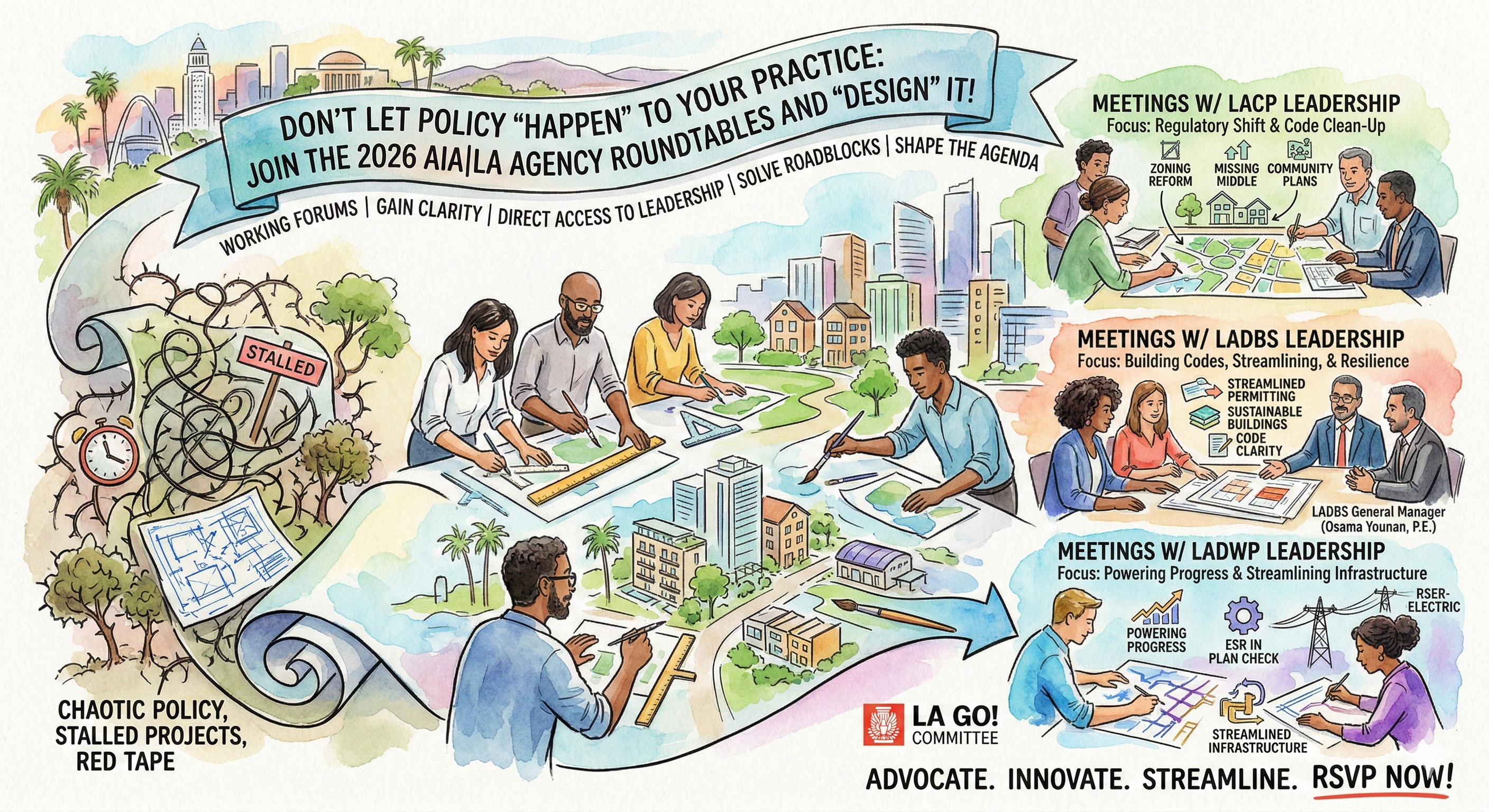
Don’t Let Policy ‘Happen’ to Your Practice: Join the 2026 AIA|LA Agency Roundtables and ‘Design’ It!
Navigating the regulatory landscape of Los Angeles is often one of the most complex, time-consuming, and expensive challenges in architecture today. Projects stall, budgets inflate, and timelines stretch—often due to processes that feel out of our control.
But you do have control.
The AIA|LA Government Outreach (GO!) Committee has organized a comprehensive series of quarterly roundtables with the leadership of the three agencies that dictate the flow of your projects: Los Angeles City Planning (LACP), the Department of Building and Safety (LADBS), and the Department of Water and Power (LADWP).
These sessions are not standard webinars; they are working forums designed to break down silos, modernize standards, and establish a shared culture of trust between the private sector and city personnel.
Why You Need to Be in the Virtual Room
Gain Immediate Clarity: Get ahead of major operational shifts (like Zoning Plan Check moving to LACP) before they disrupt your current workflow.
Direct Access to Leadership: Cut through the red tape and hear firsthand updates on emerging initiatives directly from General Managers and Department Heads.
Solve Specific Roadblocks: Have a project stalled by 14′ ground floor minimums or late-stage LADWP transformer placements? This is where we advocate for specific, technical code clean-ups.
Shape the Agenda: Your boots-on-the-ground experience directly informs AIA|LA’s advocacy efforts, turning your daily frustrations into actionable policy reforms.
Below is the 2026 schedule for each agency. Please RSVP via the links provided to secure your spot and ensure your voice is heard.
1. Meetings w/ Los Angeles City Planning (LACP) Leadership
Focus: The Regulatory Shift & Code Clean-Up
Our upcoming April session will dive deep into the ‘nuts and bolts’ of the Development Services Bureau, focusing extensively on the critical transition of the zoning plan check process, shifting from LADBS to LACP. Future sessions will tackle statewide housing initiatives (SB 79, AB 130), the impact of AI on compliance, and navigating the Missing Middle and Livable Communities Initiative.
2026 Schedule (Virtual via Zoom, 1:00 pm – 2:30 pm)
2. Meetings w/ LA Department of Building and Safety (LADBS) Leadership
Focus: Building Codes, Streamlining, & Resilience
Connect directly with Osama Younan, P.E., General Manager of LADBS. This is the forum for architects and design professionals to clarify building code interpretations, push for permit streamlining, and discuss the implementation of sustainable building practices.
2026 Schedule (Virtual, 1:00 pm – 2:00 pm)
3. Meetings w/ LA Department of Water and Power (LADWP) Leadership
Focus: Powering Progress & Streamlining Infrastructure
Since 2021, we have secured critical wins with LADWP, including faster processing for ED1 affordable housing and smarter financial solutions for line extensions. Our Prime 2026 Advocacy Priority is pushing LADWP to require review and approval by the Service Planner and ESR (Field Team) during the normal Plan Check Period—avoiding the costly delays that occur when the ESR first sees a project late in the construction phase.
2026 Schedule (Virtual via LADWP’s MS Teams, 11:00 am – 12:30 pm)
Have a specific item for the agenda? We want to hear about the specific issues, challenges, and recommendations you are facing in the field. Please email Will@aialosangeles.org to have your item added to the docket for upcoming meetings.
Advocate. Innovate. Streamline. We look forward to seeing you there.
Very truly yours,
AIA Los Angeles GO! Committee
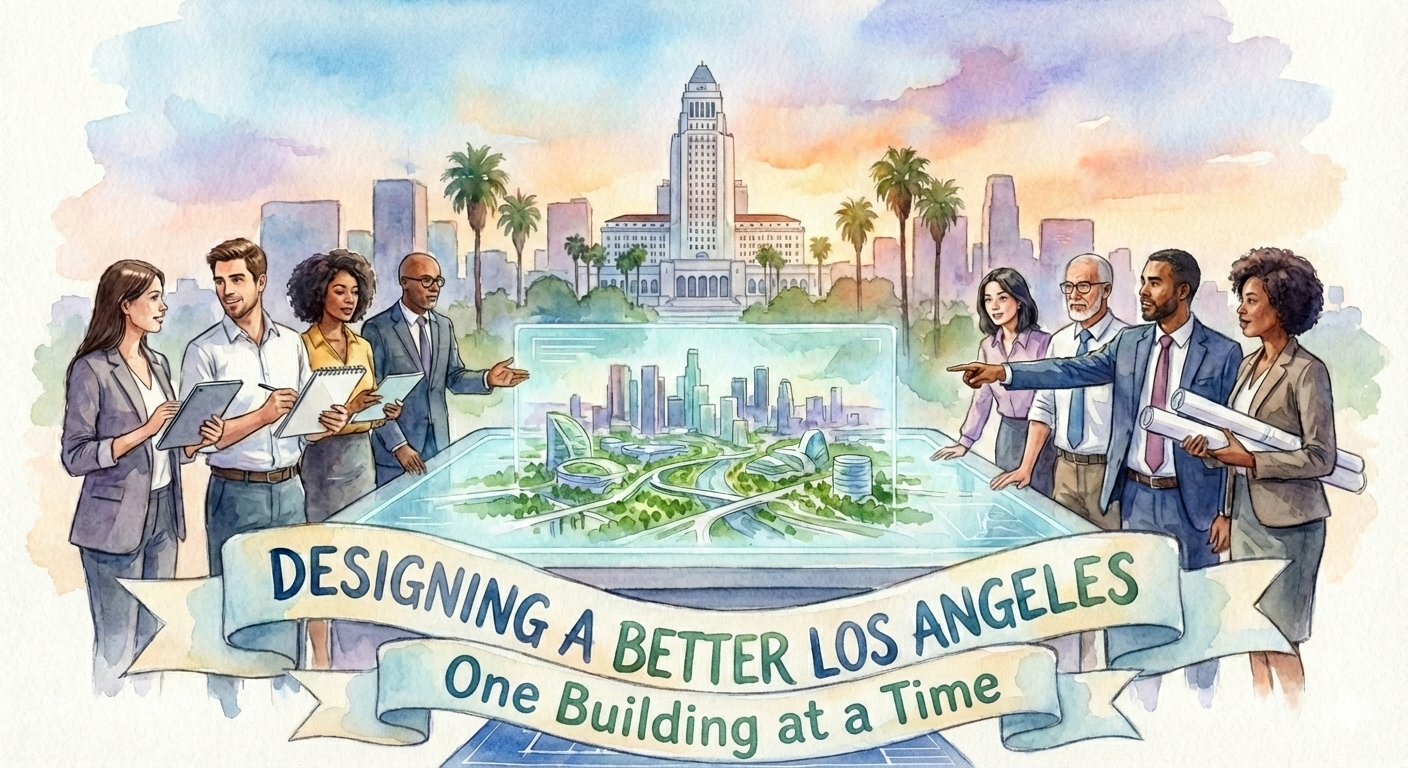
Help Shape the Future of LA: Join the AIA|LA & LACP Design Review Sessions
Calling all architects and designers with a vision for a better Los Angeles!
The AIA|LA, in partnership with the Los Angeles City Planning (LACP)’s Urban Design Studio, invites you to participate in the Professional Volunteer Program (PVP). This collaborative initiative offers a unique opportunity to directly influence the design quality of upcoming projects across the city and play a vital role in shaping the urban fabric of Los Angeles.
Why Participate?
Impact Your City: Share your design expertise and insights on pending projects that will be reviewed by the Planning Commission. Your feedback can help shape the future of our city’s built environment.
Educate and Collaborate: Work alongside LACP planning staff to discuss urban design issues, complex urban typologies, and project-specific design challenges.
Expand Your Network: Connect with fellow architects, designers, and city planning professionals who share your passion for urban design.
How to Get Involved:
The PVP will be hosting 31 virtual design review sessions throughout the year. These sessions are a great opportunity to get involved and make a real difference. We encourage you to register for three or four sessions that fit your schedule.
View the Full Schedule and Register Today:
Prepare for a Meaningful Impact:
To maximize your contribution, we recommend reviewing the Urban Design Studio’s resources and the City’s design guidelines:
Confidentiality:
PVP discussions provide an open forum for design feedback, and all participants are expected to maintain confidentiality and anonymity.
For More Information:
Please contact Will Wright, Hon. AIA|LA, at (213) 639-0764 or will[@]aialosangeles.org with any questions.
Together, we can create a more vibrant, equitable, and resilient Los Angeles through the power of design. Join us in shaping the city’s future!
FOR MORE INFORMATION:
Will Wright, Hon. AIA|LA
Director, Government & Public Affairs
t: 213.639.0764
e: will@aialosangeles.org
www.aialosangeles.org
*Disclaimer: The advice and perspectives shared here belong to the author and should not be considered official recommendations from AIA Los Angeles.


