AIA|LA ADVOCACY REPORT
February 24, 2026


The Architecture of Affordability: Soil & Roots
By Will Wright, Hon. AIA|LA
For the design and development community in Los Angeles, the housing crisis is not an abstract concept; it is a daily professional reality. We see it in the tent encampments adjacent to project sites, and we feel it in the crushing weight of the permitting queues that stall critical work. We advocate for design that brings dignity, but too often, those visions languish in a bureaucratic purgatory.
As we look toward the 2026 legislative cycle, two major initiatives have emerged that promise to reshape our built environment: the 2026 Roadmap Home initiative and the Building an Affordable California Act. Viewed separately, they are ambitious but incomplete. Viewed together, they represent the single greatest opportunity for systemic change in a generation.
To understand why, we must look at our crisis through an ecological lens. We are trying to cultivate a forest in depleted soil while choking off the very roots that would allow it to grow.
The Nutrient-Rich Soil: The Roadmap Home
The Roadmap Home functions as the “nutrient-rich soil” essential for California’s recovery. Anchored by Housing California and the California Housing Partnership, it sets the necessary moral mandate: advancing racial equity, ending homelessness, and producing 1 million affordable homes by 2030.
Crucially, it identifies the resources necessary to nourish this massive undertaking, including a proposed $10 billion statewide housing bond. It recognizes housing as the foundation for health and economic resilience. However, the Roadmap’s own analysis admits a terrifying truth: at our current pace of production (roughly 15,000 affordable homes per year), cultivating this canopy would take 70 years. We do not have 70 years.
The Healthy Root System: Building an Affordable California Act
This is where the second initiative comes in. If the Roadmap provides the nutrients, the Building an Affordable California Act clears the toxins from the ground to establish a “healthy root system.”
Sponsored by the California Chamber of Commerce, this Act addresses the “70-year problem” by removing the regulatory blight that prevents projects from taking hold. It mandates enforceable 365-day approval timelines for Environmental Impact Reports and curbs the abuse of CEQA litigation—often used not to protect the environment, but to obstruct growth. By streamlining judicial review to 270 days and creating “vested rights” stability, it is estimated to lower development costs by approximately $75,000 per home.
The Alignment: Solving the Paradox
For those of us championing the built environment, the alignment of these two initiatives solves the “Capital vs. Cost” paradox. We know that even with unlimited water and fertilizer, we cannot grow a forest if the ground itself is toxic. Inefficiencies imperil all housing production, regardless of the budget.
The Roadmap Home raises the capital needed to subsidize the work, while the Building an Affordable California Act ensures that capital isn’t withered away by bureaucratic delays and legal fees. The Roadmap ensures the right seeds are planted—those focused on equity and sustainability. The Act ensures those seeds actually take root on a human-relevant timeline.
A “Green Light” Strategy for the Future
To fully realize the potential of this moment, we must advocate for a synthesis of these efforts—a unified “California Building Guarantee” that attracts massive private and institutional investment. Here is how we can improve and integrate these initiatives:
1. The “Multiplier Effect” Narrative: We must explicitly link resource generation with waste reduction. By passing the Building an Affordable California Act, we unlock an “efficiency dividend” of $75,000 per unit. This means the Roadmap Home’s bond funding can shelter thousands more families than originally projected. This is a narrative of stewardship that appeals to taxpayers and investors alike.
2. A Cultivated Investment Class: Capital flees uncertainty. We should advocate for a certified asset class for projects that meet the Roadmap’s high standards for equity (such as “Opportunity Hubs” with co-located childcare or health services) and utilize the Act’s streamlined pathways. These projects should qualify for a “Platinum Lane” permitting process—targeting 90-day approvals—signaling to the market that the most socially beneficial projects are also the lowest-risk investments.
3. The “Green Equity” Workforce Pipeline: Labor availability is a critical bottleneck. We should use revenue from the Roadmap to fund free trade school programs specifically for the “Essential Projects” defined in the Act. This assures the industry that the caretakers will exist to tend to this growth, creating a guaranteed decade of work for our trades.
4. A “City of Yes” Incentive Structure: State mandates often face local obstruction. We can align political will by using the Roadmap’s discretionary funds to reward cities that fully embrace the Act’s streamlining. Municipalities that beat the 365-day approval timeline should receive priority access to grants for community amenities like parks and libraries.
Our Role As advocates for a better built environment, we are the bridge between the vision of what could be and the reality of what is built. We understand that a vision without a mechanism is a hallucination, and a mechanism without a vision is aimless.
The Roadmap Home provides the destination. The Building an Affordable California Act clears the path. It is up to us to ensure they work in tandem. Let us advocate for a system where funding and efficiency are not competing interests, but synchronized forces in an ecosystem designed to build a more equitable, affordable, and prosperous California.
Will Wright, Hon. AIA|LA, is the Director of Government & Public Affairs for the American Institute of Architects, Los Angeles Chapter. The above editorial is his opinion and not meant to represent the official view of AIA Los Angeles, its membership, or its Board of Directors.
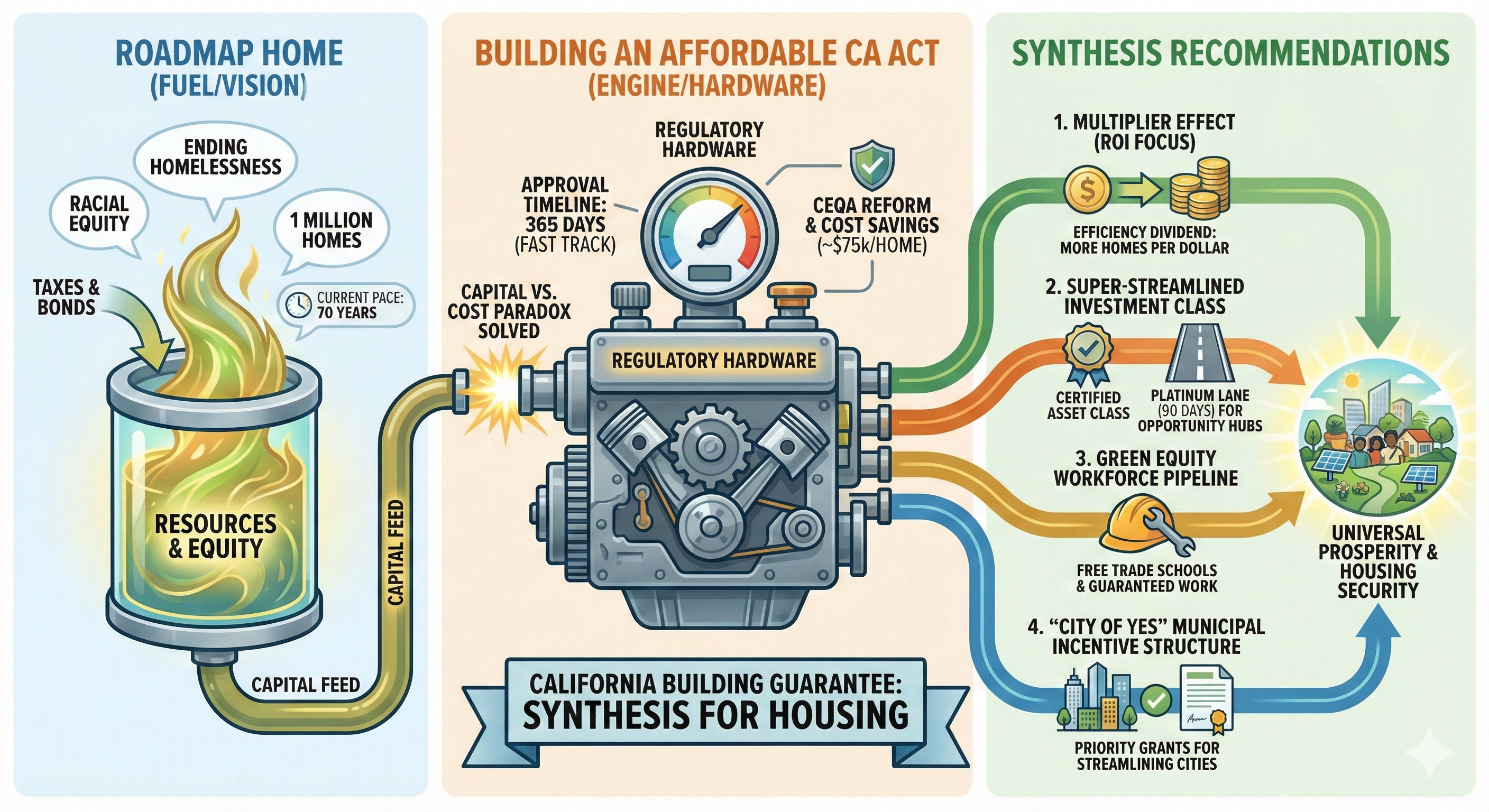
A RECOMMENDED ALIGNMENT
The Roadmap Home initiative and the Building an Affordable California Act represent two halves of a necessary whole: one provides the vision and resources, while the other provides the mechanism for execution.
The Roadmap Home: This initiative acts as the strategic “software” for California’s recovery. It sets the moral mandate (racial equity, ending homelessness), defines the targets (1 million affordable homes), and identifies the revenue streams (taxes, bonds) necessary to pay for it. However, it explicitly admits that at the current pace of production, meeting these goals would take 70 years.
The Building an Affordable California Act: This initiative acts as the regulatory “hardware.” It directly addresses the “70-year” problem by fixing the broken approval processes (CEQA) that cause delays and bloated costs. By mandating 365-day approval timelines and curbing frivolous litigation, it lowers the cost of development (saving ~$75,000 per home).
The Alignment: Together, they solve the “Capital vs. Cost” paradox. The Roadmap Home raises the capital needed to subsidize housing, while the Building an Affordable California Act ensures that capital isn’t wasted on bureaucratic delays and legal fees. The Roadmap ensures the right projects are funded (equity/sustainability), and the Act ensures those projects are actually built on a human-relevant timeline.
Recommendations for Synthesis: A “Green Light” Strategy for Investment
To attract massive private and institutional investment into housing, these two initiatives should not just coexist; they should be marketed as a unified “California Building Guarantee.”
1. The “Multiplier Effect” Narrative (ROI Focus): Investors and taxpayers alike are wary of funding “black hole” government programs.
Synthesis: Launch a campaign demonstrating that every dollar invested via the Roadmap goes further because of the Act. Explicitly link the Roadmap’s revenue generation with the Act’s cost reduction.
Pitch: “By passing the Building an Affordable California Act, we unlock a ‘efficiency dividend’ of $75,000 per unit, allowing the Roadmap Home’s $10 billion bond to build thousands more homes than originally projected.” This creates a compelling narrative of fiscal responsibility and maximum impact.
2. Create a “Super-Streamlined” Investment Class: Capital flees uncertainty. The Roadmap provides funding certainty (gap financing), while the Act provides regulatory certainty (timeline guarantees).
Synthesis: Create a certified asset class for projects that meet the Roadmap’s high standards for equity/sustainability and utilize the Act’s streamlined pathways.
Recommendation: Projects that achieve the Roadmap’s “Opportunity Hub” status (co-located childcare/health) should automatically qualify for the Act’s “Judicial Streamlining” and perhaps an even faster “Platinum Lane” for permitting (e.g., 90 days instead of 365). This signals to investors that the most socially beneficial projects are also the lowest-risk investments.
3. The “Green Equity” Workforce Pipeline: Both initiatives protect labor standards, but labor availability is a bottleneck.
Synthesis: Combine the Roadmap’s suggested “Housing Workforce Pipeline” with the Act’s fast-tracked “Essential Projects.”
Recommendation: Use the revenue from the Roadmap to fund free trade school programs specifically for the “Essential Projects” defined in the Act. Market this to unions and contractors as a guaranteed decade of work. This assures investors that the labor force will exist to execute the accelerated project timelines.
4. A “City of Yes” Municipal Incentive Structure: State mandates often fail at the local level due to obstruction.
Synthesis: Use the Roadmap’s “Race to the Top” funding idea to reward cities that fully embrace the Act’s streamlining.
Recommendation: Cities that adopt local ordinances mirroring the Act’s 365-day timeline (or beating it) receive priority access to Roadmap Home discretionary grants for parks and libraries. This aligns local political will with state-level investment goals.
ADVOCACY UPDATES FROM AIA NATIONAL
A message from AIA President Illya Azaroff, FAIA
In his opening address as AIA President, Azaroff outlines his three key focus areas for 2026, recaps the recent AIA Board of Directors retreat, and discusses how members can get involved.
AIA opposes proposed DOE rule limiting DOE federal loans for architecture students
In a November statement—joined by nearly 70 organizations representing hundreds of thousands of students and professionals—AIA raised concerns about a proposal Department of Education (DOE) rule that would limit federal student loans for architecture students. The now-published proposal disregards those concerns and misinterprets congressional intent by drastically redefining what qualifies as a “professional” degree.
AIA EVP/Chief Executive Officer Carole Wedge, FAIA, said, “Architects design our cities and towns—they are central to the design of housing, schools, hospitals, and critical public infrastructure. Architects protect the health, safety, and welfare of the American public. As a nation, we must ensure access to affordable federal student financing that reflects the realities of professional education. This is essential to maintaining a strong and diverse workforce.”
Register for the inaugural State & Local Government Affairs Fireside Chat
Join AIA for the first-ever State & Local Affairs Fireside Chat on March 10 at 2:30pm ET, featuring FastDemocracy. This quarterly series will share the latest strategies to support your chapter’s government affairs work and explore ways to elevate and expand your impact.
This session features FastDemocracy chief innovation officer and co-founder Sara Baker and director of sales Nicole Rollins. FastDemocracy is a real-time legislative intelligence platform that empowers organizations to track, understand, and act on policy across all 50 states and Congress. Registration is required.
U.S. Conference of Mayors recap
Last week, AIA joined more than 300 mayors and senior city leaders at the 94th Winter Meeting of the U.S. Conference of Mayors in Washington, D.C., focused on shaping the future of our communities.
A highlight was a mainstage conversation between AIA EVP/CEO Carole Wedge, FAIA, and Boston Mayor Michelle Wu on how design can strengthen local leadership. Wedge closed with a clear call to action, inviting mayors to tap into AIA’s network of more than 101,000 architects and design professionals and bring their expertise into city halls, planning commissions, and boards nationwide.
White House Ballroom update
More than 350 architects wrote to the White House in August urging restraint. Following the teardown, architects sent more than 6,000 letters to Congress. AIA remains in close contact with legislative offices and the National Trust for Historic Preservation, which has filed a lawsuit challenging the project’s legality.
Past AIA President and current Trustee of The Historic Trust, Bill Bates, FAIA, recently testified at a congressional hearing, and Rep. Raskin (D-MD) has introduced legislation using the ballroom controversy as a test case to strengthen protections for federally owned historic buildings.
AIA and historical preservation experts attended recent National Capital Planning Commission (NCPC) and Commission of Fine Arts (CFA) briefings reviewing the project’s scale, process, and compliance with statutory requirements. AIA continues to work with NCPC commissioners as the process moves forward.
Stateside’s state of play on key state housing issues
In 2026, legislators are focused on tools that make housing development simpler and more predictable. Recent sessions have focused on permitting timelines, allowing third-party review, and giving predictability for those seeking to build.
A major remaining challenge is discretionary review—local approval processes that can delay or derail projects. While the specifics vary by state, a clear trend is emerging toward by-right housing, with legislators outlining clear and specific guidelines for approval and limiting the ability of localities to block projects through delay or procedural hurdles. California’s Builder’s Remedy projects have demonstrated the potential of this approach.
Beyond approvals, lawmakers are also prioritizing preapproved plans, modular housing, and increasing the number of accessory dwelling units. Housing is no longer just a coastal issue; it has become a near-universal legislative priority nationwide and an area where AIA members can make a real impact.
Public Architects Symposium 2026: Call for Proposals
The Public Architecture Committee Symposium 2026 brings together public architects, civic leaders, and industry professionals to explore how architects can shape equitable, resilient, and future-ready communities.
The program will spotlight transformative initiatives, such as the Chief Architect and Government Advocacy Initiative and emerging Equitable Development Frameworks, highlighting tools that strengthen integrity, transparency, and long-term stewardship in civic design. Proposals are due by 5pm ET on February 20.
Join GBI’s third annual lecture on data centers
The third annual Green Building Initiative (GBI) Better Buildings: Data Centers seminar brings together designers, owners, and operators to share innovative strategies for improving the sustainability and resilience of data centers amid unprecedented demand. Attendees will hear from industry leaders optimizing energy and water efficiency and implementing creative decarbonization solutions.
Stories shaping the profession

Josh Stephens – 2025 Journalism In Review
Last week, a friend of AIA Los Angeles, the multi-hyphenate editor/author Josh Stephens, shared his annual update detailing the editorials and books he authored and/or read the year before.
In his 2025 retrospective, he reflects on a difficult year for urban centers, particularly highlighting the political and economic challenges facing Los Angeles. Stephens shares a collection of his recent writings that explore global urban planning, comparing the pedestrian-friendly success of Japan to controversial “charter city” proposals in California. His work emphasizes the urgent need for affordable housing and sustainable transit solutions, such as gondolas, to revitalize struggling metropolitan areas. Beyond infrastructure, the newsletter honors the legacies of influential figures like Frank Gehry and Bob Weir while reviewing essential literature on land use and social equity. Finally, Stephens provides personal updates and professional recommendations, advocating for local engagement and high-quality journalism as tools to improve civic life.
THE PODCAST
I thought it would be an interesting experiment to transform all of that insight into a brief podcast, “Freedom Cities, Gondolas, and Dying Newsrooms”, created by tools available in the Notebook LM application.
CLICK HERE to listen to the podcast.
THE CHALLENGES OF CALIFORNIA
Based on Josh Stephens’ 2025 Journalism Year-in-Review, the “California Challenges” in urban planning are depicted as a mix of self-inflicted political wounds, an acute housing crisis threatening key industries, and the struggle to implement effective infrastructure.
1. The Housing Crisis as an Existential Economic Threat: The review identifies housing scarcity not just as a social issue, but as a threat to California’s premier industry: Hollywood. Stephens argues that the entertainment industry is “suffering” because it has historically been “too cool to care about land use politics”.
Impact on Workforce: Housing is now “too scarce and too expensive” for the “aspiring stars and hardworking tradespeople” that the industry relies on.
Design Solutions: He points to Common Ground: Multifamily Housing in Los Angeles as proof that the necessary “dense housing does not have to be bland,” suggesting the challenge is political and aesthetic rather than architectural.
2. Political Dysfunction and “Sniping”: A recurring theme is that California planning is hindered by ineffective governance and conflict.
Bureaucratic Gridlock: Stephens bluntly states that Los Angeles “cannot get out of its own way”.
Counterproductive Conflict: Citing the rebuilding of Pacific Palisades after fires, he notes that while accountability is needed, “political sniping got out of hand,” impeding progress.
Misguided Proposals: He critiques the “Freedom Cities” proposal (a charter city concept for the Bay Area) as “asinine” and “problematic.” He argues that proponents fail to realize California is already one of the “most developed ‘countries’ in the world,” rendering such developmental schemes unnecessary.
3. Infrastructure and Environmental Balancing Acts: The sources highlight specific regional challenges regarding resources and transit:
The Lithium Boom: In the Imperial Valley, the challenge is managing the “lithium-fueled development boom” to ensure it is a “win-win.” Stephens notes the difficulty of living in the Mojave Desert but hopes the green economy can extract lithium “without too undue environmental impact”.
Transit Viability: He questions the trend of proposing gondolas for Los Angeles (specifically Dodger Stadium), arguing they “don’t make sense in most places,” unlike in cities with specific topographies like La Paz or Medellín.
4. The “Quality of Life” Gap Through: a comparison with Japan, Stephens illuminates what California urbanism currently lacks. He describes Japan as “unabashedly and expertly urban,” contrasting it with California to highlight the absence of “smallness; quietness; cleanliness; and pedestrianism” in American cities.
5. The Erosion of Civic Discourse: Finally, Stephens identifies a systemic challenge to solving these urban problems: the collapse of local journalism. He notes that while California leads national trends, its “city-based papers have withered.” He argues this is “especially troubling” because it removes a critical tool for “civil discourse” precisely when cities face “hostility” from the federal government.
The Future of Where We Live: 5 Counterintuitive Lessons Learned from Josh Stephens and his 2025 Year in Review
Entering 2025, the American city finds itself in a state of profound displeasure. There is a palpable friction between a federal government projecting newfound hostility toward our urban centers and the reality of the “peaceful, productive, and awesome” people who actually inhabit them. For those of us tracking the development of Los Angeles and its peers, this tension has catalyzed a crisis of confidence. Yet, while the federal environment remains abrasive, the path forward is illuminated by local potential. If we are to rise above the political nonsense, our local jurisdictions—residents, businesses, and governments—must become their own best advocates. Optimism in 2025 isn’t a gift from the top down; it is a resource we manufacture ourselves through better design, rigorous advocacy, and a willingness to look beyond our own borders.
1. Precision Over Scale: The Japanese Model
In a year defined by domestic urban tension, the urbanism of Japan provides a vital counter-narrative and a necessary dose of hope. After spending time immersed in their systems, I found a brand of excellence rooted in “smallness, quietness, cleanliness, and pedestrianism.” These aren’t just aesthetic choices; they are the pillars of a highly functional environment that prioritizes the human scale over the industrial one.
“I drew optimism from a country that is unabashedly and expertly urban: Japan.”
This brand of excellence is fundamentally counterintuitive to the typical American development mindset, which remains pathologically addicted to the “bigger is better” philosophy. While we continue to prioritize bloated infrastructure and massive, impersonal developments, the Japanese model demonstrates that precision, quietude, and ease of movement on foot are the true markers of an “expert” urban landscape. To find optimism today, we must embrace the idea that a city’s strength is measured by its intimacy, not its expanse.
2. The “Freedom City” Mirage
A recurring, and frankly asinine, scheme currently circulating is the proposal for “charter cities” or “Freedom Cities” in the San Francisco Bay Area. The logic of the charter city—where a less-developed region contracts with a more-developed nation to build a city from scratch—has some historical economic precedent (Hong Kong being the most cited example). However, attempting to transplant this model into California is a staggering exercise in logical inconsistency.
The proponents of these schemes seem to forget that California is already one of the most developed “countries” on Earth. Proposing a sovereign-lite “Freedom City” in the heart of the Silicon Valley ecosystem ignores the existing infrastructure and economic maturity of the region. It is a distraction from real-world urban problems, masquerading as innovation while failing to grasp that our challenge isn’t a lack of “new” cities, but the management of our existing ones.
3. Hollywood’s Housing Existentialism
One of the most surprising casualties of the housing crisis is an industry that has historically viewed itself as “too cool” to care about land-use politics: Hollywood. For decades, the entertainment industry remained aloof from the minutiae of zoning and development. Today, that detachment has come home to roost. Housing scarcity in Los Angeles is no longer just a resident complaint; it is an existential threat to the industry’s labor force.
The “aspiring stars and hardworking tradespeople” who form the backbone of production can no longer afford to live within a reasonable distance of a soundstage. As the industry suffers under the “weight of its own self-regard,” it is simultaneously being battered by changing global tastes and the disruption of artificial intelligence. Los Angeles, yet again, cannot get out of its own way. If Hollywood wants a future, it must realize that its survival is inextricably linked to the housing market.
4. Looking Up: The Case for Aerial Transit
While we often get bogged down in the traditional ground-based transit wars, 2025 demands we consider more creative elevations. Specifically, aerial gondolas offer a counterintuitive but proven solution for dense urban grids. While no transportation mode is a silver bullet, international success stories in La Paz, Medellin, and Mexico City prove their viability as efficient mass-transit tools.
In the local context, the rendering of a Los Angeles Aerial Rapid Transit (LA ART) station by the firm RIOS shows how a gondola could connect disconnected points like Dodger Stadium to the broader transit network. These systems are far from “perfect,” and they may not fit every neighborhood, but they are “well worth considering” as we look for ways to move people through a city that has run out of room on the ground.
5. The Paradox of the Vanishing Witness
Perhaps the most “wild” trend of the last forty years is the widening gap between the quality of our cities and the quality of the journalism that covers them. Since 1986, publications like the California Planning & Development Report (CP&DR), under the long-term leadership of Bill Fulton, have meticulously documented the ways in which American cities have physically improved. Urbanism has surged in popularity, yet the journalism industry required to hold power accountable is in a state of rot.
While niche newsletters and specialized reports can plug some of the gaps, the disappearance of city-based daily newspapers is a catastrophic blow to civil discourse. This decline is particularly troubling for democracy; as cities become more complex and “improved,” the lack of transparent, localized reporting means that the forces trying to undermine our progress often go unchecked.
Advocacy as an Act of Literacy
In a hostile federal environment, the responsibility for urban success falls squarely on local shoulders. We must foster environments that are as welcoming, prosperous, and diverse as possible. This requires us to view our built environment through a more sophisticated lens—one that treats “dense housing” and “shade” not as luxuries, but as essential natural resources.
As we look at recent literature, from Frances Anderton’s defense of aesthetically pleasing multifamily housing in Common Ground to Sam Bloch’s exploration of Shade, we see a roadmap for a better way to live. We must reckon with our history, as Greg King does in The Ghost Forest, and we must be willing to skewer our modern idols, as Malcolm Harris does with Silicon Valley in Palo Alto.
Ultimately, our best chance to figure out a way forward lies in our willingness to engage with these difficult ideas. As long as we are “still reading,” we are still advocating for the city. In the modern condition, reading is not just a pastime—it is an act of resistance. #

CALL TO ACTION: Please have your firm write to the Department of Education opposing their rule change.
CLICK HERE to read the letter that AIA Los Angeles sent to the Department of Education.
Please note that we have officially submitted AIA|LA’s comment letter to the Department of Education opposing the proposed rule to reclassify Master of Architecture degrees. You can view our full submission here.
To read more about AIA National’s advocacy and Call to Action = AIA Opposes Proposed Department of Education Rule That Would Limit Federal Loans for Architecture Students
In our letter, we pivoted from a general plea for “fairness” to a hard-hitting economic argument. We framed the Architect not just as a designer, but as an “Economic Multiplier”—emphasizing that restricting the educational pipeline chokes off the construction sector, delays housing production, and hurts the national GDP.
Action Item: We Need Your Firm’s Voice: While the Chapter’s voice is powerful, the Department needs to see that the business community is paying attention. Volume matters.
I strongly encourage you to submit a comment on behalf of your firm before the March 2, 2026 deadline. It takes less than 5 minutes.
Simple Instructions to Submit:
Go to Regulations.gov: [Link to Docket ED-2025-OPE-0944-0001]
Click: The blue “Comment” button.
Upload or Paste: You can copy/paste the text below or upload a PDF on your firm’s letterhead.
Submit.
Draft Template for Your Firm (Feel free to modify):
Re: Docket ID ED-2025-OPE-0944-0001 – Protecting the Construction Workforce
To the Department of Education:
On behalf of [FIRM NAME], a [SMALL/MEDIUM/LARGE] architecture firm based in Los Angeles, I write to oppose the reclassification of Master of Architecture (M.Arch) degrees under the proposed rule.
Our firm relies on a steady pipeline of highly trained, licensed professionals to execute complex construction projects that contribute to the national economy. Downgrading the status of architectural education and capping federal loans at $20,500 creates a bottleneck in our workforce supply chain.
Architecture is a high-liability profession centered on public safety. To maintain our nation’s global competitiveness and solve our housing crisis, we need a workforce equipped with accredited, professional degrees. We urge you to amend the regulations to explicitly include NAAB-accredited degrees in the definition of a “Professional Degree.”
Sincerely,
[NAME] [TITLE]
Thank you for helping us amplify this message.

Help Shape the Future of LA: Join the AIA|LA & LACP Design Review Sessions
Calling all architects and designers with a vision for a better Los Angeles!
The AIA|LA, in partnership with the Los Angeles City Planning (LACP)’s Urban Design Studio, invites you to participate in the Professional Volunteer Program (PVP). This collaborative initiative offers a unique opportunity to directly influence the design quality of upcoming projects across the city and play a vital role in shaping the urban fabric of Los Angeles.
Why Participate?
Impact Your City: Share your design expertise and insights on pending projects that will be reviewed by the Planning Commission. Your feedback can help shape the future of our city’s built environment.
Educate and Collaborate: Work alongside LACP planning staff to discuss urban design issues, complex urban typologies, and project-specific design challenges.
Expand Your Network: Connect with fellow architects, designers, and city planning professionals who share your passion for urban design.
How to Get Involved:
The PVP will be hosting 31 virtual design review sessions throughout the year. These sessions are a great opportunity to get involved and make a real difference. We encourage you to register for three or four sessions that fit your schedule.
View the Full Schedule and Register Today:
Prepare for a Meaningful Impact:
To maximize your contribution, we recommend reviewing the Urban Design Studio’s resources and the City’s design guidelines:
Confidentiality:
PVP discussions provide an open forum for design feedback, and all participants are expected to maintain confidentiality and anonymity.
For More Information:
Please contact Will Wright, Hon. AIA|LA, at (213) 639-0764 or will[@]aialosangeles.org with any questions.
Together, we can create a more vibrant, equitable, and resilient Los Angeles through the power of design. Join us in shaping the city’s future!
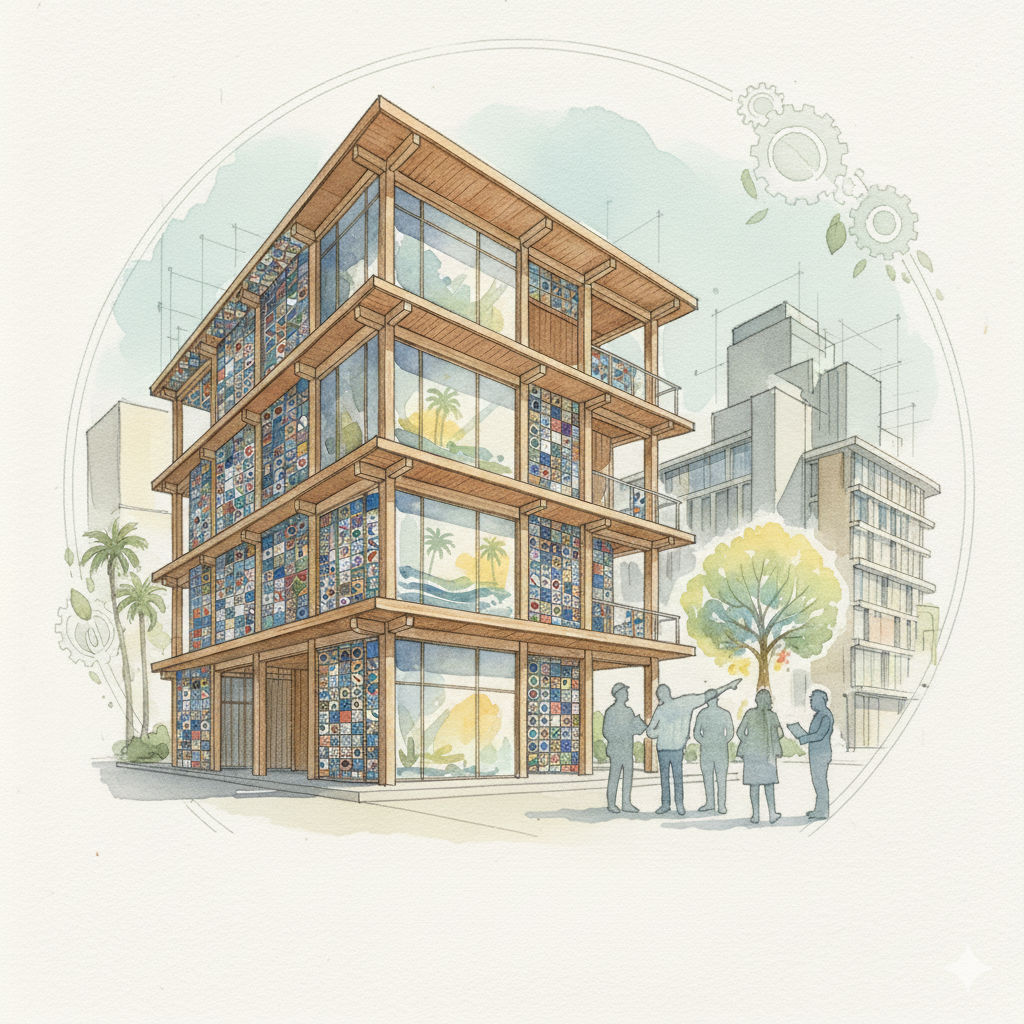
Call for Entries: Innovate with the Santa Monica Mass Timber Accelerator
AIA|LA is delighted to officially partner with the City of Santa Monica on an exciting new initiative: The Santa Monica Mass Timber Accelerator.
As architects and designers, we constantly seek methods that marry aesthetic beauty with environmental responsibility. Santa Monica has long held a reputation as a regional leader in sustainability and innovation. Now, through the Mass Timber Accelerator, we have a unique opportunity to advance the City’s built environment by exploring the potential of high-strength, prefabricated wood products.
Why Participate? Southern California is poised to become a significant market for mass timber, yet widespread adoption requires pioneers willing to demonstrate its feasibility. This program creates a structured pathway for design teams to lead that charge. Mass timber offers tangible benefits to the building sector, including:
Program Details & Support Part of the broader Accelerator Cities Program—co-funded by the Softwood Lumber Board and the USDA Forest Service—this initiative is designed to de-risk the adoption of new systems.
The program will competitively select up to five private development projects to receive funding and technical assistance. Selected teams will not be working alone; participants will receive expert guidance from WoodWorks regarding structural design, fire resistance, code compliance, and detailing. This is a rare opportunity to receive financial backing and high-level technical consulting to bring a mass timber project to life.
How to Apply: We invite all eligible design and development teams to apply. Whether you are looking to assess workforce capacity, explore Cross-Laminated Timber (CLT) feasibility, or simply create the next landmark sustainable project in Santa Monica, we want to see your vision.
Key Deadline: Applications are due to the Office of Sustainability & the Environment by February 27th, 2026, at 11:59 PM.
Selected teams will be notified by mid-March 2026. Join us in shaping a more sustainable, efficient, and beautiful future for Santa Monica.
Download the Santa Monica Mass Timber Accelerator Application Guide Here
FOR MORE INFORMATION:
Will Wright, Hon. AIA|LA
Director, Government & Public Affairs
t: 213.639.0764
e: will@aialosangeles.org
www.aialosangeles.org
*Disclaimer: The advice and perspectives shared here belong to the author and should not be considered official recommendations from AIA Los Angeles.


