AIA|LA ADVOCACY REPORT
February 17, 2026


February 12, 2026
AIA strongly opposes the Environmental Protection Agency’s decision to rescind the 2009 Endangerment Finding and repeal associated greenhouse gas vehicle standards, a move that disregards science and undermines public safety.
The American Institute of Architects (AIA) strongly opposes the Environmental Protection Agency’s decision to rescind the 2009 Endangerment Finding and repeal associated greenhouse gas vehicle standards, a move that disregards science and undermines public safety. While the administration frames this as a “deregulatory victory,” it in fact threatens the economic stability and safety of the built environment.
For fifteen years, the architecture, engineering, and construction (AEC) sector has operated with a clear, science-based mandate to protect public health, safety, and welfare by investing in high-performance buildings, advanced materials innovation, and emissions-reducing technologies. This is because architects understand the role the built environment plays in air quality, carbon emissions, and ecological health.
Buildings alone are responsible for nearly 42% of annual global carbon dioxide emissions, but architects cannot tackle this challenge alone. The performance of a building is inextricably linked to the transportation systems and energy grids that serve it. By dismantling these standards, the EPA is injecting volatility into the $1.6 trillion construction industry and opening the door to further deregulation impacting the built environment. This policy reversal will continue to weaken the United States’ position as a global climate leader, undermine trust in the federal government as a reliable partner, and jeopardize decades of progress in reducing carbon emissions.
Architects are committed to practical, science-driven solutions that strengthen public safety, economic resilience, and environmental performance. AIA calls on federal leaders to uphold policies grounded in credible science and long-term risk management. Architects will continue to lead through design, but we urge federal partners to join us in recognizing the critical interdependence of transportation, energy, and the places Americans live and work.
Illya Azaroff, FAIA
2026 AIA President

CALL TO ACTION: Please have your firm write to the Department of Education opposing their rule change.
CLICK HERE to read the letter that AIA Los Angeles sent to the Department of Education.
Please note that we have officially submitted AIA|LA’s comment letter to the Department of Education opposing the proposed rule to reclassify Master of Architecture degrees. You can view our full submission here.
To read more about AIA National’s advocacy and Call to Action = AIA Opposes Proposed Department of Education Rule That Would Limit Federal Loans for Architecture Students
In our letter, we pivoted from a general plea for “fairness” to a hard-hitting economic argument. We framed the Architect not just as a designer, but as an “Economic Multiplier”—emphasizing that restricting the educational pipeline chokes off the construction sector, delays housing production, and hurts the national GDP.
Action Item: We Need Your Firm’s Voice: While the Chapter’s voice is powerful, the Department needs to see that the business community is paying attention. Volume matters.
I strongly encourage you to submit a comment on behalf of your firm before the March 2, 2026 deadline. It takes less than 5 minutes.
Simple Instructions to Submit:
Go to Regulations.gov: [Link to Docket ED-2025-OPE-0944-0001]
Click: The blue “Comment” button.
Upload or Paste: You can copy/paste the text below or upload a PDF on your firm’s letterhead.
Submit.
Draft Template for Your Firm (Feel free to modify):
Re: Docket ID ED-2025-OPE-0944-0001 – Protecting the Construction Workforce
To the Department of Education:
On behalf of [FIRM NAME], a [SMALL/MEDIUM/LARGE] architecture firm based in Los Angeles, I write to oppose the reclassification of Master of Architecture (M.Arch) degrees under the proposed rule.
Our firm relies on a steady pipeline of highly trained, licensed professionals to execute complex construction projects that contribute to the national economy. Downgrading the status of architectural education and capping federal loans at $20,500 creates a bottleneck in our workforce supply chain.
Architecture is a high-liability profession centered on public safety. To maintain our nation’s global competitiveness and solve our housing crisis, we need a workforce equipped with accredited, professional degrees. We urge you to amend the regulations to explicitly include NAAB-accredited degrees in the definition of a “Professional Degree.”
Sincerely,
[NAME] [TITLE]
Thank you for helping us amplify this message.
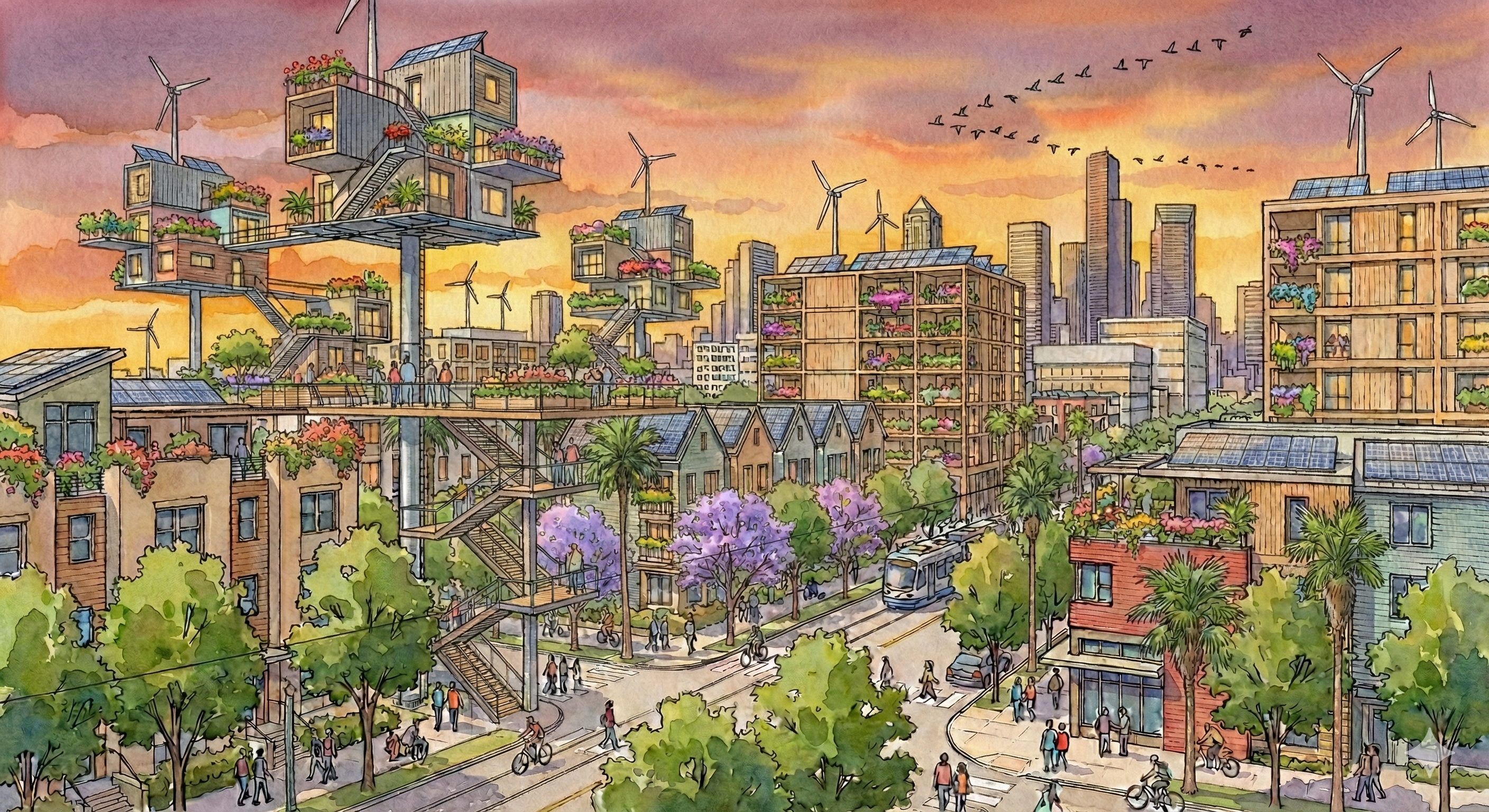
The California Dream is Broken. Here is How We Redesign It.
By Will Wright, Hon. AIA|LA
California faces an existential housing deficit of 4.5 million units. This is not a crisis of intent, but a crisis of obsolescence. We are attempting to solve a 21st-century emergency with a 19th-century process. The result is a math problem that doesn’t add up: we produce fewer than 80,000 homes annually against a need of 180,000. Our delivery mechanism is so fractured that development costs are 2.3 times higher than in competitor states, driven by 49-month timelines and an average of $29,000 in impact fees per unit.
The consequence of this failure is a deepening chasm of inequality, where over three million renters are cost-burdened and nearly a quarter of the nation’s unhoused population lives on our streets.
We do not need to just build more housing; we need to redesign the machine that delivers it.
California must pivot from a regulatory culture of restriction to a production culture of innovation. We must stop treating housing as a series of isolated, artisanal projects and start treating it as what it is: high-performance, scalable infrastructure necessary for our state’s economic and social survival.
To achieve this, we need a radical shift in how we govern, design, and build. We must move from a fragmented, low-productivity construction model to a high-performance, component-based assembly system.
Here is the blueprint.
1. The Systemic Shift: Housing as a Product: We must reverse fifty years of construction stagnation. The current “stick-built” ecosystem is too slow, too expensive, and too unpredictable. The future is not just about “shipping air” in rigid volumetric modules; it’s about a “Kit of Parts” strategy. We need mass-customizable, factory-built components—smart walls, floor cassettes, and integrated utility cores—that are precision-manufactured off-site and assembled on-site. This approach delivers speed, resilience, and the scale necessary to meet our deficit.
2. Modernizing Governance: The Digital State: Our regulatory framework is the single biggest bottleneck. We need to modernize how we govern construction.
3. Aggregating Demand: Supply Chain as Infrastructure: Housing developers often fail due to the cyclical nature of project-based financing, creating a “Volume Trap” for manufacturers. The state must intervene to de-risk the industrial transition. We can deploy “Demand Aggregation,” using state assets—universities, surplus land, and public housing authorities—to guarantee a baseline pipeline of orders. This provides the certainty component manufacturers need to invest in factories and innovation.
4. The Logistics Engine: Deploying AI: Managing millions of components across irregular urban sites is a logistical nightmare. This is where artificial intelligence becomes an essential tool. We must deploy AI-driven platforms to optimize site fit, calculate embodied carbon, and ensure constructability in real-time. AI can move permitting from months to minutes, simulating the building to optimize resources before a single shovel hits the ground.
5. Socio-Economic Resilience: The “New Trades”: This transition must be equitable for our labor force. We are moving from brute force to precision logistics. We must launch a “Digital Construction Corps” to upskill our trades from manual framing to digital assembly. This is not about replacement; it is about creating higher-wage, safer roles in component integration and advanced manufacturing.
The “California Standard”: Complexity is not the enemy; disorganization is. Our current system, with its redundancy of reviews and sequential funding sources, is designed to fail. We need digital simultaneity. We need a “California Standard”—a universal industrial component interface that allows for a “Lego set” of building parts to work together seamlessly across the state.
We must pilot “BIM-to-Permit” pathways and mandate AI-based “Green Lane” processing for projects that utilize pre-approved, low-carbon components. We must use our “stranded assets,” like vacant offices, as live training labs for retrofit strategies.
The time for incrementalism has passed. The crisis is here. We have the technology, the capital, and the moral imperative. What is required now is the political will to break the old machine and build a new one. Let’s get to work.
12 Recommendations for Advancing an Effective Implementation Strategy
These recommendations are synthesized from the Governor’s Briefing and the Tactical Addendum, providing a roadmap for state and local action.
STATE-LEVEL ACTIONS (Strategic Framework)
LOCAL-LEVEL ACTIONS (Tactical Implementation – City of LA Focus)
Online Resources to Support Proactive Next Steps
Industrialized Construction & “Kit of Parts” Strategy
Digital Governance & AI in Permitting
Policy, Code Reform, and Housing Data
Workforce Development & “New Trades”
Add more resources here…..
UPDATE FROM AIA CALIFORNIA
We’re proud to share that, as a result of AIA California’s ongoing advocacy, we’ve been invited to be at the table for the newly formed Assembly Select Committee on Housing Construction Innovation.
We’re grateful for the important work this Select Committee is doing—and especially thankful for the continued leadership of Assemblymember Buffy Wicks, AIA California’s 2025 Legislator of the Year, in taking on some of the toughest housing challenges facing our state.
AIA California was pleased to convene a group of architects actively working on innovative housing construction models to meet with staff from the Select Committee and the UC Berkeley Terner Center, sharing the architect’s perspective on housing construction innovation. The Committee, working in partnership with the Terner Center, is gathering expert input to inform a forthcoming report and policy recommendations to the Legislature.
Chaired by Assemblymember Wicks, the Select Committee is focused on identifying modern, cost-efficient, and climate-aligned construction approaches—from modular and prefabricated construction to new materials and technology-enabled design and review processes—that can help California close its persistent housing gap. We look forward to continuing to contribute our expertise as this work moves toward a white paper in early 2026 and a package of legislative proposals later that year.

Help Shape the Future of LA: Join the AIA|LA & LACP Design Review Sessions
Calling all architects and designers with a vision for a better Los Angeles!
The AIA|LA, in partnership with the Los Angeles City Planning (LACP)’s Urban Design Studio, invites you to participate in the Professional Volunteer Program (PVP). This collaborative initiative offers a unique opportunity to directly influence the design quality of upcoming projects across the city and play a vital role in shaping the urban fabric of Los Angeles.
Why Participate?
Impact Your City: Share your design expertise and insights on pending projects that will be reviewed by the Planning Commission. Your feedback can help shape the future of our city’s built environment.
Educate and Collaborate: Work alongside LACP planning staff to discuss urban design issues, complex urban typologies, and project-specific design challenges.
Expand Your Network: Connect with fellow architects, designers, and city planning professionals who share your passion for urban design.
How to Get Involved:
The PVP will be hosting 31 virtual design review sessions throughout the year. These sessions are a great opportunity to get involved and make a real difference. We encourage you to register for three or four sessions that fit your schedule.
View the Full Schedule and Register Today:
Prepare for a Meaningful Impact:
To maximize your contribution, we recommend reviewing the Urban Design Studio’s resources and the City’s design guidelines:
Confidentiality:
PVP discussions provide an open forum for design feedback, and all participants are expected to maintain confidentiality and anonymity.
For More Information:
Please contact Will Wright, Hon. AIA|LA, at (213) 639-0764 or will[@]aialosangeles.org with any questions.
Together, we can create a more vibrant, equitable, and resilient Los Angeles through the power of design. Join us in shaping the city’s future!
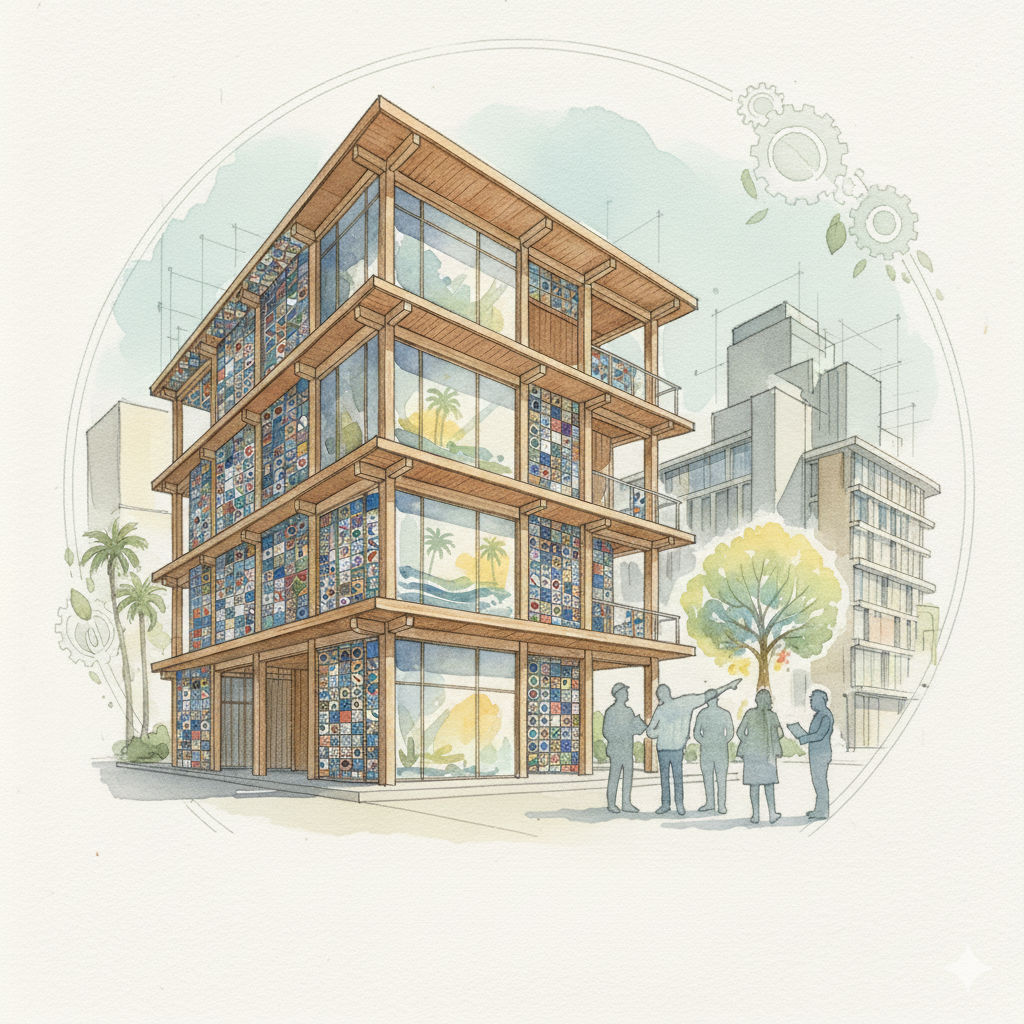
Call for Entries: Innovate with the Santa Monica Mass Timber Accelerator
AIA|LA is delighted to officially partner with the City of Santa Monica on an exciting new initiative: The Santa Monica Mass Timber Accelerator.
As architects and designers, we constantly seek methods that marry aesthetic beauty with environmental responsibility. Santa Monica has long held a reputation as a regional leader in sustainability and innovation. Now, through the Mass Timber Accelerator, we have a unique opportunity to advance the City’s built environment by exploring the potential of high-strength, prefabricated wood products.
Why Participate? Southern California is poised to become a significant market for mass timber, yet widespread adoption requires pioneers willing to demonstrate its feasibility. This program creates a structured pathway for design teams to lead that charge. Mass timber offers tangible benefits to the building sector, including:
Program Details & Support Part of the broader Accelerator Cities Program—co-funded by the Softwood Lumber Board and the USDA Forest Service—this initiative is designed to de-risk the adoption of new systems.
The program will competitively select up to five private development projects to receive funding and technical assistance. Selected teams will not be working alone; participants will receive expert guidance from WoodWorks regarding structural design, fire resistance, code compliance, and detailing. This is a rare opportunity to receive financial backing and high-level technical consulting to bring a mass timber project to life.
How to Apply: We invite all eligible design and development teams to apply. Whether you are looking to assess workforce capacity, explore Cross-Laminated Timber (CLT) feasibility, or simply create the next landmark sustainable project in Santa Monica, we want to see your vision.
Key Deadline: Applications are due to the Office of Sustainability & the Environment by February 27th, 2026, at 11:59 PM.
Selected teams will be notified by mid-March 2026. Join us in shaping a more sustainable, efficient, and beautiful future for Santa Monica.
Download the Santa Monica Mass Timber Accelerator Application Guide Here
FOR MORE INFORMATION:
Will Wright, Hon. AIA|LA
Director, Government & Public Affairs
t: 213.639.0764
e: will@aialosangeles.org
www.aialosangeles.org
*Disclaimer: The advice and perspectives shared here belong to the author and should not be considered official recommendations from AIA Los Angeles.


