

- This event has passed.
SPRING ARCH TOUR FEST: 26 Point 2 Apartments
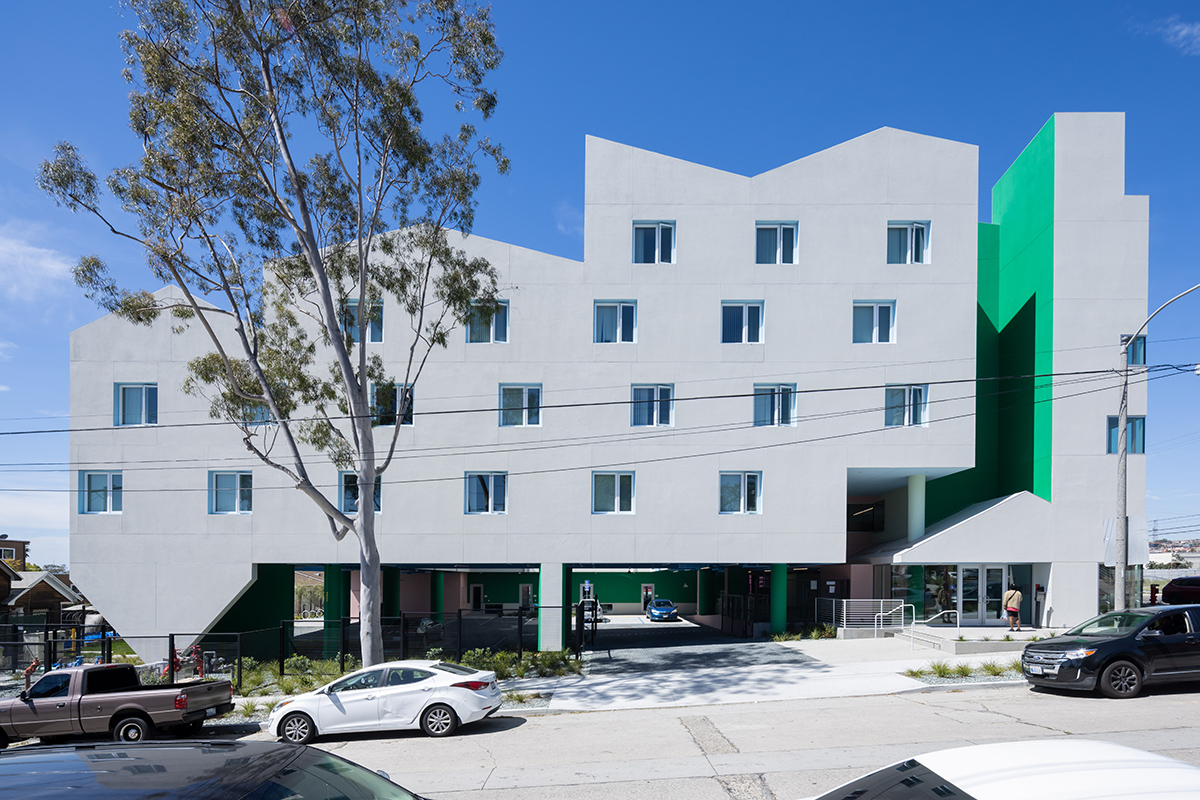
Photo Credit: Iwan Baan
Spring ARCH TOUR FEST: 26 Point 2 Apartments
26 Point 2 Apartments, designed for Excelerate Housing Group, is a 5-story permanent supportive housing apartment building in Long Beach, California that bridges between a busy commercial zone and a residential neighborhood. The 48,000 sf, 77-unit project uses color as a strategic spatial device, to enhance the reading of discrete yet interconnected zones.
The project straddles Pacific Coast Highway to the north – a busy commercial strip – and a residential neighborhood with modest single-family homes to the south. The sculptural massing that connects to the differing contexts on either side bridges this shift in scale and character. Along the eastern residential street, the facade is articulated into a series of pitched motifs that relate to the gabled roofs of nearby houses.
The residential volume hovers over the site on a series of columns while the single-story, pitched-roof amenity volume faces the street at a pedestrian friendly scale. Amenities, staff, and supportive spaces are located along the west and north edges of the site bordering the outdoor covered parking area. A fully glazed street level enclosure allows the ground plane to extend uninterrupted across the interior, preserving a visual connection to the city beyond while maintaining a protected experience for the occupants.
The project earned LEED Gold certification by employing a range of sustainability strategies. High efficiency mini-split systems, solar hot water, high albedo roofing, open air circulation, operable windows, and occupant lighting controls help to reduce overall energy use. On site water treatment tanks, extensive permeable paving, and native drought-tolerant landscaping conserve and protect water resources.
The project also offers socially sustainable high-density housing, by providing supportive living and wrap-around services for the formerly unhoused, with on-site counseling, staff offices, and social amenity spaces to foster a sense of community.
Tour Led by:

Yun Yun, Associate, RA, WELL AP
Yun Yun joined MMA in 2016 after receiving a Master of Architecture degree from the University of Michigan’s Taubman College of Architecture and Urban Planning. Prior to her graduate studies, she received a Master of Science in Architectural Engineering from Purdue University and a Bachelor of Science in Civil Engineering from Tianjin University. Her team project (a)typical office was selected as the winning Mies Crown Hall America’s Prize (MCHAP) Student Project in 2015-16. While at the University of Michigan, Yun was also awarded the Burton L. Kampner Memorial Award for Best Thesis Project. Since joining the practice, she has been involved in significant cultural, institutional, housing, and resort projects. Yun is a licensed architect in California and a WELL Accredited Professional.
Architect: Michael Maltzan Architecture
Building Credits:
Architect: Michael Maltzan Architecture
Principal, Michael Maltzan
Principal in Charge, Tim Williams
Project Manager, Ben Ruswick
Project Designer, Khoa Vu,
Job Captain, Sharon Xu
Civil Engineer: KPFF Engineering
Structural Engineer: Labib Funk and Associates (LFA)
MP Engineer: Donald F. Dickerson Associates
Electrical Engineer: Salas O’Brien
Civil Engineer: KPFF
Landscape Architect:
Tina Chee Landscape Studio
Specifications: AWC West
Waterproofing: D7 Consulting
Code/Fire/Life Safety: Simpson Gumpertz & Heger
LEED Sustainability: Partner Energy
Low Voltage: OMB Electrical Engineers
Learning Units
1. Examine strategies for integrating supportive housing into existing urban fabric while addressing seismic safety constraints and maintaining accessibility to critical infrastructure (oil wells)
2. Analyze how architectural design elements like natural ventilation, daylighting, and strategic space planning can promote community health and social well-being in supportive housing
3. Evaluate sustainable design solutions that achieve LEED Gold certification through water conservation, energy efficiency, and climate-responsive features in a mild coastal environment
4. Explore how the thoughtful placement of communal spaces and essential services can enhance resident welfare while meeting safety and accessibility requirements in supportive housing
5. Investigate how building massing, color, and material choices can create successful transitions between different urban contexts while maintaining occupant safety and comfort
These objectives emphasize HSW elements including:
Safety (seismic design, infrastructure access)
Health (ventilation, daylighting)
Welfare (supportive services, community spaces)
Sustainability (LEED features, energy efficiency)
Accessibility (universal design principles)
Parking Information:
Street parking only.


