

- This event has passed.
ARCH TOUR FEST: Highway House
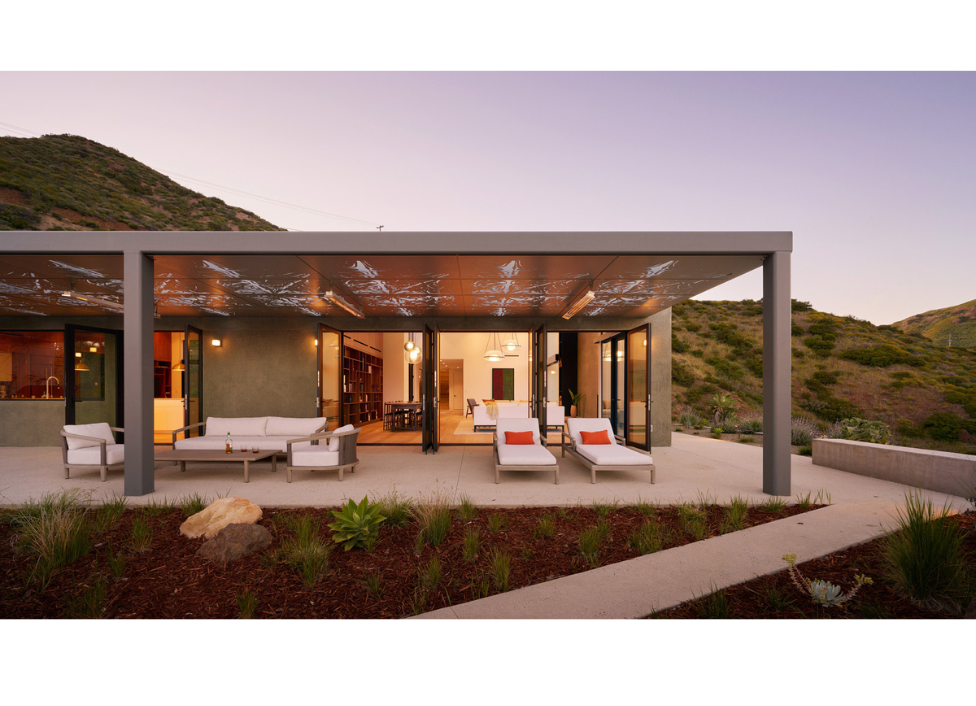
Photo Credit: Eric Staudenmaier
ARCH TOUR FEST: Highway House
Highway House is a Woolsey Fire Rebuild project. The steep Santa Monica Mountains serve as both the formal inspiration and the immediate context for this new home. In the design, sharply angled shed roofs follow the site’s topography while contrasting with the natural hillsides of this Malibu, CA residence.
After the original structures were lost, the new formal massing reused the old concrete grade beams and caissons, the only salvageable parts. The resulting structures, though fully transformed, avoid wasteful and environmentally intensive concrete work, reducing costs and lowering the carbon footprint of this fire rebuild.
In addition to an architectural tour of the home, we will highlight fire-resilient design strategies. The rebuild exceeds the Very High Fire Hazard Severity Zone (VHFHSZ) requirements. To address the recurring threats of wildfires and mudslides, we implemented a combination of strategies. A specialized exterior sprinkler system is distributed across the roofs and adjacent hillsides to wet vegetation in the event of a fire, preventing flames from approaching the house. Preserving vegetation also helps stabilize the hillside during the rainy season, when mudslides are most common after fire damage.
Additional fire prevention measures include non-combustible exterior finishes; two 5,000-gallon backup tanks for the sprinklers; an on-site hydrant that draws from the pool in case county water is lost; and a solar-charged battery backup system for power during outages.
Passive design strategies further connect the occupants to their environment by maximizing daylighting and natural ventilation. Drought-tolerant, native species planted throughout the property strengthen the local ecosystem while deepening the human connection to the land.
Shading is provided by trellises with custom laser-cut aluminum screens featuring a unifying motif. These create shifting shade patterns throughout the day, which are backlit at night to remain visible.
Tour Led By:
Lisa Little, AIA – Principal and Founder at Vertebrae
Lisa Little holds a Master of Architecture from the Southern California Institute of Architecture (SCI-Arc) and a Bachelor of Science in electrical engineering from Georgia Institute of Technology. Little integrates her engineering and architecture backgrounds to create an atypical approach to research and design. Her work strives to engage ambient phenomena through built form while questioning the role of technology in contemporary architectural practice. She is the principal and founder of the award-winning firm Vertebrae. Recent projects include private residences, commercial interiors, and large-scale artworks. Little currently teaches graduate and undergraduate level design studios at the University of Southern California and is a licensed architect in the state of California.
Architect: Vertebrae
Building Credits:
GC: RJC Builders, Inc
Landscape Architect: Terremoto
SE: CW Howe
AIA CES: 1.0 LU|HSW Approved
Learning Objectives
Participants will be able to explain how reusing the old concrete grade beams and caissons, the only salvageable parts of the original house, avoids wasteful and environmentally intensive concrete work, reducing costs and lowering the carbon footprint of this fire rebuild.
Participants will review how the specialized exterior sprinkler system is distributed across the roofs and adjacent hillsides to wet vegetation in the event of a fire, preventing flames from approaching the house. Preserving vegetation also helps stabilize the hillside during the rainy season, when mudslides are most common after fire damage.
Participants will become familiar with additional fire prevention measures including non-combustible exterior finishes; two 5,000-gallon backup tanks for the sprinklers; an on-site hydrant that draws from the pool in case county water is lost; and a solar-charged battery backup system for power during outages.
Participants will discuss the ways that passive design strategies further connect the occupants to their environment by maximizing daylighting and natural ventilation. Drought-tolerant, native species planted throughout the property strengthen the local ecosystem while deepening the human connection to the land.
Participants will observe how shading is provided by trellises with custom laser-cut aluminum screens featuring a unifying motif. These create shifting shade patterns throughout the day, which are backlit at night to remain visible.
Parking:
No fees, parking is limited, carpool encouraged.


