

- This event has passed.
Alliance Judy Ivie Burton Technology Academy High School
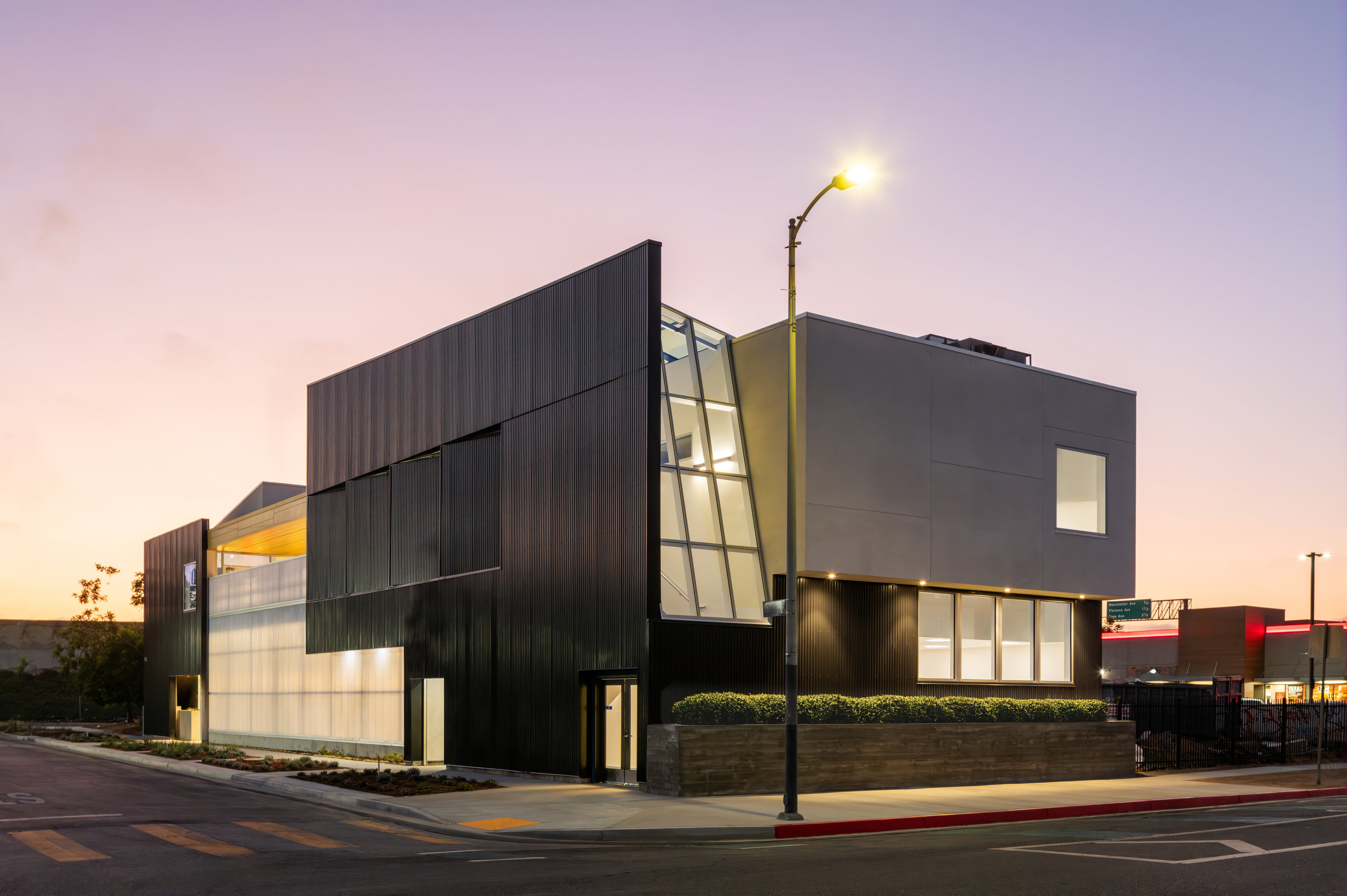
Photographer Credit: Here and Now Agency
Architecture Firm Credit: LOC Architects
See Full Credit List Below
TOUR DETAILS
The Burton Tech High School Expansion demonstrates how thoughtful design can directly advance equity, health, and environmental performance within a constrained urban campus. Located in South Los Angeles, this new two-story academic building increases instructional capacity while redefining what high-quality public school facilities can be in underserved communities.
Participants will explore how daylighting served as a primary design driver, with classrooms, circulation spaces, and stairways oriented to maximize natural light while reducing energy consumption through daylight sensors and high-performance glazing. The tour will examine how passive design strategies, compact massing, and vertical organization respond to a tight infill site governed by FAR limitations and budget constraints.
The project’s indoor–outdoor learning environments—including a flexible courtyard and roof deck classroom—demonstrate how educational spaces can support student well-being, engagement, and social interaction while maintaining safety and controlled access appropriate for a school setting. Polycarbonate wall systems balance privacy with transparency, reinforcing both security and civic presence along the public street.
This tour offers insight into sustainable school design, daylighting in dense urban contexts, equitable educational environments, and the integration of health, safety, and welfare principles into contemporary K–12 architecture.
TOUR HOSTS
Ali Jeevanjee, AIA, Principal LOC Architects
Ali Jeevanjee is co-founder and principal of LOC Architects, where he leads projects that integrate architecture, urban context, and human experience into thoughtful, enduring design. At LOC, Ali provides design direction across civic, cultural, educational, and residential projects, guiding each from concept through construction. His approach is rooted in crafting spaces that are human-scaled and encourage deeper connections to their surrounding environment. Prior to founding LOC, Ali gained experience with Frank O. Gehry, contributing to The Art of the Motorcycle exhibit at the Guggenheim and the Vincor Winery in Canada. He also gained extensive experience at Ellerbe Becket on large-scale sports and entertainment venues, and collaborated with Kathryn Gustafson on the South Coast Plaza bridge and terrace. Ali holds a Bachelor of Architecture from Cornell University and a Master of Architecture from the Graduate School of Design at Harvard University and has taught architecture at Cal Poly Pomona and USC.
Poonam Sharma, Principal LOC Architects
Poonam Sharma is a founding partner of LOC Architects, where she leads projects at the intersection of architecture, education, and cultural practice..At LOC, Poonam has led the design of learning environments, community spaces, and performance venues, with a focus on public benefit, sustainability, and inclusive design. Her recent work includes educational, performance spaces, and community centers.
Prior to founding LOC with Ali Jeevanjee, Poonam worked with StudioWorks on a new urban campus for the Los Angeles Unified School District, and with the Jerde Partnership on large-scale mixed-use developments. She also served as an Exhibition Designer at the Museum of Fine Arts, Boston, where she contributed to major exhibitions and gallery redesigns.She holds a Master of Architecture from the Southern California Institute of Architecture (SCI-Arc) and a B.A. in Literature from Scripps College. Her background in the humanities and design underpins a thoughtful, research-driven approach to architecture that values both narrative and spatial clarity
TOUR MEETING SPOT
305 W. 101st Street, Los Angeles CA 90003
AIA CES: 1.0 LU|HSW Approved
LEARNING OBJECTIVES
1. Analyze daylighting strategies—including courtyard orientation, clerestory glazing, and polycarbonate wall systems—that improve visual comfort, reduce energy use, and enhance student well-being in dense urban school sites.
2. Evaluate passive design measures such as solar control glazing, daylight sensors, and massing strategies that support energy efficiency and long-term operational performance.
3. Assess how urban infill constraints—including limited site area, adjacency, and FAR restrictions—inform safe circulation planning, controlled access, and secure yet transparent school design.
4. Examine the integration of indoor–outdoor learning environments in supporting social-emotional health, engagement, and flexible instructional modalities.
5. Identify strategies for achieving equitable, high-quality educational environments within tight budget constraints while maintaining code compliance, accessibility, and occupant safety.
6. Interpret how compact circulation planning and vertical organization can maximize instructional capacity while preserving life-safety requirements and environmental quality.
PARKING
Street Parking
FULL CREDIT LIST (Architects, Builders, Engineers, etc.)
LOC Architects, Miyamoto International (Structural)
DelAmo (Contractor)


