AIA|LA ADVOCACY REPORT
May 19, 2026

UPDATE ON SB 79 IMPLEMENTATION IN THE CITY OF LA
Last week, in advance of the May 14th City Planning Commission, we submitted the following letter to encourage the Commission to treat the Low-Rise Ordinance and SB 79 Phased Implementation Ordinance not as compliance exercises, but as a genuine opportunity to lead on transit-oriented housing that is equitable, financially viable, and well-designed.
CLICK HERE to read the letter.
AIA LA Letter Low-Rise Ordinance and SB 79 Phased Implementation Ordinance
AIA CALIFORNIA ADVOCACY UPDATE
Advocacy in Action (Part 1): Housing, Feasibility, and Unlocking Architectural Opportunity
By Scott Terrell – Director of Government Relations, AIA California
Each year, AIA California engages deeply in the legislative process to ensure architects have a voice in shaping policies that affect the built environment. In 2026, AIA California took positions on 56 bills spanning housing, climate, and professional practice.
This first installment highlights key legislation focused on housing production, project feasibility, and streamlining—areas where architects are on the front lines of delivering solutions.
You can find the full list of bills AIA CA took positions on here.
Unlocking Housing Through Streamlining and Design Flexibility
AB 1751 (Quirk-Silva) — Missing Middle Townhomes (Support)
AB 1751 allows qualifying townhome projects to be approved ministerially (by right), eliminating discretionary review and significantly reducing delays.
For architects, this means:
Townhomes are one of the most attainable forms of homeownership, and this bill strengthens the pipeline of projects where architects can play a leading role.
AB 1070 (Ward) — Missing Middle Code Reform (Support)
AB 1070 explores allowing 3–10 unit housing developments to be built under the California Residential Code (CRC) rather than the more complex California Building Code (CBC).
The bill directs the Department of Housing and Community Development to convene a working group to study and recommend potential code changes that would better align building standards with the scale and nature of small multifamily housing. It also requires ongoing analysis of how building standards contribute to rising construction costs.
For architects, this bill could have significant implications for the delivery of “missing middle” housing by:
By exploring whether smaller multifamily projects can utilize a more appropriately scaled code framework, AB 1070 aims to reduce unnecessary complexity while maintaining health, safety, and building performance standards.
Making ADUs Easier to Build and Deliver
SB 1117 (Cervantes) — ADU Fee Reform (Support)
SB 1117 reduces impact fees for ADUs by limiting them to only the portion of a unit exceeding 750 square feet.
For architects, this:
SB 1196 (McNerney) — ADU Utility Streamlining (Support)
SB 1196 addresses one of the most persistent barriers to ADU production in California: lengthy utility connection delays.
While California has significantly streamlined ADU permitting in recent years, many projects still face months-long delays waiting for electrical service connections after permits have already been approved.
SB 1196 would require the Public Utilities Commission to establish clear timelines and accountability standards for utility providers processing ADU service requests. The bill also allows utility applications to be submitted concurrently with building permit applications and prevents utilities from canceling applications without the applicant’s consent.
For architects, these reforms improve:
As California continues relying on ADUs as a key housing strategy, SB 1196 helps ensure utility processes keep pace with broader housing streamlining efforts.
Making Projects Pencil: Fees and Incentives
SB 1036 (Grayson) — Mitigation Fee Reform (Support)
SB 1036 ensures development fees reflect only a project’s incremental impact, requiring credit for prior uses on a site.
For architects working on infill and adaptive reuse:
With development fees often accounting for 6–13% of total costs, this reform has a meaningful impact.
AB 1265 (Haney) — Historic Tax Credit Expansion & Extension (Co-Sponsor)
AIA California is proud to co-sponsor AB 1265 alongside the California Preservation Foundation.
The bill strengthens and renews California’s Historic Tax Credit program, which is currently set to expire next year. AB 1265:
For architects, this is a high-impact opportunity area:
Historic rehabilitation remains one of California’s most effective tools for simultaneously advancing housing production, economic revitalization, sustainability, and community preservation. Many historic buildings throughout the state remain vacant or underutilized because rehabilitation costs can be prohibitively high. By extending and modernizing the Historic Tax Credit, AB 1265 helps unlock these projects and ensures architects can continue leading complex adaptive reuse efforts that revitalize communities while preserving cultural and architectural heritage.
Why This Matters
These bills share a common theme: making it easier to design and deliver housing in California.
For architects, that translates into:
Next: Be on the lookout for Part 2, where we will explore how AIA California is helping advance legislation to rebalance risk, modernize contracts, and support long-term project delivery.
YOUR SEAT AT THE TABLE THAT SHAPES LA.
Five high-access events. Six decision-makers. One moment for architects to be in the room where it happens — as Los Angeles rebuilds, reshapes, and reimagines itself.
WHY NOW?
LA is navigating wildfire recovery, a mayoral race, the FIFA World Cup, the 2028 Olympics, a housing crisis, and a clean-energy transition — all at once. The decisions being made today will define this city for a generation.
Architects belong in every one of these conversations.
A MESSAGE TO THE AEC COMMUNITY
The 2026 AIA|LA City Leaders Breakfast Series and annual Design for Dignity Conference represent a rare opportunity: direct, roundtable access to the city officials, elected leaders, and infrastructure stewards making decisions that directly impact your work, your clients, and your communities.
These are not passive lecture events. They are intimate conversations — held over breakfast, held in roundtable format — designed specifically for architects and designers to engage, question, and influence. Seats are limited, and they fill fast.
================================================================================
UPCOMING EVENTS | May – June 2026
================================================================================
CITY LEADERS BREAKFAST SERIES
——————————————————————————–
SPEAKER: FIRE CHIEF JAIME E. MOORE
20th Fire Chief, Los Angeles Fire Department
30+ Year LAFD Veteran | UCLA Graduate
DATE: Wednesday, May 28, 2026
TIME: 8:00 am
LOCATION: TBD
COST: $10 AIA Member | $15 Non-Member
RSVP HERE
Chief Moore was unanimously confirmed as LAFD’s 20th Fire Chief in November 2025, taking command in the aftermath of the devastating 2025 Palisades Fire. A lifelong Angeleno raised in Venice/Mar Vista, Chief Moore led the LAFD’s data-driven FireStatLA performance system and has commanded operations across wildland fires, including the Hurst, Kenneth, Archer, and Getty fires. He has been explicit about his mission: improving preparedness for major disasters, rebuilding community trust, and readying LA for the FIFA World Cup 2026 and the 2028 Olympic and Paralympic Games.
WHY IT MATTERS FOR ARCHITECTS:
Post-wildfire reconstruction, fire-resilient design codes, defensible space standards, and emergency egress are all areas where Chief Moore’s priorities will shape what gets built — and how. This is a rare chance to hear directly from the person defining those standards.
The 11th ANNUAL DESIGN FOR DIGNITY CONFERENCE
——————————————————————————–
DATES: Friday, May 29, 2026 AND Friday, June 5, 2026
TIME: 8:30 am – 1:30 pm (both days)
LOCATION: AIA|LA Center for Communities
4450 West Adams Blvd., Los Angeles, CA 90016
COST: $175 AIA Member (2-day pass) | $235 Non-Member (2-day pass)
$100 AIA Member (single day) | $160 Non-Member (single day)
$80 Student (2-day pass) | $50 Student (single day)
REGISTER HERE
From Crisis to Construction — Building a “City of Yes”
Now in its 11th year, Design for Dignity is AIA|LA’s premier exploration of how architects and designers can address housing inequity, displacement, and inclusive community building in Los Angeles. The 2026 edition continues a tradition of bringing together practitioners, policymakers, nonprofit leaders, and community advocates in substantive, action-oriented sessions.
This year the conference spans two consecutive Friday mornings, expanding access for more members of the AEC community to participate.
AIA CES learning units are available. Come both days — the conversation builds.
The only major architecture conference in LA exclusively dedicated to housing equity and design justice.
CITY LEADERS BREAKFAST SERIES
——————————————————————————–
SPEAKER: ALLAN T. MARKS – President, LADWP Board of Commissioners
Lawyer & Strategic Advisor | International Energy & Infrastructure Finance
DATE: Wednesday, June 24, 2026
TIME: 8:00 am
LOCATION: AUX Architecture
COST: $10 AIA Member | $15 Non-Member
RSVP HERE
Unanimously elected LADWP Board President in January 2026, Allan Marks brings decades of experience in international energy finance, infrastructure, and sustainability — having overseen transactions valued at over $100 billion globally. He oversees the nation’s largest municipal utility, serving more than 4 million Angelenos. His focus is clean-energy transition, climate resilience, and equitable infrastructure investment — topics with enormous implications for how LA’s built environment is designed and powered.
WHY IT MATTERS FOR ARCHITECTS:
Electrification mandates, all-electric building codes, grid reliability, and energy resilience in post-wildfire rebuilding are all under LADWP’s purview. Designers shaping the next generation of LA buildings need to understand what is coming from the utility side.
================================================================================
FOUR REASONS THE AEC COMMUNITY SHOWS UP
================================================================================
01 / ROUNDTABLE FORMAT
These are not panels or lectures. You sit across from city leaders and ask the questions that matter to your practice, your projects, and your community.
02 / RARE ACCESS
A fire chief, a mayoral candidate, a state assemblymember, an energy board president — these are the decision-makers whose policies shape every permit, code, and project in Los Angeles.
03 / AFFORDABLE ENTRY
Breakfasts are just $10 for AIA members and students. The access-to-cost ratio here is extraordinary.
04 / ADVOCACY IN ACTION
Your presence sends a message: architects are engaged, invested, and indispensable to Los Angeles’s future. Show up and make that case in the room.
Eight Policy Recommendations to Improve ED #19 (Invite us to the table next time. We’re nice!)
1: Establish a Single Point of Executive Authority
Issue: ED #19 directs coordination across twelve departments but designates no individual or office with binding authority to compel compliance, resolve conflicts, or escalate missed deadlines. Without enforcement authority, interdepartmental coordination frameworks have historically collapsed when departmental priorities diverge. AIA|LA’s September 2024 LADBS Roadmap and the “Seventeen Reforms” white paper both identify this as the single most consequential structural gap in Los Angeles’ development services system.
Solution: Add a section establishing a Deputy Mayor for Development Services — or designating an existing senior mayoral office position — with explicit authority to: (a) convene binding joint review sessions among all clearance departments; (b) compel resolution of interdepartmental code conflicts within 10 business days; and (c) escalate missed ED #19 reporting deadlines to the Mayor’s Chief of Staff for immediate corrective action. Codify this position in the City Charter through the current Charter Reform proceeding (Council File 26-0489).
Benefit: Creates enforceable accountability for the coordination architecture that the rest of ED #19 depends on. Without it, the directive’s 30-, 45-, and 60-day reporting deadlines are aspirational rather than operational.
2: Require AIA|LA and Licensed Design Professionals in the AI RFP Process
Issue: Section 1(a) directs LADBS and ITA to initiate an AI pre-plan check procurement within 60 days, but the RFP process as written, does not require input from licensed architects or engineers — the practitioners who understand where plan check corrections actually originate, and what an AI tool would need to reduce them meaningfully. AI tools designed without practitioner involvement risk automating the wrong workflows or creating new correction categories that increase rather than reduce cycle times.
Solution: Amend Section 1(a)(ii) to add a requirement that the RFP process include a formal practitioner advisory panel composed of licensed architects and structural engineers, convened by LADBS before the RFP is issued, with findings incorporated into the RFP scope. AIA|LA formally offers to organize and participate in this panel. Additionally, require that any AI tool procured undergo a 90-day pilot with practitioner feedback before full deployment.
Benefit: Grounds the technology procurement in actual practitioner workflow realities, reducing the risk of procuring a tool that addresses symptoms rather than causes — and creates a formal channel for ongoing AIA|LA input into the city’s digital permitting infrastructure.
3: Guarantee Departmental Clearance Exemption for Self-Certification Projects
Issue: Section 2(e)’s Citywide Self-Certification Pilot for commercial tenant improvements is a reform AIA|LA has advocated for explicitly since the prior LADBS pilot failed. However, the directive’s current language does not guarantee that qualifying self-certification projects will receive exemption from the full slate of departmental clearances — only from LADBS plan check review. If qualifying projects still require individual clearances from LAFD, LADWP, BOE, LASAN, and other departments, the time savings will be negligible, repeating the failure mode of the prior pilot.
Solution: Amend Section 2(e) to add explicit language: “Qualifying projects under the Citywide Self-Certification Pilot shall be exempt from individual clearance requirements from all City departments except LAFD life-safety review, unless LADBS determines a specific clearance is required by state law or federal regulation.” Additionally, replace the ICC testing requirement for program eligibility with a professional licensure affidavit of responsibility, consistent with the LA County Self-Certification Pilot model.
Benefit: Transforms the pilot from a marginal improvement in LADBS processing into a genuine time-saving tool — the difference between weeks of delay reduction and months. This directly addresses the dysfunctionality AIA|LA identified in its September 2024 LADBS Roadmap.
4: Co-Design the Standard Plans Program with Licensed Architects
Issue: Section 2(d) directs LADBS to consolidate Standard Plans into a unified portal and expand plan types within 30 days. However, the directive contains no requirement that licensed design professionals participate in the program’s design architecture. AIA|LA’s September 2024 Roadmap documented that the prior Standard Plan pilot was not viable because it was “designed in a vacuum without practitioner input” — producing plan sets that did not reflect how architects actually customize projects for site-specific conditions.
Solution: Amend Section 2(d)(iii) to add a requirement that LADBS convene a co-design working group with AIA|LA and structural engineering representatives before finalizing the expanded Standard Plans program scope. Specifically, direct LADBS to adopt a ‘halfway mark’ architecture: pre-approved structural and engineering cores that licensed architects can customize for foundations, site conditions, and aesthetic elements without triggering full re-review. Establish a clear contractual framework governing licensing, liability, and professional responsibility for plans in the catalog.
Benefit: Produces a Standard Plans program that architects will actually use — because it reflects how design and permitting actually interact — rather than one that sits underutilized because it cannot accommodate real-world project variability.
5: Add Performance Metrics and Public Accountability Reporting
Issue: ED #19 establishes reporting deadlines for each reform area but contains no requirement that the resulting reports include quantitative performance baselines, improvement targets, or public disclosure obligations. Without baseline metrics and public reporting, there is no mechanism for external stakeholders — including AIA|LA, the development community, and the public — to evaluate whether the directive’s reforms are producing measurable improvements in permitting timelines and project feasibility.
Solution: Add a new Section 4 titled “Performance Accountability,” directing the Mayor’s Office to: (a) establish baseline metrics for average permitting timelines, correction cycle counts, and clearance processing times within 45 days; (b) require each affected department to publish quarterly progress reports against these baselines on the City’s open data portal; and (c) designate a public dashboard — integrated with BuildLA when operational — displaying real-time performance against ED #19 targets. The CAO should be designated as the independent reviewer of departmental self-reported metrics.
Benefit: Creates the external accountability infrastructure necessary to sustain reform momentum past the initial reporting wave, and provides AIA|LA and other stakeholders with objective data to assess progress and identify where additional intervention is needed.
6: Mandate Concurrent — Not Sequential — LADWP Reviews from Project Inception
Issue: Section 3(b) directs LADWP to convene a New Business Task Force and improve its energization customer service portal, but does not require LADWP service planner and ESR field team reviews to occur concurrently with the standard plan check period. As documented in AIA|LA’s “Seventeen Reforms” white paper, LADWP infrastructure reviews conducted after project approval — rather than during it — routinely trigger late-stage conflicts that delay final construction completion by months, generating carrying costs that can make marginal projects financially unviable.
Solution: Amend Section 3(b) to add: “Within 60 days of this directive, LADWP shall implement a concurrent service planning workflow in which Service Planner review, ESR field review, and transformer placement assessment are initiated no later than the date of LADBS plan check submission for multi-family residential projects of five or more units. LADWP’s 45-day report to the Mayor’s Office shall include a phased implementation timeline for achieving this concurrency requirement.” Additionally, amend Rules Governing Water and Electric Service to reflect this requirement.
Benefit: Eliminates the most common and most costly late-stage construction bottleneck identified by AIA|LA members, potentially compressing final delivery timelines by six to twelve weeks on qualifying projects — a change that directly affects project financial feasibility for smaller affordable housing developments.
7: Extend Expedited Review Pathways to Missing Middle and Density Bonus Projects
Issue: ED #19’s expedited permitting provisions (Section 2(b)) apply exclusively to 100% affordable housing projects and shelters. Projects utilizing California’s Density Bonus Law — which in 2024 was used to approve 47% of all homes in multifamily projects statewide, ten times more than every other state streamlining law combined — are not included. Similarly, missing middle typologies (duplexes, triplexes, courtyard apartments) that AIA|LA’s “Seventeen Reforms” white paper identifies as the fastest path to neighborhood-scale housing capacity receive no expedited review pathway.
Solution: Amend Section 2(b) to create a tiered expedited review structure: Tier 1 (current 60-day / 5-business-day standard) for 100% affordable projects and shelters; Tier 2 (90-day outer boundary, 10-business-day clearances) for projects utilizing Density Bonus Law with at least 15% very-low-income units; and Tier 3 (120-day outer boundary) for qualifying missing middle typologies of 2–12 units with objective design standard compliance. Direct LADBS and City Planning to assign all Density Bonus Law applications to the Expedited Review Unit green lane by default.
Benefit: Aligns ED #19 with the most powerful housing production tools currently on the books in California, creating a permitting environment that actively incentivizes Density Bonus Law utilization and missing middle development — the two categories with the highest near-term production potential at accessible price points.
8: Address Adaptive Reuse Code and Financing Barriers
Issue: ED #19 does not address adaptive reuse, despite the city’s expanded Adaptive Reuse Ordinance (ARO) representing one of its highest-profile housing policy commitments, and despite Downtown LA office vacancy exceeding 33%. AIA|LA’s March 2023 open letter to Mayor Bass — “Dear Mayor Bass: Recommendations to Improve & Advance Adaptive Reuse Citywide” — identified two specific barriers that continue to block conversions regardless of ARO eligibility: (1) the “full building change of use” code interpretation that treats partial-floor conversions as complete structural overhauls, and (2) the absence of city-deployed gap financing tools comparable to those New York, Chicago, and Calgary have deployed to bridge adaptive reuse pro-forma gaps.
Solution: Add a new Section 2(k) titled “Adaptive Reuse Implementation,” directing: (a) LADBS to formally adopt Chapter 13 of the California Existing Building Code for performance compliance methods within 45 days, treating partial conversions as tenant improvements rather than full change-of-use reconstructions; (b) the CAO to report within 45 days on financial mechanisms — including property tax abatement, transfer tax exemptions, and Tax Increment Financing — to support conversion feasibility; and (c) LADBS and City Planning to designate adaptive reuse conversion applications for concurrent departmental review under the Section 1(b) ePlan framework as a priority project type.
Benefit: Closes the gap between the city’s ARO policy intent and its permitting and financing reality, unlocking the estimated 43,000+ new homes the expanded ARO is designed to produce — while simultaneously addressing the Downtown LA office vacancy crisis that threatens billions in assessed property value.
References and Source Documents
The following source documents were used in the preparation of this analysis:
• Executive Directive No. 19 — Development Services Streamlining and Modernization. Mayor Karen Bass, City of Los Angeles. April 27, 2026.
• No, Actually, Yes: Seventeen Reforms to Build the Los Angeles We Love. Will Wright, Hon. AIA|LA. AIA Los Angeles, April 2026.
• AIA|LA & LADBS: A Roadmap for Improving Los Angeles Development Services. AIA Los Angeles Government & Public Affairs. September 2024.
• Dear Mayor Bass: Recommendations to Improve & Advance Adaptive Reuse Citywide. AIA Los Angeles. March 2023.
• The Advocacy Report. AIA Los Angeles. March 2026, November 2025, October 2025, September 2025, April 2025, January 2025 editions.
• Win-Win Bonus: Density Bonus Law Utilization in California. Circulate Planning & Policy. April 2026.
• Potential Pathways to Scale Innovative Construction Methods in California. Terner Center for Housing Innovation, UC Berkeley. March 2026.
• Enterprise Community Partners Los Angeles Pipeline Analysis. Enterprise Community Partners. March 2026.
• Santa Monica Missing Middle Housing Realignment Plan. Santa Monica Planning Commission. April 2026.
• AB 2345 (2020) and AB 1287 (2023) — California Density Bonus Law amendments.
• Senate Bill 79 (2025) — Transit-Oriented Development zoning.
• California Office of the State Fire Marshal Single-Stair Building Report. March 2026.
Recommendations from the Architecture & Design Community
ON HOW TO IMPROVE THE PROPOSED BUDGET TO ENSURE HEALTHIER & MORE FUNCTIONAL OUTCOMES
The following 11 recommendations are offered by the architecture and design community to improve the effectiveness, beauty, and livability of outcomes produced by the proposed 2026–27 City Budget. They are grounded in the budget’s own stated priorities and are intended to be practical, actionable, and fiscally responsible.
1. Establish a City Design Office and Fund a Design Excellence Program
Modeled on precedents in New York, Boston, and Chicago, a Design Office embedded within the Mayor’s Office or General Services would provide design leadership across public projects. The budget should allocate seed funding (est. $2–5M) to establish design standards, create peer review panels for public commissions, and develop guidelines that elevate the quality of city-funded buildings, parks, and streetscapes. Improved design quality on public projects generates long-term value far exceeding its upfront cost.
2. Increase City Planning Staffing to Reduce Permitting Delays
The chronic understaffing of the Department of City Planning is one of the most significant impediments to housing production and economic investment in Los Angeles. The budget should fund a net increase of at least 50 to 100 new planning positions, prioritizing housing entitlement and design review staff. Faster permitting directly reduces carrying costs for developers and supports the Mayor’s housing production goals.
3. Fund a Building & Safety Modernization and Digital Permitting Initiative
The budget should include a dedicated allocation for the complete digitization of plan check and permit workflows in the Department of Building and Safety. A fully electronic, trackable, and predictable permitting system would reduce errors, decrease review times, improve transparency, and lower costs for applicants—benefiting architects, contractors, and clients alike. Many cities have accomplished this; LA should make it a budget priority.
4. Adopt a 1% for Art and Design Standard on All Public Capital Projects
The CTIEP Municipal Facilities and Physical Plant accounts fund dozens of capital projects each year. The budget should formalize a requirement that 1% of the construction budget of each project be allocated to public art and high-quality design features—consistent with national best practice. The Department of Cultural Affairs should administer the public art component in coordination with the design teams for each project.
5. Require Community Design Standards in Interim Housing Procurements
The $700 million homelessness budget, including Inside Safe and interim housing beds, funds physical environments that house thousands of Angelenos. The budget should direct Housing and the Mayor’s Office of Homelessness to develop and enforce minimum design standards for interim housing facilities—including daylighting, outdoor space, dignity-affirming interiors, and ADA compliance. Well-designed interim housing improves health outcomes and resident success rates.
6. Elevate Streetscape Design Standards for the 700-Mile Street Repair Program
The budget’s investment in 700 lane miles of street repair presents a once-in-a-generation opportunity to redesign public rights-of-way for all users. The Bureau of Street Services should be directed to apply Complete Streets principles to all street resurfacing and reconstruction projects over a minimum threshold, incorporating bicycle lanes, pedestrian improvements, tree canopy, and stormwater management. A modest supplement to the Bureau of Engineering budget could fund streetscape design support for high-priority corridors.
7. Create an Urban Greening and Tree Canopy Budget Line
Los Angeles has a profound urban heat island problem, and tree canopy has a documented relationship with heat mitigation, stormwater, air quality, and property values. The budget should establish a dedicated Urban Greening line item—distinct from standard parks maintenance—to fund tree planting, canopy maintenance, and green infrastructure on public rights-of-way, prioritizing low-income neighborhoods with the greatest heat exposure.
8. Fund a Post-Wildfire Resilient Design and Reconstruction Program
In the aftermath of the January 2025 wildfires, thousands of properties in Los Angeles require reconstruction. The budget should fund a dedicated office or task force within the Department of Building and Safety and City Planning to streamline fire rebuild permits, develop community design frameworks for affected neighborhoods, and provide design assistance resources for homeowners who cannot afford architectural services. This office should also develop wildfire-resilient design standards applicable to new construction in high-risk zones.
9. Invest in Public Space Activation and Maintenance in Underserved Neighborhoods
The Department of Cultural Affairs and Recreation and Parks should receive increased allocations tied specifically to the design, activation, and maintenance of public spaces in historically underserved communities. Budgeted funding should support community-led design processes, temporary activations, permanent placemaking installations, and the ongoing maintenance budgets necessary to sustain these investments over time.
10. Develop a Citywide Adaptive Reuse and Building Conversion Strategy
With commercial vacancy rates elevated following the post-pandemic shift in office use, the budget should fund a study and policy initiative within City Planning and Economic and Workforce Development to identify conversion opportunities for vacant commercial and institutional buildings—into housing, community facilities, arts spaces, and mixed-use development. Architects are uniquely positioned to lead this work, and budget support for feasibility studies and streamlined entitlement pathways would unlock significant private investment.
11. Commission an Annual State of the Built Environment Report
Los Angeles has no mechanism to track the design quality, sustainability, or livability of its built environment over time. The Mayor’s Office, in collaboration with the Departments of City Planning, Cultural Affairs, and General Services, should commission an annual State of the Built Environment report—modeled on similar efforts in London and Copenhagen—that measures indicators such as tree canopy coverage, public space access, housing quality, ADA compliance, and civic building condition. This report would inform future budget priorities and enable evidence-based investment.
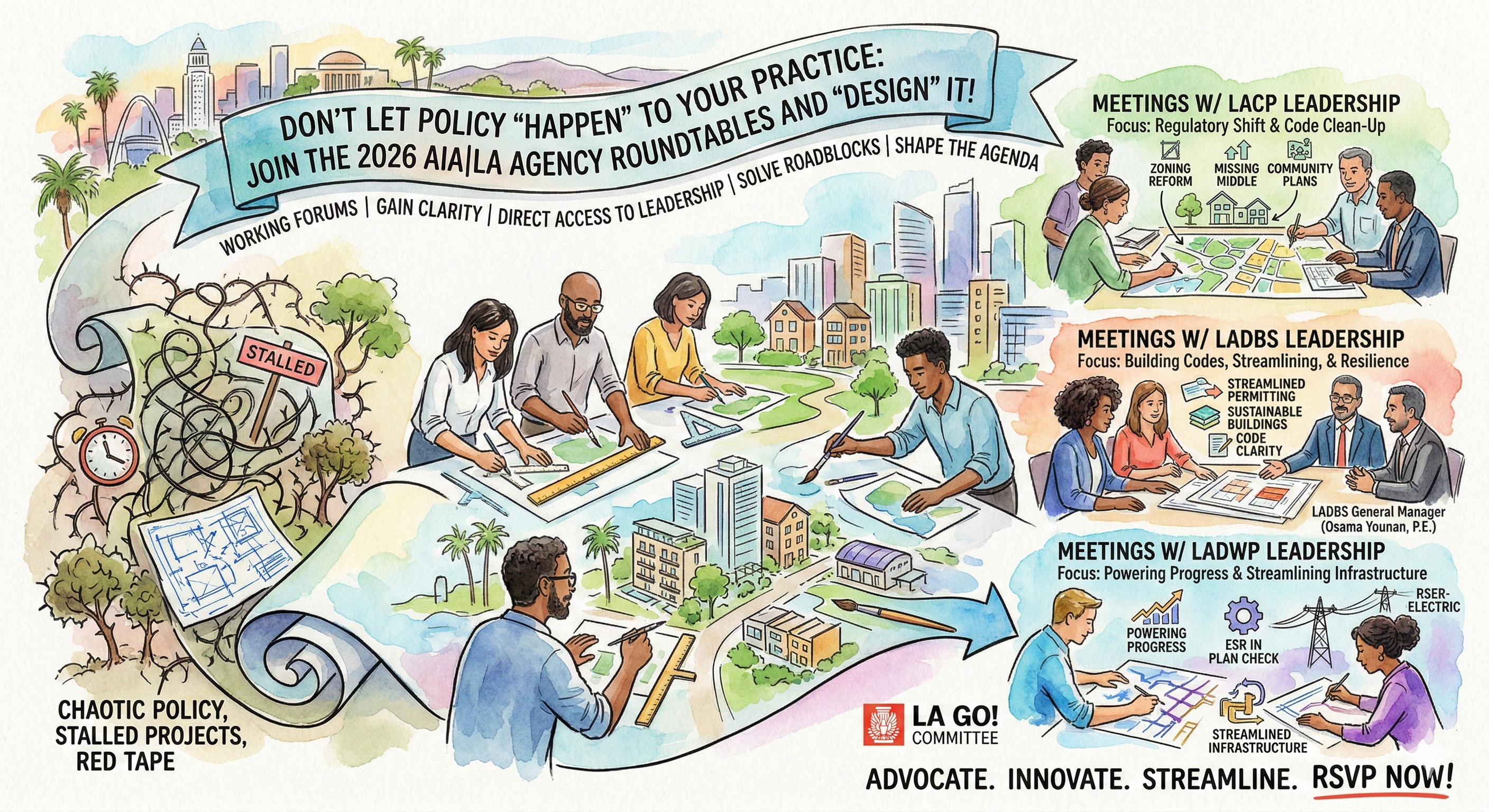
Don’t Let Policy ‘Happen’ to Your Practice: Join the 2026 AIA|LA Agency Roundtables and ‘Design’ It!
Navigating the regulatory landscape of Los Angeles is often one of the most complex, time-consuming, and expensive challenges in architecture today. Projects stall, budgets inflate, and timelines stretch—often due to processes that feel out of our control.
But you do have control.
The AIA|LA Government Outreach (GO!) Committee has organized a comprehensive series of quarterly roundtables with the leadership of the three agencies that dictate the flow of your projects: Los Angeles City Planning (LACP), the Department of Building and Safety (LADBS), and the Department of Water and Power (LADWP).
These sessions are not standard webinars; they are working forums designed to break down silos, modernize standards, and establish a shared culture of trust between the private sector and city personnel.
Why You Need to Be in the Virtual Room
Gain Immediate Clarity: Get ahead of major operational shifts (like Zoning Plan Check moving to LACP) before they disrupt your current workflow.
Direct Access to Leadership: Cut through the red tape and hear firsthand updates on emerging initiatives directly from General Managers and Department Heads.
Solve Specific Roadblocks: Have a project stalled by 14′ ground floor minimums or late-stage LADWP transformer placements? This is where we advocate for specific, technical code clean-ups.
Shape the Agenda: Your boots-on-the-ground experience directly informs AIA|LA’s advocacy efforts, turning your daily frustrations into actionable policy reforms.
Below is the 2026 schedule for each agency. Please RSVP via the links provided to secure your spot and ensure your voice is heard.
1. Meetings w/ Los Angeles City Planning (LACP) Leadership
Focus: The Regulatory Shift & Code Clean-Up
Our upcoming April session will dive deep into the ‘nuts and bolts’ of the Development Services Bureau, focusing extensively on the critical transition of the zoning plan check process, shifting from LADBS to LACP. Future sessions will tackle statewide housing initiatives (SB 79, AB 130), the impact of AI on compliance, and navigating the Missing Middle and Livable Communities Initiative.
2026 Schedule (Virtual via Zoom, 1:00 pm – 2:30 pm)
2. Meetings w/ LA Department of Building and Safety (LADBS) Leadership
Focus: Building Codes, Streamlining, & Resilience
Connect directly with Osama Younan, P.E., General Manager of LADBS. This is the forum for architects and design professionals to clarify building code interpretations, push for permit streamlining, and discuss the implementation of sustainable building practices.
2026 Schedule (Virtual, 1:00 pm – 2:00 pm)
3. Meetings w/ LA Department of Water and Power (LADWP) Leadership
Focus: Powering Progress & Streamlining Infrastructure
Since 2021, we have secured critical wins with LADWP, including faster processing for ED1 affordable housing and smarter financial solutions for line extensions. Our Prime 2026 Advocacy Priority is pushing LADWP to require review and approval by the Service Planner and ESR (Field Team) during the normal Plan Check Period—avoiding the costly delays that occur when the ESR first sees a project late in the construction phase.
2026 Schedule (Virtual via LADWP’s MS Teams, 11:00 am – 12:30 pm)
Have a specific item for the agenda? We want to hear about the specific issues, challenges, and recommendations you are facing in the field. Please email Will@aialosangeles.org to have your item added to the docket for upcoming meetings.
Advocate. Innovate. Streamline. We look forward to seeing you there.
Very truly yours,
AIA Los Angeles GO! Committee

Help Shape the Future of LA: Join the AIA|LA & LACP Design Review Sessions
Calling all architects and designers with a vision for a better Los Angeles!
The AIA|LA, in partnership with the Los Angeles City Planning (LACP)’s Urban Design Studio, invites you to participate in the Professional Volunteer Program (PVP). This collaborative initiative offers a unique opportunity to directly influence the design quality of upcoming projects across the city and play a vital role in shaping the urban fabric of Los Angeles.
Why Participate?
Impact Your City: Share your design expertise and insights on pending projects that will be reviewed by the Planning Commission. Your feedback can help shape the future of our city’s built environment.
Educate and Collaborate: Work alongside LACP planning staff to discuss urban design issues, complex urban typologies, and project-specific design challenges.
Expand Your Network: Connect with fellow architects, designers, and city planning professionals who share your passion for urban design.
How to Get Involved:
The PVP will be hosting 31 virtual design review sessions throughout the year. These sessions are a great opportunity to get involved and make a real difference. We encourage you to register for three or four sessions that fit your schedule.
View the Full Schedule and Register Today:
Prepare for a Meaningful Impact:
To maximize your contribution, we recommend reviewing the Urban Design Studio’s resources and the City’s design guidelines:
Confidentiality:
PVP discussions provide an open forum for design feedback, and all participants are expected to maintain confidentiality and anonymity.
For More Information:
Please contact Will Wright, Hon. AIA|LA, at (213) 639-0764 or will[@]aialosangeles.org with any questions.
Together, we can create a more vibrant, equitable, and resilient Los Angeles through the power of design. Join us in shaping the city’s future!
FOR MORE INFORMATION:
Will Wright, Hon. AIA|LA
Director, Government & Public Affairs
t: 213.639.0764
e: will@aialosangeles.org
www.aialosangeles.org
*Disclaimer: The advice and perspectives shared here belong to the author and should not be considered official recommendations from AIA Los Angeles.


