AIA|LA ADVOCACY REPORT
April 7, 2026

AIA Legal Action Regarding the John F. Kennedy Center
In March, AIA joined a coalition of preservation and architecture organizations in filing suit to ensure that federal law is followed before any major demolition or alterations occur at the John F. Kennedy Center for the Performing Arts, a nationally significant architectural and cultural landmark.
This action is about protecting the process that ensures architects, preservation experts, and the public have a voice when nationally significant architecture is changed.
What This Is
The lawsuit asks the court to require the federal government to follow laws such as the National Historic Preservation Act, which are designed to protect and preserve nationally significant architecture, before undertaking major demolition or structural changes.
The Kennedy Center has been determined eligible for the National Register of Historic Places, which triggers federal review requirements. These laws require:
•Consultation with preservation experts and professional organizations
•Public transparency and review
•Careful evaluation before irreversible actions such as demolition
Our coalition is asking the court to ensure this required process occurs before demolition or fundamental redesign proceeds.
What This Is Not
•This lawsuit is not about politics, does not oppose modernization or improvements, and does not prescribe a design outcome.
•Routine maintenance and necessary upgrades can proceed.
•The question before the court is straightforward: Should federal law be followed before major demolition or alterations take place?
Why AIA Is Participating
AIA advocates for architects and the value of architecture and preservation in society, ensuring that the nation’s shared architectural heritage is protected for future generations.
When established review processes are bypassed, the professional expertise architects bring to civic architecture can also be sidelined. These processes exist for a reason. Architects have a responsibility to protect the health, safety, and welfare of the public, and federal review laws help ensure that major changes to important public buildings receive appropriate professional scrutiny.
Last year, AIA raised concerns about the proposed White House ballroom project, calling for preservation, transparency, and adherence to established review processes. Significant actions affecting nationally important architecture should follow lawful process and include professional oversight.
Past administrations have followed these statutory processes. When they are bypassed, it risks setting a precedent that weakens the safeguards protecting important, historical civic architecture. We recognize that actions involving nationally significant sites can draw public and political attention. Our role here is to not engage in that discourse but to uphold the professional and legal standards that guide how such decisions are made.
What This Means for Architects
Architects play a central role in stewarding important civic places. Laws like the National Historic Preservation Act help ensure that professional expertise, public input, and careful review guide major decisions affecting them.
Respecting these processes helps ensure architects can fulfill their professional obligation to protect the health, safety, and welfare of the public. When they are followed, architects’ expertise is brought into the process , and the outcomes are immensely improved.
What to Expect Next
The coalition has requested a preliminary injunction asking the court to pause demolition or major alterations while the legally required review and consultation processes occur.
This litigation focuses narrowly on ensuring lawful process before irreversible action is taken, safeguarding the preservation of nationally significant architecture like the Kennedy Center. AIA will keep members informed as the case proceeds.
You can read the full announcement here:
Thank you for the work you do every day to shape our communities and the built environment.
Sincerely,
Illya Azaroff, FAIA – 2026 President , The American Institute of Architects
March 23, 2026
Three Law Firms Unite to Advance Plaintiffs’ Claims
Washington, DC – March 23, 2026 – A coalition of eight leading cultural heritage and architectural organizations jointly represented by three law firms today filed suit in federal district court in Washington, DC seeking to require the Trump administration to comply with historic preservation laws and secure Congressional authorization before implementing the President’s plans to further alter the John F. Kennedy Center for the Performing Arts.
The filing follows statements by President Trump that he may take the building “down to the steel” during a two-year closure beginning July 4, 2026. Plaintiffs cite the lesson learned when the President assured the American public that the East Wing of the White House would remain untouched during construction of his ballroom—and then approved its complete demolition.
The plaintiffs include: the American Institute of Architects; the American Society of Landscape Architects; the Committee of 100 on the Federal City; the DC Preservation League; Docomomo US; the National Trust for Historic Preservation; the Society of Architectural Historians; and The Cultural Landscape Foundation. Collectively, the organizations have more than one million members and supporters.
Completed in 1971, the Kennedy Center is among the most prominent cultural institutions in the United States and an iconic architectural treasure. The building and grounds have been determined eligible for listing on the National Register of Historic Places, which triggers processes and protections under the National Historic Preservation Act (NHPA) and the National Environmental Policy Act (NEPA).
Because the Kennedy Center serves both as the nation’s living memorial to President Kennedy and as the United States’ principal national performing arts center, changes to the building and grounds carry cultural and symbolic significance far beyond the nation’s capital.
The lawsuit, and a request for a preliminary injunction that plaintiffs expect to file soon, will ask the court to halt any demolition or substantial alteration until the government completes required public review and consultation processes.
The complaint makes clear that plaintiffs do not challenge routine repairs and maintenance, for which Congress recently appropriated $257 million. Rather, plaintiffs seek to prevent irreversible harm to defining architectural and historic features without the process and authority required by law.
No plaintiff can remember an instance in which so many national and regional organizations have coalesced to defend a single historic building and its grounds, reflecting both the Kennedy Center’s significance and the breadth of concern that the administration’s approach could weaken longstanding federal protections for historic sites nationwide.
The case also brings together for the first time three law firms whose clients have challenged several other high-profile efforts by the administration to alter historic federal properties without following legally required review processes.
In November, Cultural Heritage Partners filed suit to prevent the administration from painting the historic granite façade of the Eisenhower Executive Office Building without public consultation. In December, Foley Hoag challenged plans to construct a large ballroom following demolition of the White House East Wing. In February, Lowell & Associates sued seeking to enjoin the planned redevelopment of the historic East Potomac Golf Course and the dumping of East Wing demolition debris on the site.
Quotes
Rebecca Miller, Executive Director, DC Preservation League:
“The Kennedy Center is not a personal project of any president. It is a national cultural monument built to honor John F. Kennedy and to serve the American people. Federal law requires transparency, expert review, and public participation before it can be fundamentally altered.”
Carol Quillen, President and CEO, National Trust for Historic Preservation:
“The Kennedy Center is a historically significant architectural icon and a performance venue beloved by millions of Americans. We’re concerned that, as with the White House East Wing, the potential scope of planned changes is understated and will result in irreparable loss. We respectfully urge the Administration to follow all required consultative processes. Doing so will improve the design and enable transparency and public engagement—values befitting a government by the people.”
Greg Werkheiser, Founding Partner, Cultural Heritage Partners:
“The administration is advancing sweeping changes to some of the nation’s most important civic landmarks without transparency or public process. When decisions about America’s heritage are made behind closed doors, the rule of law is the only safeguard.”
Abbe David Lowell, Founding Member, Lowell & Associates:
“This case is not about politics or aesthetics. It is about whether the President can impose major changes to historic buildings while denying the public voice that federal law requires.”
Tad Heuer, Partner, and Greg Craig, Senior Counsel, Foley Hoag:
“We are proud to represent this coalition of cultural heritage and architectural organizations to ensure that the processes in place are followed before irreparable changes are made to an iconic building intended to be a lasting and living memorial to John F. Kennedy.”
Illya Azaroff, FAIA, President, American Institute of Architects:
“Architects have the core responsibility of protecting the health, safety, and welfare of the public and that includes our nation’s civic and cultural landmarks. The Kennedy Center is a public asset that must be shaped through transparency, expertise, and the communities it serves.”
Charles A. Birnbaum, Founding President & CEO, The Cultural Landscape Foundation:
“The Kennedy Center campus is a nationally significant example of Modernist design. From its processional arrival experience to its terraces, which afford sweeping views of the Potomac River and civic monuments, landscape architecture is integral to this important cultural monument.”
Liz Waytkus, Executive Director, Docomomo US
“It is unconscionable that the administration has already begun actions to degrade and irreparably harm the Kennedy Center. Designed by Edward Durell Stone, the building is a masterwork of Modern architecture and one of the most significant Modern buildings in the Washington, D.C., area. Significant alterations to the Kennedy Center would not only compromise an architectural landmark but would undermine a place deeply tied to the nation’s cultural values and to the legacy of leadership that President Kennedy represented.”
Ben Thomas, Executive Director, Society of Architectural Historians:
“SAH, a network of institutions and individuals that focus on the history of the built environment and its impact on society, joins the other seven plaintiffs to urge the administration to submit any proposals to alter the Kennedy Center for proper review and deliberation. Decisions that affect our communal cultural heritage should not be made lightly and should follow established guidelines and procedures.”
Brad McCauley, President, American Society of Landscape Architects
“The Kennedy Center and its grounds are part of our shared public realm. Federal law requires careful, informed reviews to guide decisions about its future, accounting for preservation law, public input, cultural understanding, and long-term stewardship. Following proper process to honor the Kennedy Center’s role as a national civic landmark matters.”
Judy Chesser, Chair, Committee of 100 for the Federal City
“The Kennedy Center is a national treasure. Its construction set new standards, from accessibility to acoustics. Without public input and congressional approval as required by law, the Administration’s statements that its intentions are only to ‘enhance’ the Center are not reassuring but are cause for alarm.”
About the Plaintiffs
The American Institute of Architects (AIA): With 101,000 members, AIA is the world’s largest, most influential network of architects and design professionals. Founded in 1857, AIA consistently works to create more valuable, healthy, secure, and sustainable buildings, neighborhoods, and communities. Through more than 200 international, state, and local chapters, AIA advocates for public policies that promote economic vitality and public well-being.
American Society of Landscape Architects: Founded in 1899, the American Society of Landscape Architects (ASLA) is the professional association for landscape architects in the United States, proudly representing more than 16,000 members. Landscape architects lead the planning, design, and stewardship of healthy, equitable, safe, and resilient environments.
Committee of 100 on the Federal City: Founded more than a century ago, the Committee of 100 on the Federal City is a nonprofit organization dedicated to safeguarding and advancing Washington’s historic distinction, natural beauty, and overall livability. The Committee’s work recognizes the critical value of public planning, informed by traditions that originate from the L’Enfant Plan and the McMillan Commission, continuing to the current day.
DC Preservation League: Founded in 1971, the DC Preservation League (DCPL) has played a major role in advocating for the preservation, protection, and enhancement of significant landmarks, neighborhoods, and cultural sites across all eight wards of Washington, D.C. The membership-supported nonprofit carries out its work through advocacy, public education, and partnerships with government agencies and community groups.
Docomomo US is the United States chapter of Docomomo International, a non-profit organization dedicated to the documentation and conservation of buildings, sites, and neighborhoods of the modern movement. Committed to the principle that modern design merits the attention and preservation received by earlier periods, Docomomo US represents twenty-eight regional chapters and partner organizations that share knowledge of and enthusiasm for modern architecture, landscapes, and design.
National Trust for Historic Preservation is a privately funded nonprofit organization dedicated to helping communities maintain and enhance the power of historic places. Chartered by Congress in 1949 and supported by partners, friends, and champions nationwide, the Trust helps preserve the places and stories that make communities unique. Through the stewardship and revitalization of historic sites, the Trust helps communities foster economic growth, create healthier environments, and build a stronger, shared sense of civic duty and belonging.
Society of Architectural Historians: Founded at Harvard University in 1940, SAH is a nonprofit membership organization that serves an international network of institutions and individuals who, by profession or interest, focus on the history of the built environment and its role in shaping contemporary life. SAH promotes the study, interpretation, and conservation of architecture, design, landscapes, and urbanism worldwide for the benefit of all.
The Cultural Landscape Foundation (TCLF) is a 501(c)(3) non-profit founded in 1998 to connect people to places. TCLF educates and engages the public to make our shared landscape heritage more visible, identify its value, and empower its stewards. Through its website, publishing, lectures, and other events, TCLF broadens support and understanding for cultural landscapes. TCLF is also home to the Cornelia Hahn Oberlander International Landscape Architecture Prize.
About the Law Firms
Cultural Heritage Partners, PLLC (CHP) uses law, policy, and public attention to protect and preserve archaeology, art, architecture, landscapes, burial grounds, sacred spaces, traditional knowledge and practices, and related civil and human rights. The firm’s clients include Indigenous nations, African American communities, historic cities and towns, and cultural institutions globally. Since its founding in 2010, the firm has been led by Marion F. Werkheiser and Greg Werkheiser.
Foley Hoag, is an award-winning, mid-sized, international law firm that focuses on innovative industries and high-stakes litigation. The firm maintains robust offices in Boston, New York, Washington, DC, Denver, and Paris. The diverse backgrounds, perspectives, and experiences of the firm’s lawyers and business services professionals contribute to the exceptional service Foley Hoag delivers to clients. Counsel in this matter are Greg Craig, Tad Heuer, and Matt Casassa.
Lowell & Associates, PLLC provides strategic, principled legal representation across civil, criminal, compliance, congressional, and regulatory matters. Led by its Founding Member, Abbe David Lowell, the firm’s mission is the provision of pro bono and public interest representation in matters that defend the integrity of the legal system and protect individuals and institutions from government overreach and other threats to fundamental rights.
Contact (will coordinate access to all clients and firms as requested):
Greg Werkheiser, Founding Partner
Cultural Heritage Partners, PLLC
1717 Pennsylvania Avenue NW, Suite 1025, Washington, DC 20006
(703) 408-2002 / greg@culturalheritagepartners.com
Building the Evidence Base:
What Three Converging Reports Mean for LA’s Design Community—and What We Should Do Now
March 25, 2026
Three independent research efforts, published within weeks of each other, offer a rare moment of analytical convergence on housing, preservation, and infrastructure finance in the LA region. An economist at the Wharton School, a preservation economics firm working in San Diego, and a Los Angeles transit data team have arrived at overlapping conclusions—and together they sketch a coherent regional strategy in which the architecture and design community has a far more central role than it may currently recognize.
The three reports are: Joe Gyourko’s Thinking About the Growing Housing Affordability Problem (Brookings Institution, March 2026); The Urban Vitality Blueprint, produced by PlaceEconomics for San Diego’s Save Our Heritage Organisation (February 2026); and Streets for All’s How LA County Can Fund High Speed Rail Projects in the County with No New Taxes (March 23, 2026). Read separately, each is valuable. Read together, they point toward an agenda—and a deadline.
What the Research Says
Supply Is the Crisis
Gyourko’s central argument is stark: the U.S. housing affordability crisis is primarily a supply crisis, driven by a local regulatory environment that has grown systematically more restrictive over four decades. LA’s median price-to-income ratio now stands at 7.75, compared to 2.21 in 1970—when every major American housing market was affordable by any reasonable standard. His preferred remedies are supply-side: upzoning, ADU expansion, permitting streamlining, federal land disposition, and restructuring local regulatory systems to broaden accountability beyond immediate neighbors to the wider community of people who would benefit from new housing.
Preservation Is Part of the Solution
The Urban Vitality Blueprint challenges the preservation-versus-housing framing directly. San Diego’s historic districts are, on average, nearly twice as dense as undesignated residential neighborhoods, grow housing units faster, and produce ADUs at nearly twice the rate. Their median household income is more than $12,000 below the citywide median—dismantling the stereotype of historic districts as enclaves of privilege. And pre-1970 housing stock functions as Naturally Occurring Affordable Housing: 52% of rental units in older neighborhoods are affordable to households below 80% of area median income, versus 36% in newer neighborhoods. Los Angeles has no equivalent analysis for its own HPOZs. That gap is costing us.
The Railroad That Pays for Itself
The Streets for All report is the most time-sensitive of the three. It proposes using Enhanced Infrastructure Financing Districts—a California mechanism that captures property tax increment within a defined geography—to fund LA County’s $16.8 billion share of High Speed Rail construction costs for the Palmdale-to-Union Station segment. The team models net-present EIFD revenue of $15 to $23 billion, projecting a $6.5 billion net gain for the County General Fund above construction costs. The mechanism works only if development actually materializes within the two-mile station catchment areas. EIFD formation in 2026 is the threshold for enabling bond issuance in time to support construction in the 2030s. The boundary-setting conversations are happening right now.
“Architects draw the buildings that generate the tax increment. Preservation professionals protect the NOAH stock that keeps station areas affordable. Urban designers shape the public realm that sustains land values over time. No other professional community has the tools, the spatial literacy, and the cross-sector relationships to hold all of this together.”
20 Recommendations for the LA Architecture & Design Community
These recommendations synthesize all three reports into a coherent action agenda, organized by domain. Items marked ⚠️ are time-critical in 2026.
Supply, Regulation & Permitting Reform
1. Launch a Missing Middle Pattern Library [Start immediately]
Produce a publicly accessible pattern library of LA’s historic missing-middle typologies—bungalow courts, dingbats, courtyard apartments—with measured drawings and adaptive reuse guides. Give builders, planners, and communities a tangible vocabulary for density that respects neighborhood character.
2. Co-Create Pre-Approved ADU Templates for Historic Contexts [Q2 2026]
Partner with the City’s Department of Building and Safety and Office of Historic Resources to create pre-approved ADU designs tailored to distinct historic district contexts. Pre-approval reduces soft costs and permitting timelines—directly addressing the Gyourko report’s emphasis on lowering regulatory friction.
3. Champion Build-by-Right Design Standards for Infill Corridors [⚠️ Critical in 2026]
Engage LA City Planning to develop design-quality-based build-by-right standards for infill multifamily in upzoned corridors. Within EIFD station areas, this is a precondition for the financial model: if regulatory friction prevents development, the tax increment doesn’t materialize and the bonds don’t get repaid.
4. Build a Demolition-to-Denial Evidence Base [Ongoing]
Systematically document cases where design-quality projects were denied or significantly delayed by discretionary review, building the evidence base that state legislators need to streamline approvals for projects meeting objective design standards.
5. Develop a Pre-Design Affordability Impact Dashboard [2026–2027]
Create a tool that allows architects and developers to see, at the pre-design stage, the projected affordability impact of different massing, unit mix, and tenure decisions in specific LA neighborhoods.
Preservation, NOAH & Adaptive Reuse
6. Commission the LA Equivalent of the San Diego HPOZ Study [⚠️ Critical in 2026]
Produce data on density, ADU production, income levels, and affordability outcomes for LA’s HPOZs and older neighborhoods—and present it to City Council and the Planning Commission as a direct counternarrative to the “preservation blocks housing” argument.
7. Establish a Rehabilitation-Over-Demolition Carbon Accounting Standard [2026–2027]
Advocate for a standard lifecycle carbon assessment protocol for all projects over a certain square footage threshold, making the embodied carbon calculus visible on permit applications.
8. Launch a Mills Act Outreach Program for Lower-Income Homeowners [Q3 2026]
Organize pro bono design assistance clinics in neighborhoods like Boyle Heights, Leimert Park, and Watts to help moderate-income historic homeowners access tax relief, fund repairs, and avoid displacement.
9. Establish a NOAH Preservation Studio at a Local Architecture School [AY 2026–2027]
Partner with SCI-Arc, UCLA, or USC to create a studio focused on adaptive reuse of LA’s pre-1970 housing stock, tied to real sites with community land trusts and nonprofit housing developers.
10. Create a Retrofit-Ready Certification for Older Multifamily Buildings [2027]
Develop a certification framework identifying older multifamily buildings as strong candidates for energy, seismic, and accessibility retrofits without demolition—preserving NOAH stock and providing a pipeline of work for the profession.
Transit-Adjacent Development & EIFD Strategy
11. Produce Station-Area Vision Plans for All Three EIFD Catchment Zones [⚠️Complete before EIFD boundaries are set]
Proactively produce illustrative vision plans for Palmdale, Burbank Airport, and Union Station demonstrating the full realistic development envelope under various upzoning scenarios—giving policymakers and bond investors a visual basis for confidence in revenue projections, and giving communities a design process before boundaries are set.
12. Develop Context-Sensitive Design Guidelines for EIFD Station Zones [⚠️ Critical in 2026]
Union Station’s two-mile catchment encompasses Chinatown, Little Tokyo, the Arts District, Boyle Heights, and Lincoln Heights—exactly the neighborhoods the San Diego report identifies as doing the most work on affordability through older housing stock. Develop guidelines that allow density to grow without displacing the NOAH stock that makes them function.
13. Advocate for Design Quality Standards as a Condition of EIFD Participation [⚠️ Critical in 2026]
The Streets for All model depends on sustained property value appreciation, which is itself a function of neighborhood quality. Advocate that LA County include minimum design quality standards—urban form, ground-floor activation, pedestrian environment, historic compatibility—as conditions of EIFD participation. Design standards are a financial instrument.
14. Lead Federal Land-to-Housing Master Planning for the Palmdale Station Area [⚠️ Act before EIFD boundary is set]
The Palmdale station area sits adjacent to significant federal and state land holdings. An EIFD-anchored master planning exercise combining federal land disposition with value capture financing could be one of the most consequential planning exercises in the region’s history. Lead this vision work before the boundary is frozen.
15. Design a Transit Premium Anti-Displacement Toolkit [2026–2027]
Within EIFD catchment zones, rising land values are the entire financial premise—meaning displacement pressure is structural and predictable. Develop a toolkit combining community land trusts, deed-restricted ADU programs, Mills Act-style incentives, and community benefit agreements to protect NOAH stock and minority homeownership through the appreciation cycle.
16. Analyze Proposition 13’s Interaction with EIFD Revenue Modeling [2026]
Prop 13-suppressed assessments may significantly understate the fiscal potential of EIFD districts in neighborhoods like Boyle Heights and Lincoln Heights. Working with tax policy experts, analyze whether this affects the revenue model—and advocate for any necessary legislative fixes before district formation.
Design Intelligence & Coalition-Building
17. Pilot a Gentle Density Demonstration Block Program [2026–2027]
Work with two or three willing block associations in or adjacent to HPOZs to develop coordinated block-scale infill strategies—ADUs, lot splits, garage conversions—that add 20–30% more units without altering neighborhood character. Document and publish as a replicable model.
18. Launch a Design-Forward Manufactured Housing Initiative [2026–2027]
Sponsor a competition or design fellowship focused on high-quality modular housing that integrates into existing neighborhood fabric, building the case for regulatory standardization at the state level.
19. Commission a Comparative Study of International HSR Station-Area Design and Value Capture [2026–2027]
Extend the Streets for All report’s fiscal benchmarking into the built environment: study how station-area design in Tokyo, Zurich, Lyon, and Taipei has interacted with land value capture mechanisms, and what typologies have produced the highest sustained appreciation. Position LA architects as informed participants in the most consequential infrastructure financing decision the county makes this decade.
20. Establish a Cross-Sector Housing Supply + Preservation Alliance [Begin immediately]
Convene preservation advocates, affordable housing developers, community land trusts, tenant organizations, planning reformers, HSR advocates, transit finance specialists, and county fiscal analysts around a shared platform: more housing, older buildings protected, equity built in by design. The EIFD mechanism creates a shared financial interest between these groups that did not previously exist. The design community is the natural convener.
The Window Is Now
What these three reports establish together is an integrated vision: LA County could, in this decade, build one of the most significant pieces of public infrastructure in its history—largely self-funded—while simultaneously creating denser, more affordable, more equitable, and more environmentally responsible neighborhoods along its spine. The Gyourko report provides the diagnosis. The San Diego report provides the proof of concept. The Streets for All report provides the financing mechanism.
Architects draw the buildings that generate the tax increment. Preservation professionals protect the NOAH stock that keeps station-area neighborhoods affordable. Urban designers shape the public realm that sustains land values over time. No other professional community has the tools, the spatial literacy, and the cross-sector relationships to hold all of this together—and the window to act is right now.
The three reports referenced in this editorial are linked below. I would encourage every member working at the intersection of housing, historic preservation, urban design, or infrastructure to read the executive summaries—and I welcome your responses by email, at our next Government & Public Affairs committee meeting, or through whatever channel works best for you.
The window is now.
By Will Wrigtht, Hon. AIA|LA – Director of Government & Public Affairs, AIA Los Angeles
Reports Referenced:
Gyourko, J. (March 2026). Thinking About the Growing Housing Affordability Problem: A Primer for Sound Policy. Brookings Institution.
PlaceEconomics for Save Our Heritage Organisation (February 2026). The Urban Vitality Blueprint: A Data-Driven Analysis of Equity, Affordability, and Vitality in San Diego’s Historic Districts. [Link]
Shoyer, J. & Vredevoogd, J. (March 23, 2026). How LA County Can Fund High Speed Rail Projects in the County with No New Taxes. Streets for All Data/Dev Blog. [Link]
* Will Wright, Hon. AIA|LA, is the Director of Government & Public Affairs for the American Institute of Architects, Los Angeles Chapter. The above editorial is his opinion and not meant to represent the official view of AIA Los Angeles, its membership, or its Board of Directors. He can be reached at will@aialosangeles.org and welcomes all feedback on his opinions.
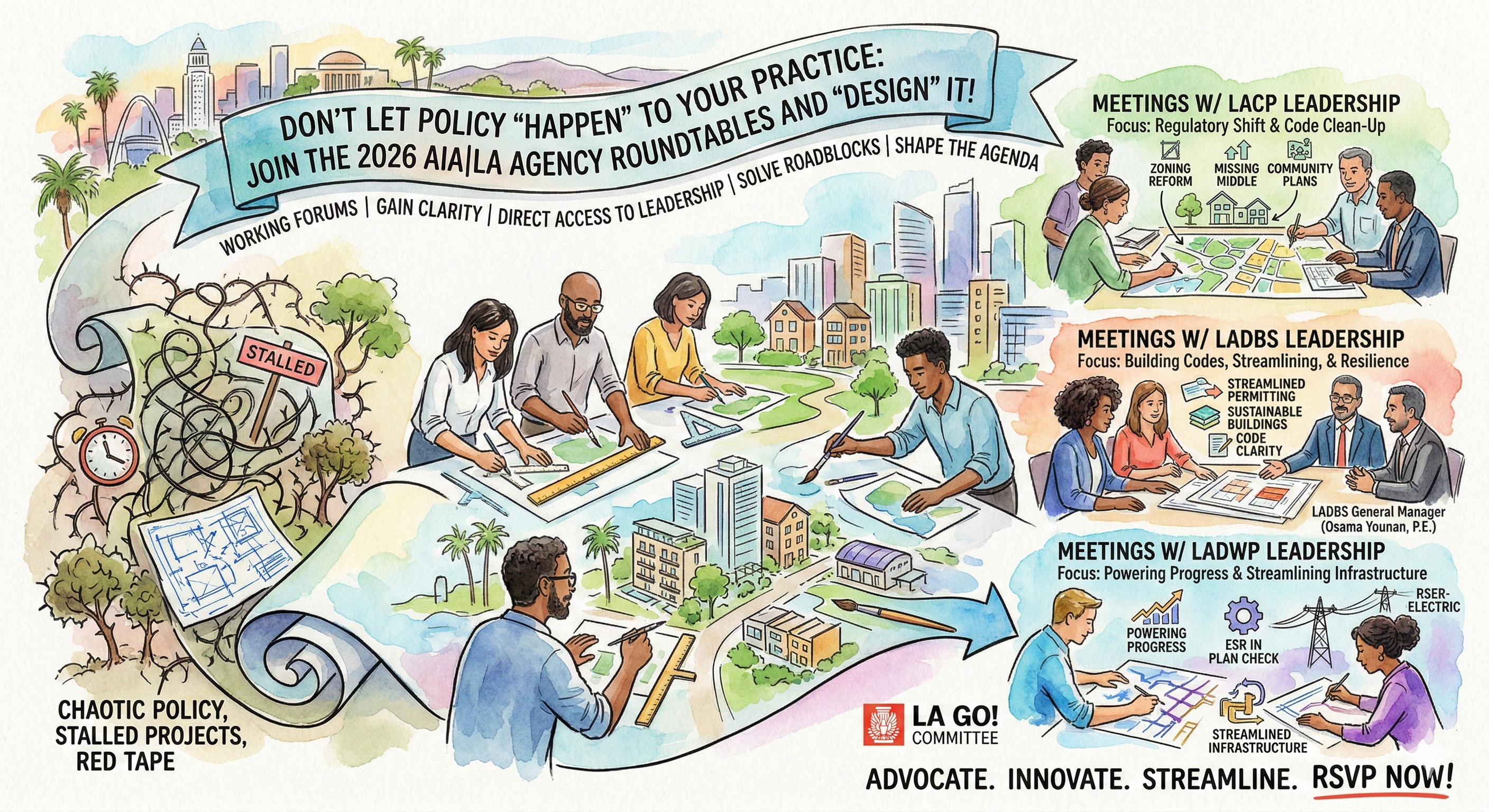
Don’t Let Policy ‘Happen’ to Your Practice: Join the 2026 AIA|LA Agency Roundtables and ‘Design’ It!
Navigating the regulatory landscape of Los Angeles is often one of the most complex, time-consuming, and expensive challenges in architecture today. Projects stall, budgets inflate, and timelines stretch—often due to processes that feel out of our control.
But you do have control.
The AIA|LA Government Outreach (GO!) Committee has organized a comprehensive series of quarterly roundtables with the leadership of the three agencies that dictate the flow of your projects: Los Angeles City Planning (LACP), the Department of Building and Safety (LADBS), and the Department of Water and Power (LADWP).
These sessions are not standard webinars; they are working forums designed to break down silos, modernize standards, and establish a shared culture of trust between the private sector and city personnel.
Why You Need to Be in the Virtual Room
Gain Immediate Clarity: Get ahead of major operational shifts (like Zoning Plan Check moving to LACP) before they disrupt your current workflow.
Direct Access to Leadership: Cut through the red tape and hear firsthand updates on emerging initiatives directly from General Managers and Department Heads.
Solve Specific Roadblocks: Have a project stalled by 14′ ground floor minimums or late-stage LADWP transformer placements? This is where we advocate for specific, technical code clean-ups.
Shape the Agenda: Your boots-on-the-ground experience directly informs AIA|LA’s advocacy efforts, turning your daily frustrations into actionable policy reforms.
Below is the 2026 schedule for each agency. Please RSVP via the links provided to secure your spot and ensure your voice is heard.
1. Meetings w/ Los Angeles City Planning (LACP) Leadership
Focus: The Regulatory Shift & Code Clean-Up
Our upcoming April session will dive deep into the ‘nuts and bolts’ of the Development Services Bureau, focusing extensively on the critical transition of the zoning plan check process, shifting from LADBS to LACP. Future sessions will tackle statewide housing initiatives (SB 79, AB 130), the impact of AI on compliance, and navigating the Missing Middle and Livable Communities Initiative.
2026 Schedule (Virtual via Zoom, 1:00 pm – 2:30 pm)
2. Meetings w/ LA Department of Building and Safety (LADBS) Leadership
Focus: Building Codes, Streamlining, & Resilience
Connect directly with Osama Younan, P.E., General Manager of LADBS. This is the forum for architects and design professionals to clarify building code interpretations, push for permit streamlining, and discuss the implementation of sustainable building practices.
2026 Schedule (Virtual, 1:00 pm – 2:00 pm)
3. Meetings w/ LA Department of Water and Power (LADWP) Leadership
Focus: Powering Progress & Streamlining Infrastructure
Since 2021, we have secured critical wins with LADWP, including faster processing for ED1 affordable housing and smarter financial solutions for line extensions. Our Prime 2026 Advocacy Priority is pushing LADWP to require review and approval by the Service Planner and ESR (Field Team) during the normal Plan Check Period—avoiding the costly delays that occur when the ESR first sees a project late in the construction phase.
2026 Schedule (Virtual via LADWP’s MS Teams, 11:30 am – 12:30 pm)
Have a specific item for the agenda? We want to hear about the specific issues, challenges, and recommendations you are facing in the field. Please email Will@aialosangeles.org to have your item added to the docket for upcoming meetings.
Advocate. Innovate. Streamline. We look forward to seeing you there.
Very truly yours,
AIA Los Angeles GO! Committee
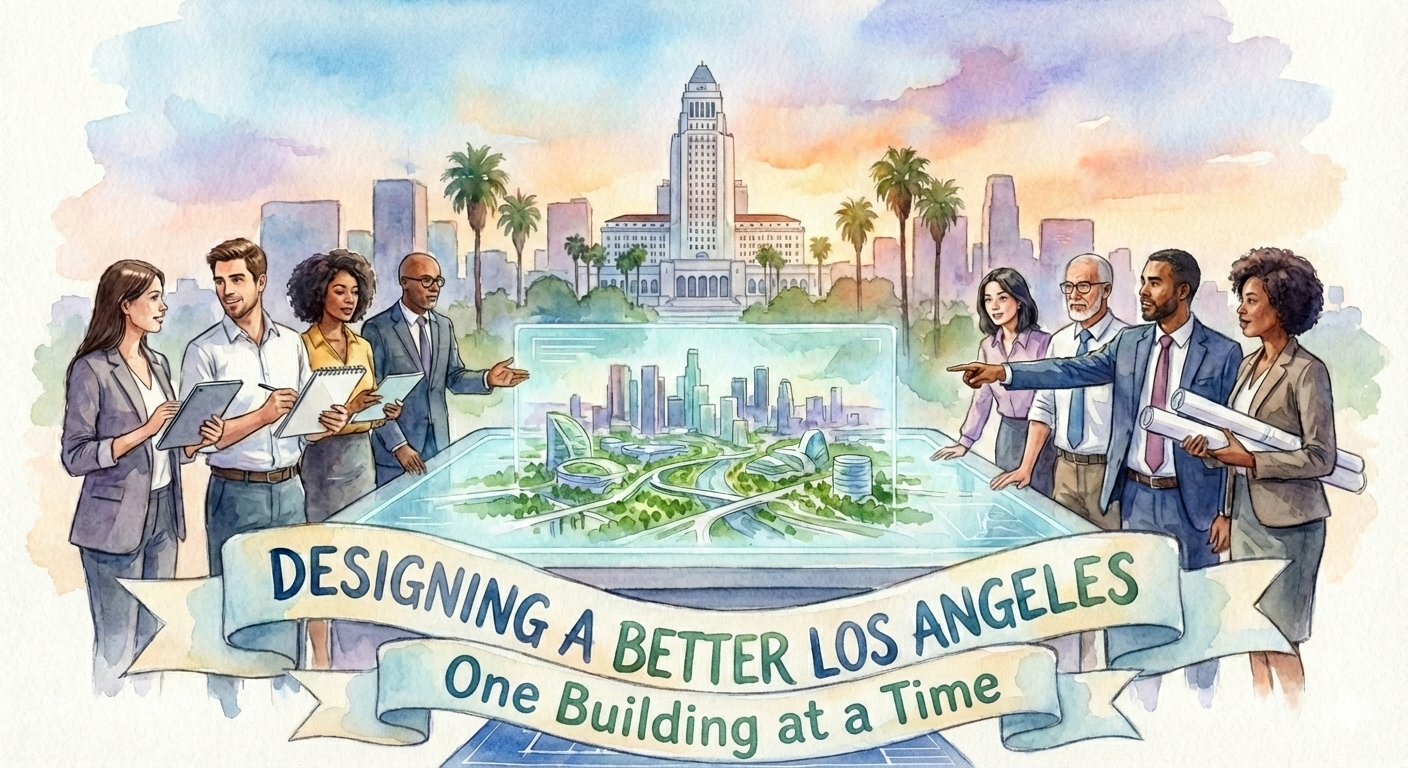
Help Shape the Future of LA: Join the AIA|LA & LACP Design Review Sessions
Calling all architects and designers with a vision for a better Los Angeles!
The AIA|LA, in partnership with the Los Angeles City Planning (LACP)’s Urban Design Studio, invites you to participate in the Professional Volunteer Program (PVP). This collaborative initiative offers a unique opportunity to directly influence the design quality of upcoming projects across the city and play a vital role in shaping the urban fabric of Los Angeles.
Why Participate?
Impact Your City: Share your design expertise and insights on pending projects that will be reviewed by the Planning Commission. Your feedback can help shape the future of our city’s built environment.
Educate and Collaborate: Work alongside LACP planning staff to discuss urban design issues, complex urban typologies, and project-specific design challenges.
Expand Your Network: Connect with fellow architects, designers, and city planning professionals who share your passion for urban design.
How to Get Involved:
The PVP will be hosting 31 virtual design review sessions throughout the year. These sessions are a great opportunity to get involved and make a real difference. We encourage you to register for three or four sessions that fit your schedule.
View the Full Schedule and Register Today:
Prepare for a Meaningful Impact:
To maximize your contribution, we recommend reviewing the Urban Design Studio’s resources and the City’s design guidelines:
Confidentiality:
PVP discussions provide an open forum for design feedback, and all participants are expected to maintain confidentiality and anonymity.
For More Information:
Please contact Will Wright, Hon. AIA|LA, at (213) 639-0764 or will[@]aialosangeles.org with any questions.
Together, we can create a more vibrant, equitable, and resilient Los Angeles through the power of design. Join us in shaping the city’s future!
FOR MORE INFORMATION:
Will Wright, Hon. AIA|LA
Director, Government & Public Affairs
t: 213.639.0764
e: will@aialosangeles.org
www.aialosangeles.org
*Disclaimer: The advice and perspectives shared here belong to the author and should not be considered official recommendations from AIA Los Angeles.


