AIA|LA ADVOCACY REPORT
March 24, 2026

Building Through Uncertainty: Why California’s 2026 Housing Legislation Is Our Moment to Lead
*By Will Wright, Hon. AIA|LA – Director of Government & Public Affairs, AIA Los Angeles
SUMMARY | After landmark housing reforms in 2025, California’s legislature enters 2026 with renewed urgency — shifting from land use to construction costs, financing, and insurance market stabilization. Against a backdrop of geopolitical volatility and economic uncertainty, the architecture profession has a rare opportunity: to step forward as consensus builders, technical authorities, and design leaders at the precise moment California needs us most.
The headwinds are real — tariff volatility, construction cost pressure, federal uncertainty, and insurers retreating from fire-scorched California markets. And yet, if we look at the legislative landscape taking shape in Sacramento, something remarkable is happening: California is not retreating. It is doubling down.
Published on March 18th, The Terner Center for Housing Innovation’s 2026 California Legislative Preview makes clear that lawmakers have shifted their aperture meaningfully. Having spent recent years untangling land use and permitting barriers, the legislature is now turning to deeper structural challenges: the cost of building, the complexity of financing, the fragility of our insurance markets, and the slow trickle of for-sale housing for working families. These are the right problems to solve — and they are problems where architects have a great deal to contribute.
Architecture has always been at its best at the intersection of creativity and civic responsibility. In moments of geopolitical and economic uncertainty, housing is not just an economic asset — it is a social anchor. Stable, dignified, well-designed homes allow communities to hold together when other systems are under stress. Consensus is harder to build when anxiety is high, which means the work of building it is more valuable, not less. This is our moment to lead.
I. THE LEGISLATIVE LANDSCAPE
1. Funding for Affordable Housing
The governor’s 2026–27 budget projected a deficit with no new funding for many core affordable housing programs. HHAP homelessness grants were cut to $500M — half of Round 6. Simultaneously, the legislature is reorganizing state housing agencies, splitting the Business, Consumer Services, and Housing Agency into the new California Housing and Homelessness Agency (CHHA) and a Housing Development and Finance Committee (HDFC) to streamline fragmented affordable housing finance.
▪ AB 2020 (Gabriel) — Allows affordable housing developers to move project reserves across portfolios to stabilize financially stressed projects.
▪ AB 736 (Wicks) / SB 417 (Cabaldon) — Companion bills to place a $10 billion affordable housing bond on the November 2026 ballot, funding the Multifamily Housing Program, CalHOME, and farmworker housing.
▪ AB 1899 / AB 1924 / SB 1091 — Bills expanding CHHA’s mandate: a youth homelessness prevention office, a statewide homelessness prevention strategy, and a community anti-displacement program.
2. Reducing Development Costs
Two new Assembly Select Committees — on Housing Finance and Affordability and on Housing Construction Innovation — signal that cost reduction is now a first-order priority. Terner Center research finds factory-built housing can reduce hard costs 10–25% and timelines 20–50% under the right conditions.
▪ AB 1815 (Wicks) — Spot bill establishing standards for factory-built housing, implementing Terner Center construction innovation recommendations.
▪ AB 2074 (Haney) — Creates a revolving loan fund for lower-cost financing of high-rise residential near regional transit hubs, with labor standards and streamlined approvals.
▪ SB 1036 (Grayson) — Requires jurisdictions to provide impact fee credits for redevelopment of sites with prior similar usage; bases fees on net public facility impact.
▪ SB 1117 (Cervantes) — Limits ADU impact fees to square footage above 750 square feet.
▪ SB 328 (Grayson) — Caps state hazardous waste remediation fees at $100,000 for residential infill projects.
▪ AB 1070 (Ward) — Requires a working group to study allowing 3–10 unit buildings to use residential rather than commercial building codes.
▪ AB 2252 (Lee) — Spot bill allowing residential buildings of four or more stories to be built with a single staircase.
▪ AB 2044 (Petrie-Norris) — Requires cost-of-compliance estimates before the Building Standards Commission can adopt new standards.
▪ AB 2089 (Ward) / SB 1415 (Arreguín) — Expand welfare property tax exemptions for nonprofit affordable housing developers and moderate-income housing.
3. Streamlining Permitting & Entitlement
The legislature continues to reduce local government delays, standardize applications, and simplify inspections.
▪ AB 1621 (Wilson) — Limits plan check cycles to two without written health/safety findings; caps permit appeal timelines at 30–45 business days.
▪ SB 1014 (Grayson) — Requires jurisdictions to disclose all required improvements and costs within 30 days of application; prohibits adding requirements after that window.
▪ AB 748 (Harabedian) — Requires local agencies to develop and post preapproved housing plan programs with ministerial approvals within 30 days for qualifying applications.
▪ AB 1294 (Haney) — Creates a standardized statewide housing entitlement application and deemed-complete rules.
▪ AB 1738 (Carrillo) — Allows homeowners to request remote building inspections for certain structural components.
▪ AB 1751 (Quirk-Silva) — Requires ministerial approval of townhome projects and exempts them from CEQA.
▪ AB 1740 (Zbur) — Allows qualifying urban, multimodal communities to bypass Coastal Commission approvals for certain housing and transportation projects.
▪ AB 2118 (Hoover) — Strengthens AB 2011 to prevent objective zoning standards from blocking mixed-use development; specifies that by-right projects are CEQA-exempt.
▪ AB 1710 (Carrillo) — Extends SB 330’s anti-subjectivity protections to include materials requirements and post-entitlement permit standards.
▪ SB 908 (Wiener) — Clarifies ambiguities in SB 79 (2025), which set height and density standards near high-frequency transit.
▪ SB 1258 (Wiener) — Allows urban infill projects on remediated hazardous sites to access streamlined approvals once the state confirms suitability.
4. Insurance & Climate Resilience
Following the Eaton and Palisades wildfires, California homeowners face rising premiums and fewer insurer options. Without insurable housing, even approved and financed projects cannot close.
▪ SB 1076 (Pérez) — Prohibits insurers from refusing to offer or renew policies for properties meeting wildfire-safety standards.
▪ SB 1301 (Allen) — Mandates six-month notice and written rationale for nonrenewal; restricts claim-based denials.
▪ AB 1680 (Calderon) — Expands coverage in the California FAIR Plan, the insurer of last resort.
▪ SB 894 (Allen) — Creates a statewide loan program for homeowners financing wildfire safety upgrades.
5. Homeownership & Missing Middle
The session includes the most significant for-sale housing reform package in years, targeting condominiums, construction defect liability, starter home subdivisions, and ADU expansion.
▪ AB 1406 (Ward) — Doubles liquidated damages limits on homebuyer condo deposits from 3% to 6%, reducing lender risk and encouraging condo development.
▪ AB 1903 (Wicks) — Spot bill reconsidering construction defect liability law — a primary reason California’s condominium market has been suppressed for two decades.
▪ SB 1116 (Caballero) — Streamlines starter home subdivision, allowing parcels as small as 480 sq. ft. in multifamily zones and simplifying design standards.
▪ AB 956 (Quirk-Silva) — Allows homeowners to build up to two detached ADUs on a single property.
▪ SB 1216 (Cabaldon) — Creates a pro-housing designation rewarding jurisdictions meeting production outcomes, with flexibility to modify certain state requirements.
6. Tenant Protections, Density Bonus & RHNA
▪ SB 436 (Wahab) — Extends the nonpayment of rent notice period from three to 14 business days.
▪ AB 939 / AB 2433 — Density Bonus Law revisions allowing nonprofits to purchase affordable for-sale units immediately, and providing added concessions for deed-restricted ownership units.
▪ AB 1573 / 1567 / 1623 / SB 457 — RHNA modifications counting domestic violence victims, elderly congregate care, student housing, and in-kind services toward housing obligations.
II. WHAT’S ON THE BALLOT
Beyond the legislative package, California voters may face several housing-related ballot measures in November 2026. The $10 billion affordable housing bond (AB 736 / SB 417) is the most consequential. Additional measures could restrict local transfer taxes, create senior property tax exemptions, establish a middle-income homeownership loan program, and codify CEQA review deadlines through the Building an Affordable California Act. These measures represent a civic moment where the profession’s public voice matters enormously.
III. 12 RECOMMENDATIONS FOR THE ARCHITECTURE PROFESSION
These recommendations are offered in the spirit of proactive engagement — actions the architecture community can take now to maximize this legislative cycle’s impact and fill the gaps current bills leave open.
1. Become the Design Authority for Factory-Built Housing Standards
AB 1815 creates placeholder factory-built housing standards, but standards without design leadership produce efficient boxes, not communities. Architects should engage directly with the Assembly Select Committee on Housing Construction Innovation to co-author guidelines ensuring industrialized construction achieves livability, neighborhood integration, and architectural integrity.
2. Build the Preapproved Prototype Libraries AB 748 Calls For
AB 748’s 30-day ministerial approval pathway for preapproved plans is a direct invitation the profession should accept. AIA Los Angeles should partner with the City of LA, LADBS, and surrounding municipalities to develop regionally adapted prototype designs for infill multifamily typologies — duplexes, triplexes, courtyard housing, and small-lot townhomes — cutting entitlement timelines and soft costs.
3. Champion the Single-Staircase Reform with Evidence and Design
AB 2252’s proposal to allow four-story-plus buildings with a single staircase is one of the most consequential code changes in a generation. It unlocks 15–20% more rentable area per floor plate and makes smaller multifamily typologies financially viable. Architects should supply model floor plans, fire safety analyses, and international precedents from the UK, Netherlands, and Scandinavia — exactly the kind of contribution only our profession can make.
4. Participate Actively in the Building Code Threshold Study
AB 1070’s working group on whether 3–10 unit buildings should follow residential rather than commercial building codes needs architects at the table. AIA LA members should seek seats and come prepared with real project data showing how the current threshold inflates per-unit costs for the missing middle housing types California urgently needs.
5. Design for Insurability — and Communicate That Value
SB 1076 creates a direct market incentive: properties meeting wildfire-safety standards must be insured. Defensible space, ignition-resistant materials, and ember-resistant detailing are design decisions, not just code checkboxes. Every architect in high-risk zones should be fluent in these standards. AIA Los Angeles should publish a plain-language design guide for insurable, fire-resilient residential construction in Southern California.
6. Use Impact Fee Reform to Improve Project Feasibility
SB 1036 and SB 1117 create new impact fee structures that can meaningfully improve project pro formas — but only if architects and developers know to invoke them. We should incorporate impact fee analysis into early pre-design services, flagging redevelopment credits and ADU fee reductions that help projects pencil out without public subsidy.
7. Position Now for the $10 Billion Bond Pipeline
If the AB 736 / SB 417 bond passes in November, it will generate an enormous pipeline of publicly funded affordable housing. The time to build relationships with nonprofit developers, housing finance agencies, and community land trusts is now. AIA LA should connect member firms with the mission-driven development community and help members build expertise in bond-funded project delivery.
8. Advocate Vocally for Condominium Reform
AB 1903 on construction defect liability and AB 1406’s doubled deposit limits represent the most promising opening for California’s dormant condominium market in two decades. For-sale condominium development is the most direct path to building household wealth for moderate-income Californians. This is a social equity issue — and our profession should say so, loudly.
9. Advocate for Utility Coordination Legislation [Critical Gap]
Nowhere in this session is there a bill addressing utility connection and energization delays — one of the most consistent, costly bottlenecks architects face on every project. AIA California, with AIA Los Angeles as a lead advocate, should support legislation requiring utilities to provide binding service timelines for residential connections, with financial accountability for delays.
10. Push for Objective Design Review Standards [Critical Gap]
AB 1294 standardizes entitlement applications, but no bill addresses the subjective, highly variable design review processes that add months of unpredictable delay at the local level. We should advocate for companion legislation establishing clear, measurable design review criteria statewide. Architects know better than anyone how arbitrary review kills good projects — we should be the profession that proposes the fix.
11. Lead the Wildfire Rebuilding Effort in Los Angeles
The Eaton and Palisades fires destroyed thousands of homes across our region. AIA Los Angeles should develop a publicly available toolkit of pre-designed, fire-adapted rebuilding prototypes — deed-compliant, insurable, and ready to move quickly through approval — for single-family and small multifamily typologies. Practical leadership is what our communities need the most.
12. Advocate for a State Housing Design Excellence Program [Bold Gap]
The 2026 agenda accelerates housing production through streamlining and new financing — but nowhere does the legislature ask whether that housing will be good. AIA California should champion a state Housing Design Excellence Program, modeled on federal and international precedents, tying design quality standards and incentives to publicly funded housing. Speed without quality is a different kind of problem. Our profession is the right voice for ensuring California builds well, not just fast.
The architecture profession has never been more relevant to the challenges California is trying to solve. The 2026 legislative session is not just a policy moment to track — it is an invitation to lead. I am genuinely optimistic. Not because the problems are small — they are not — but because the profession’s capacity to contribute is large, and because architects rise to meet consequential moments. This is one of them.
Source Reference:
Aguilar, J. & Garcia, D. (March 18, 2026). “2026 California Legislative Preview.” Terner Center for Housing Innovation, UC Berkeley.
* Will Wright, Hon. AIA|LA, is the Director of Government & Public Affairs for the American Institute of Architects, Los Angeles Chapter. The above editorial is his opinion and not meant to represent the official view of AIA Los Angeles, its membership, or its Board of Directors. He can be reached at will@aialosangeles.org and welcomes all feedback on his opinions.
Venice Dell Is Being Killed by the City It Was Built to Serve
After nearly a decade of planning, $42.4 million in state funding, and every legal approval required, Los Angeles is still manufacturing reasons not to build 120 units of affordable housing. The City has now spent more than $1 million in outside counsel fees defending its own inaction. The AEC community needs to say: enough.
An Editorial By Will Wright, Hon. AIA|LA – Director, Government & Public Affairs · AIA Los Angeles
There is a shovel-ready affordable housing project in Venice. It has been in development for nearly a decade. It has survived a competitive RFP, Planning Commission review, a full City Council vote, a California Coastal Commission approval, a Superior Court challenge, and a formal financial review by the State of California that resulted in a $42.4 million funding commitment. Every box has been checked. Every hurdle has been cleared.
It is not being built.
Instead, as of January 2026, the Los Angeles City Attorney’s office is billing $1,380,000 in outside counsel fees — paid by Los Angeles taxpayers — to defend the City against five separate lawsuits brought by the housing developers, community organizations, and advocacy groups the City promised to partner with. The City has responded to California’s formal housing compliance warning not with a plan to build housing, but with a closed-session legal strategy and an expanding outside counsel contract.
On March 11, 2026, the City Council’s Transportation Committee will consider whether to reaffirm Venice Dell’s path to construction or to continue manufacturing new reasons to delay it. What is happening here is not a planning disagreement. It is an obstruction, documented — and it is costing this city dearly in money, legal exposure, and the trust of every developer and nonprofit willing to build affordable housing in Los Angeles.
The Price Tag of Obstruction
On January 15, 2026, City Attorney Hydee Feldstein Soto’s office submitted Report R26-0038, requesting Council approval to expand the outside counsel contract with Nossaman LLP from $620,000 to $1,380,000. The purpose: to defend the City against five simultaneously active lawsuits, all arising from its own treatment of the Venice Dell project.
Five lawsuits. Five separate plaintiffs: LA Forward Institute, Venice Community Housing (named twice), People Organized for Westside Renewal, and the Venice Dell LP itself — the developer the City chose, approved, signed a Development Agreement with, and is now fighting in court. The $1.38 million is just one outside firm. The City Attorney’s office is handling a fifth case in-house, at additional taxpayer cost. These figures do not include the $42.4 million in state Multifamily Housing Program funding that HCD has placed at risk due to the City’s delays, nor the RHNA credit the City has already claimed for Venice Dell’s 120 units — which cannot be reassigned without triggering a housing element deficit.
The City is spending more than $1 million defending its refusal to build housing it approved, funded, and legally committed to construct. That is not governance. That is fiscal malpractice.
A month before the Nossaman contract expansion, on November 25, 2025, the City Attorney filed Report R25-0590 requesting a closed session to discuss the City’s ‘proposed response’ to the California Department of Housing and Community Development’s formal Letter of Inquiry — a state regulatory action warning that City delays violated housing law and threatened LA’s Prohousing Designation. Rather than producing a housing compliance plan, the City treated HCD’s letter as a litigation matter to be handled in secret. That response has still not been made public.
What Venice Dell Actually Is
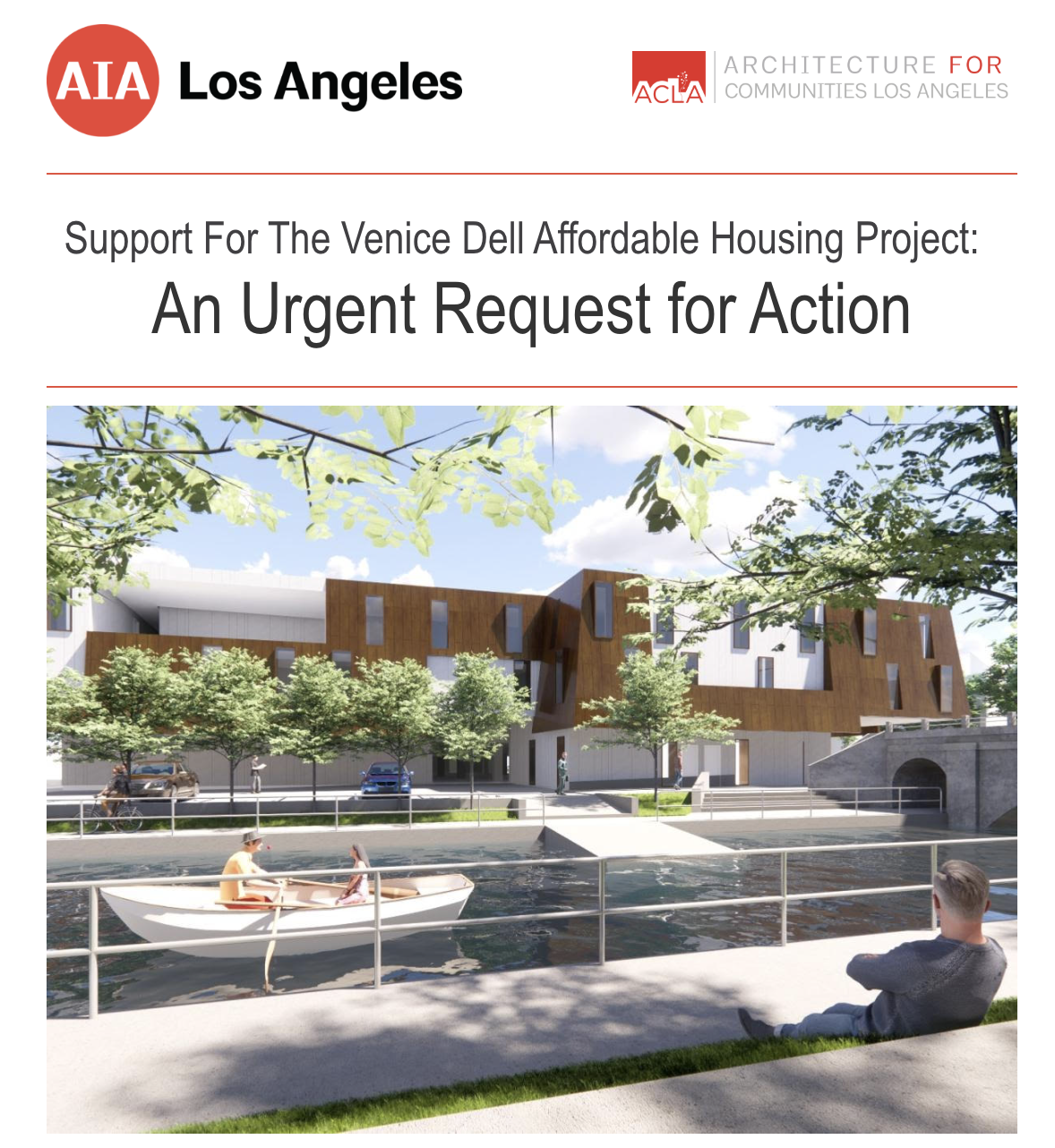
Venice Dell is a 120-unit mixed-income development on LADOT Parking Lot 731 at 200 North Venice Boulevard, designed to provide permanent supportive housing for people experiencing chronic homelessness alongside low-income rental units — in one of Los Angeles’s most resource-rich, high-opportunity coastal neighborhoods. The project includes 68 permanent supportive units, 49 low-income units, and 3 manager units, along with a replacement LADOT parking structure that increases net public parking on the site.
It was selected through a competitive City RFP in 2016. It was approved by the Planning Commission in 2021, the full City Council in December 2021, and the California Coastal Commission in December 2024. A Disposition and Development Agreement was executed in June 2022. A Superior Court upheld the City Council’s approval as proper and lawful. Of the 34 city-owned pipeline sites in the Housing Element, only six are in high-resource areas. Venice Dell is one — and one of only two that have stalled since 2023.
The design community should be especially clear on what this project represents: a well-integrated, transit-adjacent, coastal affordable housing development with underground parking, multimodal access, and a Project Labor Agreement. It is the kind of project Los Angeles has always claimed it wanted to build. The obstruction of Venice Dell is not a policy disagreement about what to build. It is a refusal to build what has already been decided.
The Pattern HCD Documented
The California Department of Housing and Community Development’s October 3, 2025 Letter of Inquiry laid out a specific sequence of City actions that, taken together, constitute what HCD characterized as a pattern of governmental obstruction: a surprise Board of Transportation Commissioners hearing in December 2024 — eight years into the project’s development — aimed at relocating it; the City’s quiet exclusion of Venice Dell from the Affordable Housing Managed Pipeline extension list in April 2025; and a series of actions HCD described as inconsistent with the City’s adopted Housing Element programs, including those specifically designed to affirmatively further fair housing in high-opportunity areas.
HCD’s response was explicit: the City’s actions conflicted with its own Housing Element commitments, violated state requirements to remove — not add — governmental constraints on supportive housing, and jeopardized the $42.4 million in competitive state funding HCD had just awarded to the project. HCD warned it would consider a Corrective Action Letter against the City’s housing element and a review of the Prohousing Designation — the state certification that gives Los Angeles priority access to housing funding across all programs, citywide.
The Raman-Park Amending Motion of October 7, 2025 asked the City to report back within 30 days on how it was responding to HCD. The 30-day deadline passed. The City’s answer was a closed-session litigation briefing and an expanded outside counsel contract. The HCD compliance question has never been publicly answered.
What LADOT’s Own Report Reveals
LADOT’s February 2026 report on creating a mobility hub at Lot 731 — the alternative being advanced as justification for displacing Venice Dell — does not make the case for displacement. LADOT’s own draft timeline does not reach construction completion until April or May 2028, at the earliest, and is explicitly flagged as ‘subject to change based on staff resources, competing priorities, litigation, California Coastal Commission permitting, and the City’s contract procurement process.’ LADOT concedes there is ‘no one-size-fits-all blueprint’ and that a feasibility study is needed before the scope can be defined. Its formal recommendation is to ‘note and file.’
There is also a hard technical reality: Venice Dell has already won its California Coastal Commission permit for Lot 731. That permit took years. It cannot be transferred to a different project. A new CCC permit for a mobility hub in the dual-jurisdictional Coastal Zone would take up to 12 additional months and begin from zero. The City is being asked to surrender a won permit, cancel a $42.4 million funded project, and defend itself against five lawsuits — in exchange for an undefined concept its own transportation department does not recommend pursuing.
Lot 701 is publicly owned, near Venice Beach, and carries none of the legal or financial encumbrances that make displacing housing from Lot 731 so costly. It is precisely the clean-slate site that LADOT’s own feasibility study process requires.
A Double Standard Named by a Neighboring Council
The West LA Sawtelle Neighborhood Council voted 8-0 on October 22, 2025 to support Venice Dell and submitted a Community Impact Statement to the full City Council. The WLASNC — not a Venice housing advocacy group, but an adjacent neighborhood council watching from the outside — named something in their statement that deserves to be in the record of every hearing on this matter:
Council District 11 has repeatedly told the West LA Sawtelle NC that it is ‘powerless to intervene’ in ED1 developments flooding the Sawtelle neighborhood. Meanwhile, the same district has devoted ‘significant political and legal resources’ to blocking Venice Dell in Venice. The WLASNC called this what it is: a serious question of equity and fiscal accountability during a period of City budget strain.
An 8-0 vote from a neighboring neighborhood council is not an abstraction. It is a community watching and naming a double standard in real time.
What This Means for the AEC Community
Every professional in architecture, engineering, and construction understands the investment required to bring a project to the stage Venice Dell has reached: the years of community engagement, environmental review, design iteration, financing, permitting, and legal exposure. When a project that has cleared all of those hurdles is then blocked not by a legitimate planning concern but by a manufactured sequence of procedural maneuvers — closed sessions, surprise hearings, exclusions from pipeline lists, outside counsel contracts — it sends a message to every developer, architect, and nonprofit provider considering whether to invest that effort in Los Angeles again.
It says: don’t bother. It says: the rules don’t apply here. It says: political will in a coastal district can override a decade of work, court rulings, executed contracts, and state law.
AIA Los Angeles believes the design professions have a responsibility that extends beyond buildings to the systems and policies that shape what gets built — and what doesn’t. The Venice Dell situation is a test of that responsibility. This is not a close call. The City has now spent more than $1 million defending its refusal to build housing it approved. The threshold for our community’s silence has been passed.
We are asking our members, colleagues, and everyone in the AEC community who cares about what Los Angeles becomes to make their voices heard.
UPDATE: On March 11th, the Transportation Committee voted to receive and file the LADOT report and also authorized $175,000 towards the feasibility of the mobility hub for Lot 731. Essentially, they continue to obstruct the affordable housing project.
TAKE ACTION: Submit public comment on CF 15-1138-S42. Urge the Transportation Committee to reaffirm Venice Dell on Lot 731, direct LADOT to begin the mobility hub feasibility study on Lot 701, and demand a public response to HCD’s Letter of Inquiry. Contact: heather.hutt@lacity.org · councilmember.hernandez@lacity.org · councilmember.padilla@lacity.org · Councilmember.Nazarian@lacity.org · CC: clerk.cps@lacity.org
CLICK HERE to read the letter that I sent to LA City Council’s Transportation Committee on March 10, 2026.
* Will Wright, Hon. AIA|LA is Director of Government & Public Affairs for AIA Los Angeles.
Don’t Let Policy ‘Happen’ to Your Practice: Join the 2026 AIA|LA Agency Roundtables and ‘Design’ It!
Navigating the regulatory landscape of Los Angeles is often one of the most complex, time-consuming, and expensive challenges in architecture today. Projects stall, budgets inflate, and timelines stretch—often due to processes that feel out of our control.
But you do have control.
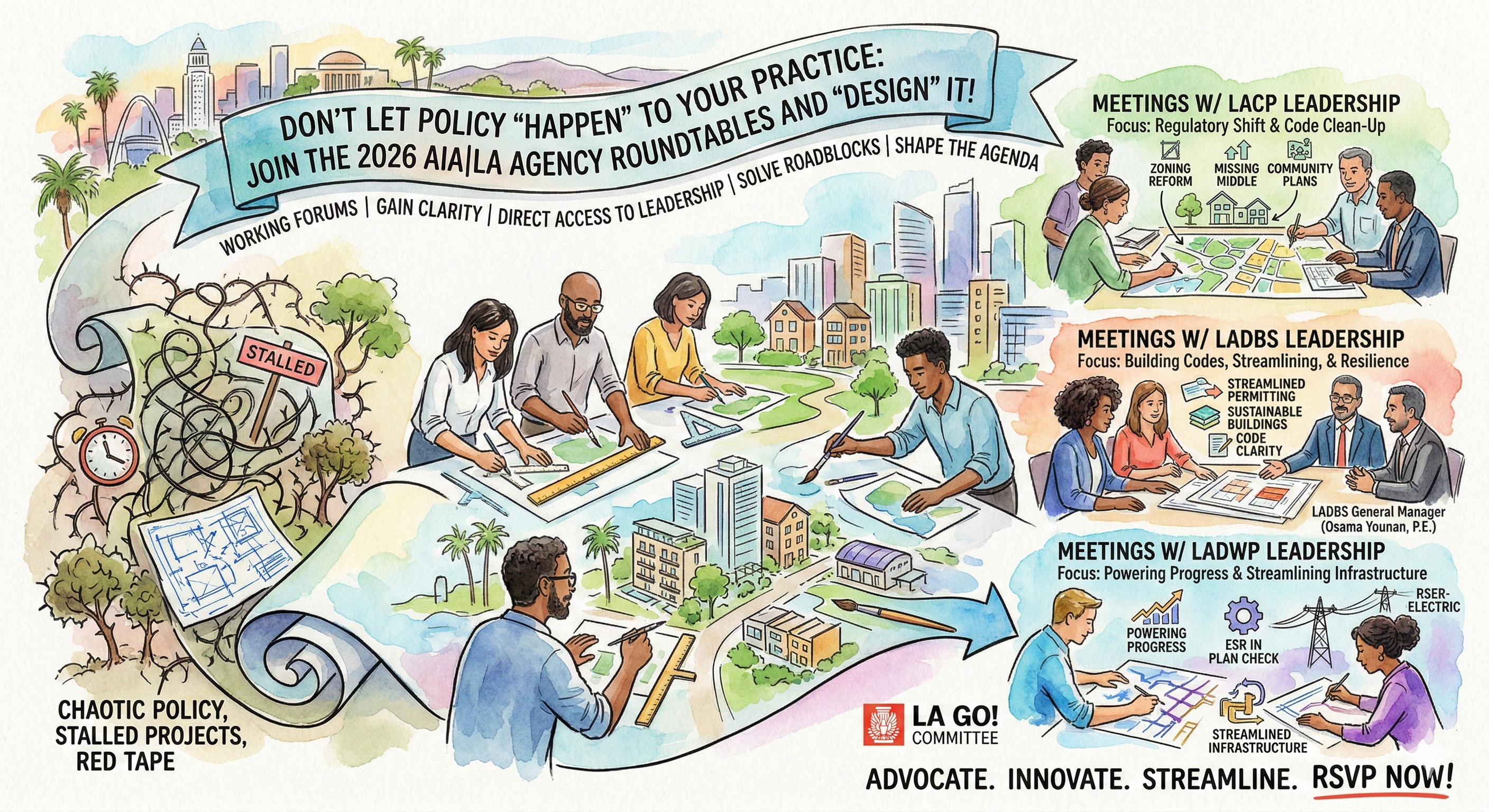
The AIA|LA Government Outreach (GO!) Committee has organized a comprehensive series of quarterly roundtables with the leadership of the three agencies that dictate the flow of your projects: Los Angeles City Planning (LACP), the Department of Building and Safety (LADBS), and the Department of Water and Power (LADWP).
These sessions are not standard webinars; they are working forums designed to break down silos, modernize standards, and establish a shared culture of trust between the private sector and city personnel.
Why You Need to Be in the Virtual Room
Gain Immediate Clarity: Get ahead of major operational shifts (like Zoning Plan Check moving to LACP) before they disrupt your current workflow.
Direct Access to Leadership: Cut through the red tape and hear firsthand updates on emerging initiatives directly from General Managers and Department Heads.
Solve Specific Roadblocks: Have a project stalled by 14′ ground floor minimums or late-stage LADWP transformer placements? This is where we advocate for specific, technical code clean-ups.
Shape the Agenda: Your boots-on-the-ground experience directly informs AIA|LA’s advocacy efforts, turning your daily frustrations into actionable policy reforms.
Below is the 2026 schedule for each agency. Please RSVP via the links provided to secure your spot and ensure your voice is heard.
1. Meetings w/ Los Angeles City Planning (LACP) Leadership
Focus: The Regulatory Shift & Code Clean-Up
Our upcoming April session will dive deep into the ‘nuts and bolts’ of the Development Services Bureau, focusing extensively on the critical transition of the zoning plan check process, shifting from LADBS to LACP. Future sessions will tackle statewide housing initiatives (SB 79, AB 130), the impact of AI on compliance, and navigating the Missing Middle and Livable Communities Initiative.
2026 Schedule (Virtual via Zoom, 1:00 pm – 2:30 pm)
2. Meetings w/ LA Department of Building and Safety (LADBS) Leadership
Focus: Building Codes, Streamlining, & Resilience
Connect directly with Osama Younan, P.E., General Manager of LADBS. This is the forum for architects and design professionals to clarify building code interpretations, push for permit streamlining, and discuss the implementation of sustainable building practices.
2026 Schedule (Virtual, 1:00 pm – 2:00 pm)
3. Meetings w/ LA Department of Water and Power (LADWP) Leadership
Focus: Powering Progress & Streamlining Infrastructure
Since 2021, we have secured critical wins with LADWP, including faster processing for ED1 affordable housing and smarter financial solutions for line extensions. Our Prime 2026 Advocacy Priority is pushing LADWP to require review and approval by the Service Planner and ESR (Field Team) during the normal Plan Check Period—avoiding the costly delays that occur when the ESR first sees a project late in the construction phase.
2026 Schedule (Virtual via LADWP’s MS Teams, 11:30 am – 12:30 pm)
Have a specific item for the agenda? We want to hear about the specific issues, challenges, and recommendations you are facing in the field. Please email Will@aialosangeles.org to have your item added to the docket for upcoming meetings.
Advocate. Innovate. Streamline. We look forward to seeing you there.
Very truly yours,
AIA Los Angeles GO! Committee

Help Shape the Future of LA: Join the AIA|LA & LACP Design Review Sessions
Calling all architects and designers with a vision for a better Los Angeles!
The AIA|LA, in partnership with the Los Angeles City Planning (LACP)’s Urban Design Studio, invites you to participate in the Professional Volunteer Program (PVP). This collaborative initiative offers a unique opportunity to directly influence the design quality of upcoming projects across the city and play a vital role in shaping the urban fabric of Los Angeles.
Why Participate?
Impact Your City: Share your design expertise and insights on pending projects that will be reviewed by the Planning Commission. Your feedback can help shape the future of our city’s built environment.
Educate and Collaborate: Work alongside LACP planning staff to discuss urban design issues, complex urban typologies, and project-specific design challenges.
Expand Your Network: Connect with fellow architects, designers, and city planning professionals who share your passion for urban design.
How to Get Involved:
The PVP will be hosting 31 virtual design review sessions throughout the year. These sessions are a great opportunity to get involved and make a real difference. We encourage you to register for three or four sessions that fit your schedule.
View the Full Schedule and Register Today:
Prepare for a Meaningful Impact:
To maximize your contribution, we recommend reviewing the Urban Design Studio’s resources and the City’s design guidelines:
Confidentiality:
PVP discussions provide an open forum for design feedback, and all participants are expected to maintain confidentiality and anonymity.
For More Information:
Please contact Will Wright, Hon. AIA|LA, at (213) 639-0764 or will[@]aialosangeles.org with any questions.
Together, we can create a more vibrant, equitable, and resilient Los Angeles through the power of design. Join us in shaping the city’s future!
FOR MORE INFORMATION:
Will Wright, Hon. AIA|LA
Director, Government & Public Affairs
t: 213.639.0764
e: will@aialosangeles.org
www.aialosangeles.org
*Disclaimer: The advice and perspectives shared here belong to the author and should not be considered official recommendations from AIA Los Angeles.


