AIA|LA ADVOCACY REPORT
March 10, 2026

Designing a “City of Yes”: Why Architects Must Lead Los Angeles’s Charter Reform
*By Will Wright, Hon. AIA|LA
Los Angeles is at a structural inflection point. With the 2026 World Cup and 2028 Olympic and Paralympic Games rapidly approaching, global attention is turning toward our city. Yet, beneath the international spotlight, we face multi-billion dollars in deferred maintenance needs, a severe housing shortage, and deteriorating civic infrastructure.
For too long, we have tried to solve 21st-century crises using a 20th-century organizational chart. We rely on a siloed, fragmented government structure that makes the simple acts of building housing and maintaining our public spaces maddening and exhausting.
We cannot afford to manage a metropolis without a blueprint. Right now, the LA City Charter Reform Commission is actively rewriting the city’s operating manual. This is a once-in-a-generation opportunity to transition Los Angeles from a culture of bureaucratic gatekeeping to a proactive, prosperous, and equitable “City of Yes.”
To achieve this, we need a unified vision and the courage to demand bold, structural changes. We must advocate for reforms that treat the design and management of our city as a cohesive discipline. Here is the blueprint we must rally behind:
1. Codify a Permanent Chief Design Officer
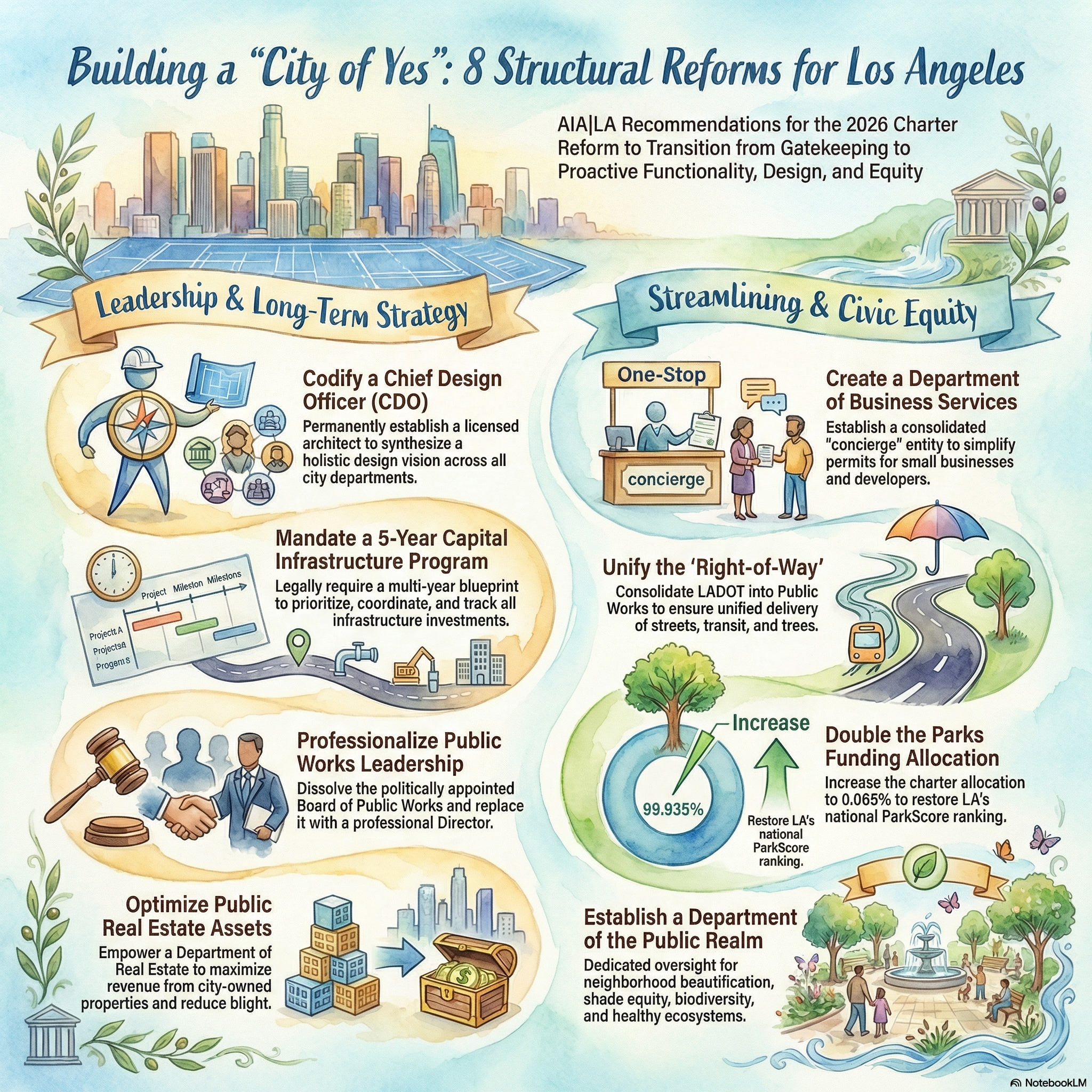
Los Angeles faces enormous, interconnected design challenges—from climate resilience to affordable housing—that simply cannot be solved within disconnected departments. We must permanently codify the role of the Chief Design Officer (CDO) in the City Charter and demand that this position be held by a licensed California architect.
This leader must be empowered with direct executive authority to synthesize a holistic vision across Public Works, City Planning, LADWP, LAHD, and other agencies. It is time to replace gatekeepers with “design-thinkers” and trailblazing solution-providers.
2. Mandate a 5-Year Capital Infrastructure Program (CIP)
Los Angeles is the only major U.S. city without a multi-year Capital Infrastructure Program. Operating reactively forces us to manage crises rather than strategically upgrading our city. We must amend the Charter to legally mandate a comprehensive five-year CIP.
This is not just best practice; it is a legal necessity. A formalized CIP maps our future, prioritizes investments, and legally protects the City’s revenue streams from post-Sheetz legal challenges* regarding development impact fees. (*U.S. Supreme Court decision in Sheetz v. County of El Dorado)
3. Consolidate Our Fragmented Bureaucracy
Spreading development functions across disconnected agencies guarantees failure, resulting in service gaps and delayed projects. We must dissolve the century-old, politically appointed Board of Public Works and replace it with a professional, centralized Director of Public Works. By consolidating the Department of Transportation (LADOT) into Public Works, we can ensure Unified Project Delivery—meaning that when a street is repaved, its transit infrastructure, bike lanes, and tree canopies are upgraded simultaneously.
4. Equitably Fund Our Parks
Our civic infrastructure is starving. Los Angeles has plummeted to 90th in the national ParkScore ranking because the Department of Recreation and Parks (RAP) operates on a charter funding formula frozen since 1937. Today, 40% of the RAP budget is diverted to cover indirect costs never envisioned in that Great Depression-era formula. We must demand the Commission double the RAP charter allocation from 0.033% to 0.065% of assessed property value to restore decades of cuts and ensure safe, accessible parks for all Angelenos. (This isn’t additional taxes. It’s a realignment of the property taxes already collected.) *Rec & Park Needs Assessment (December 2025)
5. Optimize City Assets to Pay a Dividend
A functional metropolis should raise revenue by increasing the value of its services, not by perpetually increasing taxes. As one of the largest property owners in the region, Los Angeles must optimize its real estate portfolio. By establishing an empowered Department of Real Estate to transform neglected public properties into vibrant community keystones, we can eliminate government-induced blight and stabilize our budget.
As professionals and citizens who navigate this broken system every day, our voices are essential. We are the bridge between the vision of what could be and the reality of what is built. We cannot sit on the sidelines while our city’s operating system fails to match its ambitions.
Take Action Today
The Charter Reform Commission needs to hear from the experts who build this city. Take two minutes to send an email and ensure these structural reforms make it into the final draft.
To: reformLAcharter@lacity.org
Subject: Structural Reforms for a “City of Yes”
Message: Demand that the Commission 1) Codify a licensed architect as the Chief Design Officer, 2) Mandate a 5-Year CIP, and 3) Double the RAP Charter allocation to 0.065%.
Let us stand together to design a more effective, equitable, and prosperous Los Angeles. Let’s build the “City of Yes.”
CLICK HERE to read the letter that we submitted to the charter reform commission.
*Will Wright, Hon. AIA|LA, is the Director of Government & Public Affairs for the American Institute of Architects, Los Angeles Chapter. The above editorial is his opinion and not meant to represent the official view of AIA Los Angeles, its membership, or its Board of Directors.
Leveraging the tools available in the Notebook LM app, I created a brief podcast = CLICK HERE TO LISTEN.
It’s an audio summary of how we can redesign the org chart of our city’s governance structure to make a more functional and prosperous city.
Please give it a listen and let me know what you think.
Share your comments to me at will@aialosangeles.org.
All feedback welcome!
OPINION
Los Angeles Has Two Years to Build a Housing System That Actually Works
The 2028 Games are giving us a prototype. The question is whether we make it permanent.
*By Will Wright, Hon. AIA|LA
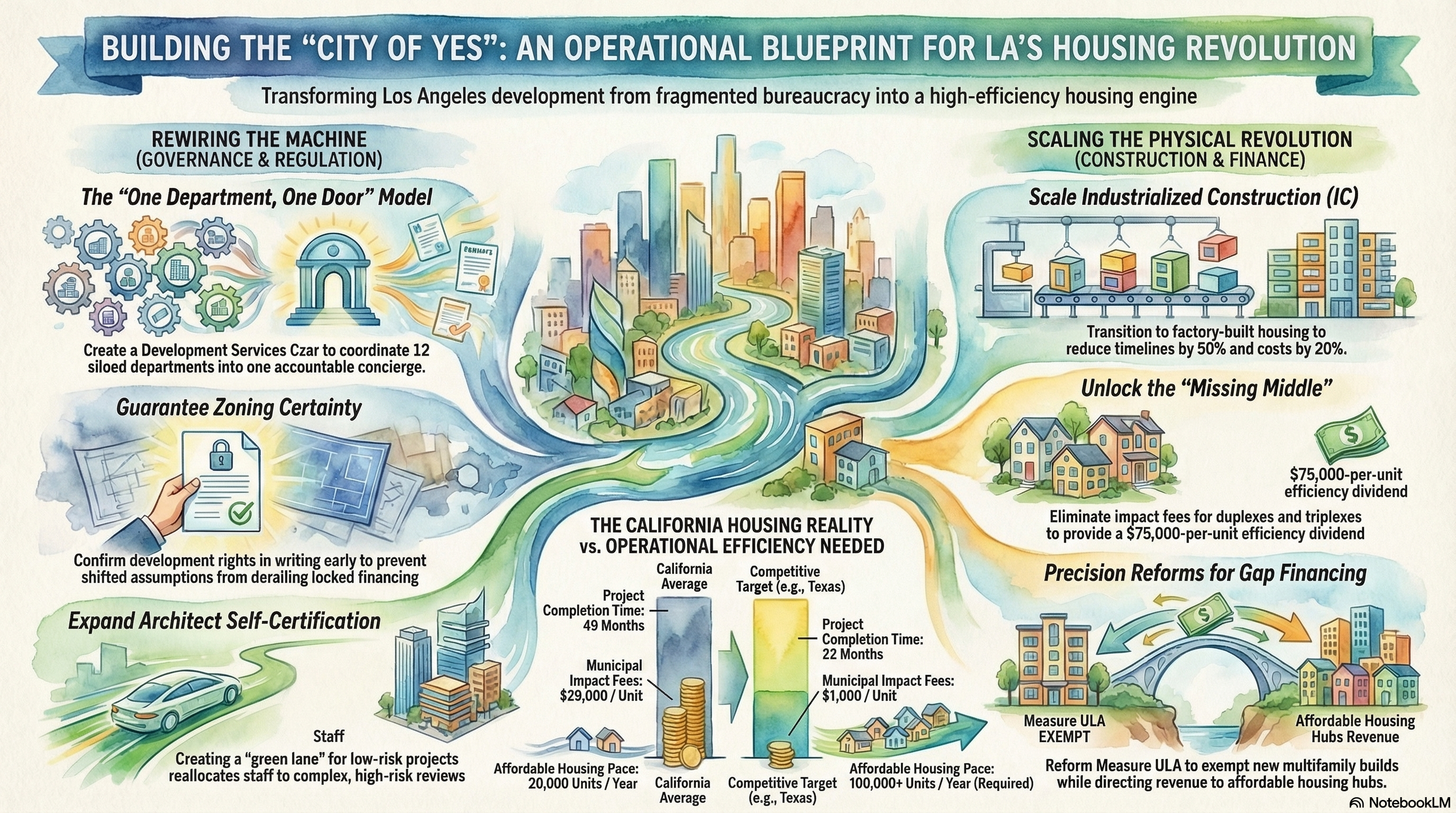
Somewhere in Los Angeles right now, a fully funded affordable housing project is sitting in a permit queue. The money is there. The site is entitled. The architect has submitted. And the project is waiting — as it has been waiting for months, sometimes years — because twelve city departments review sequentially rather than simultaneously, each with its own calendar and its own ability to stall progress indefinitely.
That project is not an anomaly. It is the system working exactly as designed.
California must build 2.5 million homes by 2030. It is producing fewer than half that number. The state ranks second-to-last in the country in housing units per capita. Hard construction costs are 2.3 times higher than in Texas. Bringing a project to completion here takes an average of 49 months — nearly two years longer than in Texas. Municipal impact fees average $29,000 per unit versus $1,000 in Texas. These are not market forces. They are policy choices. And here is the thing about policy choices: they can be changed.
We have a deadline. The 2028 Olympic and Paralympic Games have forced Los Angeles to prototype something it has never managed to build in peacetime: a faster, more coordinated development process. The Expedited Review Unit is running. Concurrent reviews are happening. The city is discovering, to no one’s great surprise, that it works.
The question is whether we let that prototype expire the day the closing ceremony ends — or whether we make it permanent, extend it, and use it as the foundation for a genuine housing system. I believe we can. Here are the four moves that would get us there.
The 2028 Games are giving us a proof of concept. The question is whether Los Angeles is willing to govern like it.
REWIRE THE MACHINE
The permitting problem is not a staffing problem or a funding problem. It is a coordination problem, and coordination problems have structural solutions. Los Angeles needs a single Development Services concierge — one office, one case manager per project, concurrent review across all twelve departments on a shared digital platform, and a Deputy Mayor with actual authority to break logjams. Every major peer city has some version of this. Los Angeles has the Olympic prototype. The Charter Reform process now underway is the vehicle to make it permanent.
Pair that with a digital transformation of the permitting system itself. Singapore’s Building and Construction Authority uses AI to evaluate site compliance, code conformance, and embodied carbon in real-time, compressing review timelines from months to weeks. The IT infrastructure being built for the Games is the foundation. We just have to decide to use it.
RESET THE RULES
California has 540 local jurisdictions with independent building code enforcement authority. A developer building across Los Angeles, Long Beach, Santa Monica, and Glendale navigates a different interpretive matrix in every market. This is absurd, and it is expensive — researchers estimate that mid-stream code changes alone add roughly $75,000 per unit in carrying costs and redesign fees.
Three regulatory fixes would move the needle immediately. First, extend the California Residential Code to cover triplexes and fourplexes — there is no technical justification for forcing small multifamily into the commercial code, and it is costing developers more than $1 million per project in unnecessary compliance costs. Second, reform California’s condominium liability law: a 10-year defect liability period has made for-sale condo development essentially uninsurable, which is why only 3 percent of the nearly one million multifamily units built in California between 2011 and 2021 were offered for sale, compared to 38 percent in Canada. Third, fix the prevailing wage trigger — which currently fires at five stories and adds a 10 to 15 percent cost premium at precisely the height SB 79 is trying to incentivize.
BUILD DIFFERENTLY
Los Angeles has 33 percent office vacancy downtown and tens of millions of square feet of empty space citywide. It also has Senate Bill 79, which took effect this year and allows up to nine-story residential buildings adjacent to heavy rail stations, stepping down by distance and transit tier across the state’s eight urban transit counties. The housing is there to be built. The adaptive reuse toolbox — tax abatements, TIF financing, partial conversion code relief — exists in New York, Chicago, and Calgary. We just haven’t deployed it here.
The deeper opportunity is industrialized construction. Factory-built housing can reduce costs by up to 20 percent and timelines by 40 to 50 percent on mid-rise multifamily projects. It currently accounts for less than 5 percent of new residential construction in California — not because the technology doesn’t work, but because the policy environment doesn’t support it. The Terner Center’s March 2026 research, drawing on 65-plus interviews with developers, manufacturers, lenders, and state officials, identifies the specific fixes: state code preemption for factory-built projects, pre-approved plan sets that factories can reuse across jurisdictions, removing the Assessor’s Parcel Number requirement that prevents factories from building inventory in advance, and state bonding and loan guarantee programs to unlock private capital. As one investor told Terner researchers: “Money is the Achilles’ heel of the modular industry.” The state can fix that.
FIX THE MONEY
Measure ULA was supposed to fund affordable housing by taxing high-value real estate transactions. UCLA Lewis Center and RAND research now shows it has reduced housing production by approximately 1,910 units per year. The fix is not repeal — it is precision: exempt recently constructed multifamily buildings, a change that Councilmember Raman’s own motion estimates would reduce ULA revenues by only 9 to 13 percent while removing the penalty on new production. Redirect the remaining revenue to a well-governed gap financing fund with clear metrics, independent oversight, and priority for projects co-locating housing with transit, childcare, and health services.
None of this is exotic. Every piece of it has a proof of concept somewhere — in another city, another state, or already running inside our own system as an Olympic pilot. What it requires is the decision to treat housing production as the emergency it is, and to build the institutional machinery capable of responding to an emergency at scale.
Los Angeles does not lack ambition. It lacks the operational infrastructure to execute on its ambitions. The Games are giving us two years and a prototype. That is more than most cities get.
Let’s not waste it.
To read more about the 15 policy proposals in depth, please CLICK HERE.
Will Wright, Hon. AIA|LA – Director of Government & Public Affairs, AIA Los Angeles. Will can be reached at will@aialosangeles.org.
“Blueprint for the Los Angeles Development Revolution” – a podcast I created with the NotebookLM app.
“Empty Offices and the LA Housing Paradox” – another podcast that I created with the Notebook LM app.
Please Note: I haven’t had this much fun with a computer app since I was a kid learning to code on a Commodore 128. Remember that machine?!

AIA California Housing Steering Committee
The AIA California Housing Steering Committee outlines five key barriers to housing delivery in California and proposes reforms to address them.
First, condominium liability reform is needed, as California’s 44% homeownership rate lags far behind the national 65% average, largely because the current 10-year construction defect liability period discourages condo development by imposing high legal and insurance costs on architects and contractors.
Second, commercial-to-residential adaptive reuse is underutilized despite nearly a billion square feet of projected empty office space nationwide. Outdated codes and entitlement barriers prevent conversions that could add hundreds of thousands of housing units while using significantly less embodied carbon than new construction.
Third, prevailing wage thresholds tied to building height discourage taller affordable housing construction, as exceeding four stories triggers significantly higher labor cost premiums that make added density financially unworkable.
Fourth, expanding the California Residential Code to cover triplexes, fourplexes, and various townhouse ownership structures would reduce permitting complexity and cost for small-scale “missing middle” housing developers.
Fifth, California lacks a functional statewide building code appeals process, resulting in inconsistent interpretations across 500+ jurisdictions that create unpredictable costs and delays — particularly for adaptive reuse projects — and undermine state housing goals.
CLICK HERE to read AIA California’s Housing Delivery Streamlining Overview in its entirety.
Don’t Let Policy ‘Happen’ to Your Practice: Join the 2026 AIA|LA Agency Roundtables and ‘Design’ It!
Navigating the regulatory landscape of Los Angeles is often one of the most complex, time-consuming, and expensive challenges in architecture today. Projects stall, budgets inflate, and timelines stretch—often due to processes that feel out of our control.
But you do have control.
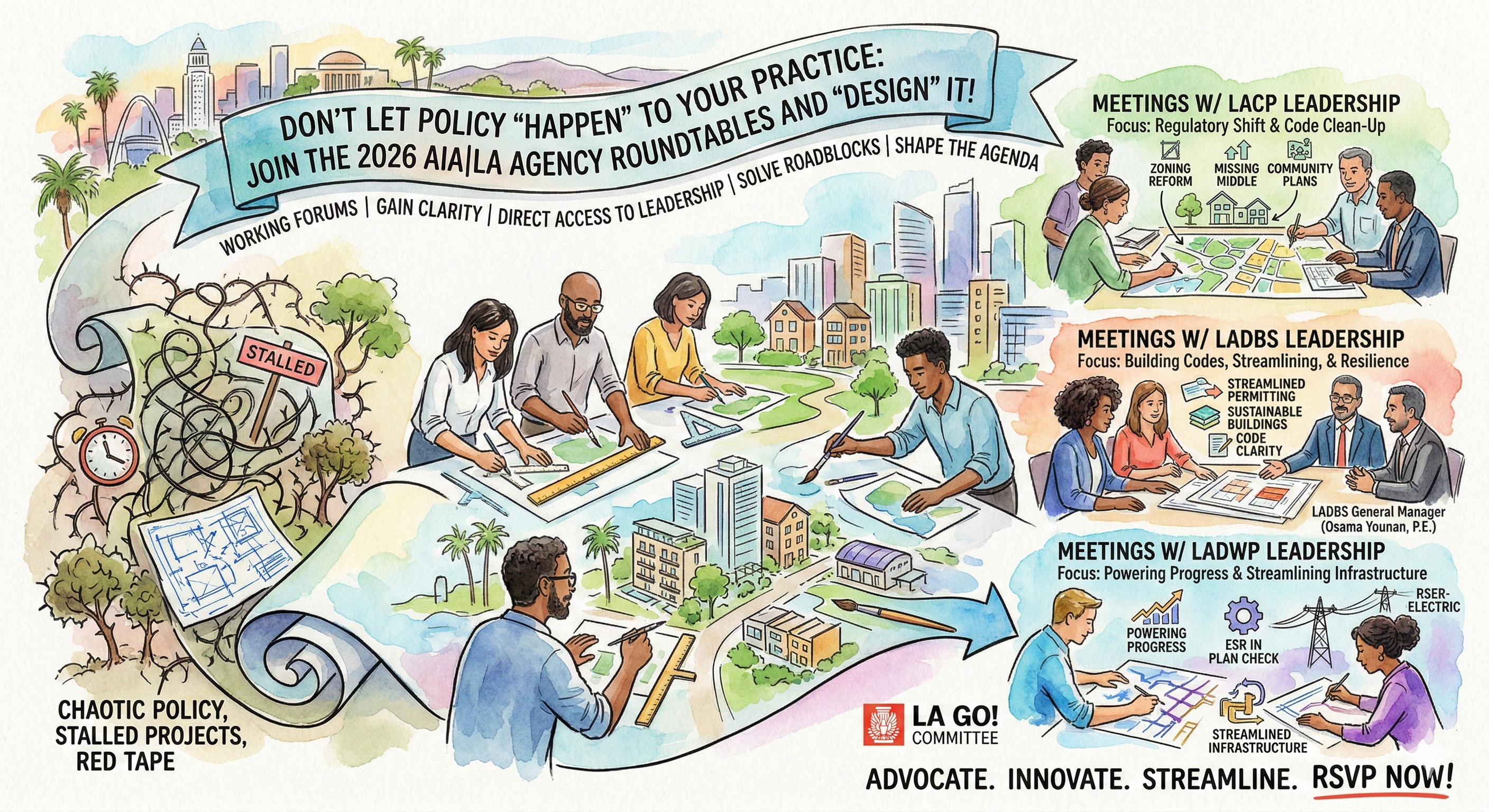
The AIA|LA Government Outreach (GO!) Committee has organized a comprehensive series of quarterly roundtables with the leadership of the three agencies that dictate the flow of your projects: Los Angeles City Planning (LACP), the Department of Building and Safety (LADBS), and the Department of Water and Power (LADWP).
These sessions are not standard webinars; they are working forums designed to break down silos, modernize standards, and establish a shared culture of trust between the private sector and city personnel.
Why You Need to Be in the Virtual Room
Gain Immediate Clarity: Get ahead of major operational shifts (like Zoning Plan Check moving to LACP) before they disrupt your current workflow.
Direct Access to Leadership: Cut through the red tape and hear firsthand updates on emerging initiatives directly from General Managers and Department Heads.
Solve Specific Roadblocks: Have a project stalled by 14′ ground floor minimums or late-stage LADWP transformer placements? This is where we advocate for specific, technical code clean-ups.
Shape the Agenda: Your boots-on-the-ground experience directly informs AIA|LA’s advocacy efforts, turning your daily frustrations into actionable policy reforms.
Below is the 2026 schedule for each agency. Please RSVP via the links provided to secure your spot and ensure your voice is heard.
1. Meetings w/ Los Angeles City Planning (LACP) Leadership
Focus: The Regulatory Shift & Code Clean-Up
Our upcoming April session will dive deep into the ‘nuts and bolts’ of the Development Services Bureau, focusing extensively on the critical transition of the zoning plan check process, shifting from LADBS to LACP. Future sessions will tackle statewide housing initiatives (SB 79, AB 130), the impact of AI on compliance, and navigating the Missing Middle and Livable Communities Initiative.
2026 Schedule (Virtual via Zoom, 1:00 pm – 2:30 pm)
2. Meetings w/ LA Department of Building and Safety (LADBS) Leadership
Focus: Building Codes, Streamlining, & Resilience
Connect directly with Osama Younan, P.E., General Manager of LADBS. This is the forum for architects and design professionals to clarify building code interpretations, push for permit streamlining, and discuss the implementation of sustainable building practices.
2026 Schedule (Virtual, 1:00 pm – 2:00 pm)
3. Meetings w/ LA Department of Water and Power (LADWP) Leadership
Focus: Powering Progress & Streamlining Infrastructure
Since 2021, we have secured critical wins with LADWP, including faster processing for ED1 affordable housing and smarter financial solutions for line extensions. Our Prime 2026 Advocacy Priority is pushing LADWP to require review and approval by the Service Planner and ESR (Field Team) during the normal Plan Check Period—avoiding the costly delays that occur when the ESR first sees a project late in the construction phase.
2026 Schedule (Virtual via LADWP’s MS Teams, 11:30 am – 12:30 pm)
Have a specific item for the agenda? We want to hear about the specific issues, challenges, and recommendations you are facing in the field. Please email Will@aialosangeles.org to have your item added to the docket for upcoming meetings.
Advocate. Innovate. Streamline. We look forward to seeing you there.
Very truly yours,
AIA Los Angeles GO! Committee

Help Shape the Future of LA: Join the AIA|LA & LACP Design Review Sessions
Calling all architects and designers with a vision for a better Los Angeles!
The AIA|LA, in partnership with the Los Angeles City Planning (LACP)’s Urban Design Studio, invites you to participate in the Professional Volunteer Program (PVP). This collaborative initiative offers a unique opportunity to directly influence the design quality of upcoming projects across the city and play a vital role in shaping the urban fabric of Los Angeles.
Why Participate?
Impact Your City: Share your design expertise and insights on pending projects that will be reviewed by the Planning Commission. Your feedback can help shape the future of our city’s built environment.
Educate and Collaborate: Work alongside LACP planning staff to discuss urban design issues, complex urban typologies, and project-specific design challenges.
Expand Your Network: Connect with fellow architects, designers, and city planning professionals who share your passion for urban design.
How to Get Involved:
The PVP will be hosting 31 virtual design review sessions throughout the year. These sessions are a great opportunity to get involved and make a real difference. We encourage you to register for three or four sessions that fit your schedule.
View the Full Schedule and Register Today:
Prepare for a Meaningful Impact:
To maximize your contribution, we recommend reviewing the Urban Design Studio’s resources and the City’s design guidelines:
Confidentiality:
PVP discussions provide an open forum for design feedback, and all participants are expected to maintain confidentiality and anonymity.
For More Information:
Please contact Will Wright, Hon. AIA|LA, at (213) 639-0764 or will[@]aialosangeles.org with any questions.
Together, we can create a more vibrant, equitable, and resilient Los Angeles through the power of design. Join us in shaping the city’s future!
FOR MORE INFORMATION:
Will Wright, Hon. AIA|LA
Director, Government & Public Affairs
t: 213.639.0764
e: will@aialosangeles.org
www.aialosangeles.org
*Disclaimer: The advice and perspectives shared here belong to the author and should not be considered official recommendations from AIA Los Angeles.


